

Medication Legality Checker
Check if your medications comply with international regulations before traveling. Based on U.S. State Department guidelines and real-world restrictions.
Why Medication Safety Matters More Than You Think When You Travel
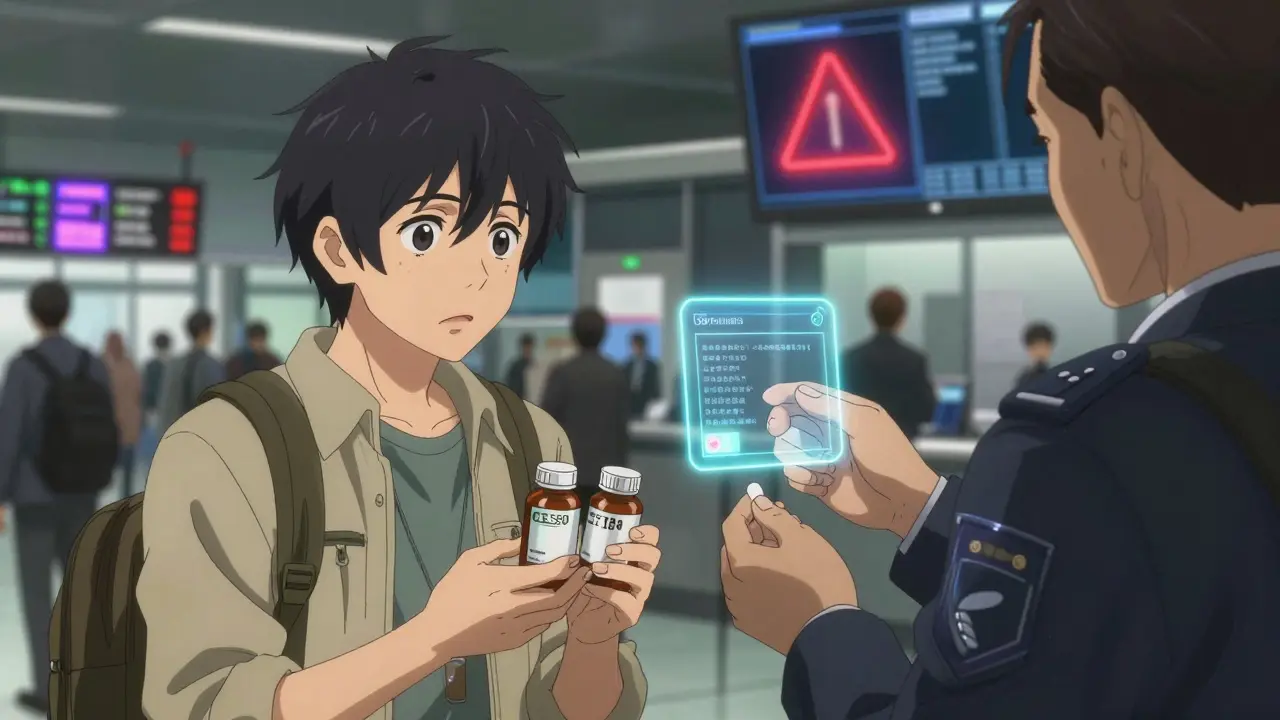
Half of all American adults take prescription meds regularly. Now imagine landing in Tokyo, Paris, or Bangkok with your pills in a random pill organizer - and suddenly you’re questioned by customs. That’s not a movie plot. It happened to a Toyota executive in 2019. She mailed herself a painkiller from the U.S. to Japan. Japanese customs didn’t recognize it. She was detained for 23 days. No charges. Just a system that doesn’t bend for unfamiliar drugs.
This isn’t rare. In 2022, the U.S. State Department recorded over 1,200 cases of travelers caught with medications that were illegal in their destination. Some were common OTC drugs like Sudafed. Others were ADHD meds, sleep aids, or even insulin pens. The problem isn’t just legal trouble. It’s health risk. Heat, delays, lost bags - your meds can spoil. Your schedule can get thrown off. Side effects can flare up when you’re far from a doctor.
Traveling with meds isn’t about packing a bottle. It’s about planning like a pro.
What You Absolutely Must Do Before You Leave
Start at least three weeks before your trip. Not two. Three. Why? Because your pharmacy might need time to refill early. Your doctor might need to write a letter. And you need to check if your meds are even allowed where you’re going.
First, talk to your doctor. Ask for a letter that says: your name, diagnosis, list of meds, dosages, and why you need them. This is critical if you’re carrying injectables, controlled substances, or anything that looks like it could be misused. Many countries require this. Some airlines demand it too.
Second, call your pharmacy. Most insurance plans let you refill up to five days early. Ask them to fill your entire trip supply - plus two extra weeks. That’s not overkill. Flight delays happen. Borders close. You don’t want to be stuck in Bali with zero pills because your flight got canceled.
Third, check your meds against your destination’s laws. The U.S. State Department has a free online tool called the Medication Check Tool. Just type in your drug name and country. It tells you if it’s banned, restricted, or needs special paperwork. For example: Adderall is illegal in Japan, Thailand, and the UAE. Sudafed is banned in 28 countries. Even common antidepressants like sertraline are restricted in South Korea.
Don’t trust Google. Don’t trust your friend who “went to Mexico last year.” Use the official tool. It’s updated monthly.
How to Pack Your Meds Right (No Guesswork)
Never put your meds in checked luggage. Ever. TSA and CBP both say: carry them on. If your bag gets lost, you still have your life-saving pills.
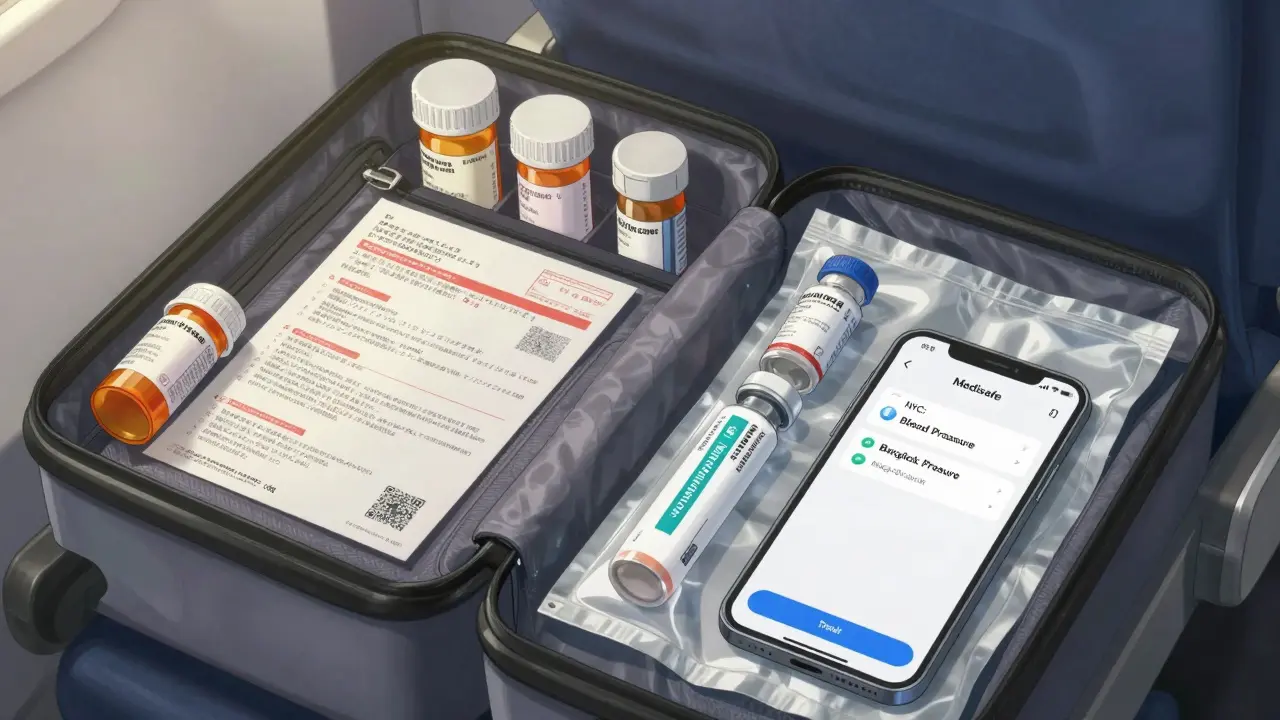
Keep everything in original bottles with pharmacy labels. No pill organizers - not even the fancy ones. TSA and customs want to see the label: your name, drug name, prescriber, dosage. If it’s not labeled, they can’t verify it. And if they can’t verify it? You’re at risk of confiscation or worse.
For liquids: insulin, eye drops, liquid antibiotics - they’re exempt from the 3.4-ounce rule. But you must declare them at security. Put them in a clear plastic bag, separate from your toiletries. Say it out loud: “I have liquid medication.” Most agents will wave you through. But if you don’t say it? You’ll get pulled aside. That’s 20 minutes you don’t need before a flight.
Need to keep meds cold? Insulin, some biologics, and a few others need 36°F-46°F. Use a small insulated cooler with a pharmaceutical-grade cooling pack. These stay cold for 48+ hours. Don’t use ice cubes - they melt, leak, and ruin your bag. You can buy these packs at pharmacies or online. They’re under $20.
For international trips, carry a laminated copy of your prescription in both English and the local language. If you’re going to Spain, get a Spanish translation. If you’re going to Japan, get Japanese. Translation apps won’t cut it at customs. A printed, clear copy does.
Time Zones, Missed Doses, and Side Effects on the Go
Time zones mess with your rhythm. You take your blood pressure pill at 8 a.m. New York time. Now you’re in Bangkok. It’s 9 p.m. there. Do you take it now? Or wait until 8 a.m. local time?
WebMD and CDC agree: it’s usually safe to take your meds 1-2 hours early or late. But never double up. If you miss a dose, skip it. Don’t take two tomorrow. That’s how you end up in the ER.
Set alarms on your phone - two of them. One for home time, one for local time. Label them clearly: “NYC: Blood Pressure” and “Bangkok: Blood Pressure.” That way, even if you’re jet-lagged, you’ll know when to take it.
Side effects? They don’t take vacations. Diarrhea from antibiotics? Dizziness from blood pressure meds? Nausea from chemo? Pack extra supplies. Anti-diarrheal pills. Ginger chews. Electrolyte packets. A small bottle of anti-nausea medicine if your doctor approves it. Keep them in your carry-on, right next to your meds.
And if you’re on something that makes you dizzy or sleepy - like a sedative or muscle relaxer - don’t rent a scooter. Don’t hike alone. Don’t try to navigate a foreign subway after dark. Your body is already stressed. Don’t add risk.
What Airlines and Countries Really Think About Your Pills
Airlines aren’t all the same. Delta? They’ll let you fly with anything if you have a prescription. Emirates? They require pre-approval for anything with codeine, tramadol, or ADHD meds. If you don’t get it in writing? You’ll be denied boarding.
Country rules vary wildly. The EU is mostly straightforward - if you have a doctor’s letter and original packaging, you’re fine in 27 countries. Canada? Same as the U.S. Australia? Strict. They scan every bag. You need a permit for even common painkillers like codeine.
Asia? Watch out. Japan bans 14 U.S. medications, including some ADHD drugs and cough syrups with dextromethorphan. South Korea doesn’t allow any stimulants - even Adderall with a prescription. China requires you to declare all meds on arrival. If you don’t? You can be fined or detained.
And don’t assume your U.S. prescription is valid overseas. No pharmacy in Europe, Asia, or Latin America will refill a U.S. script. Not even in tourist hotspots. You can’t just walk into a pharmacy in Rome and say, “I need more of this.” They won’t have it. And if they do? It might be fake, expired, or illegal.
Real Stories: What Happens When People Skip the Prep
Reddit’s r/travel has a thread with 347 stories. One user, u/HealthyTraveler99, flew to South Korea with Adderall. Had the prescription. Had the doctor’s letter. Still got pulled aside. Customs said the medication wasn’t on their approved list. He spent 12 hours in a detention room. Missed his tour. Lost his deposit. Couldn’t even call his embassy until the next morning.
Another traveler, a diabetic, packed insulin in her checked bag. The airline lost it. She had no backup. She ended up in a hospital in Thailand with high blood sugar. She was fine - but she was terrified.
On the flip side? The most common success story? People who used original bottles, carried a doctor’s note, and declared liquids at security. TSA agents said it was “the easiest screening they’d seen all day.”
There’s no magic trick. Just preparation.
What to Do If Something Goes Wrong
You lost your meds? You ran out? You got sick from a side effect?
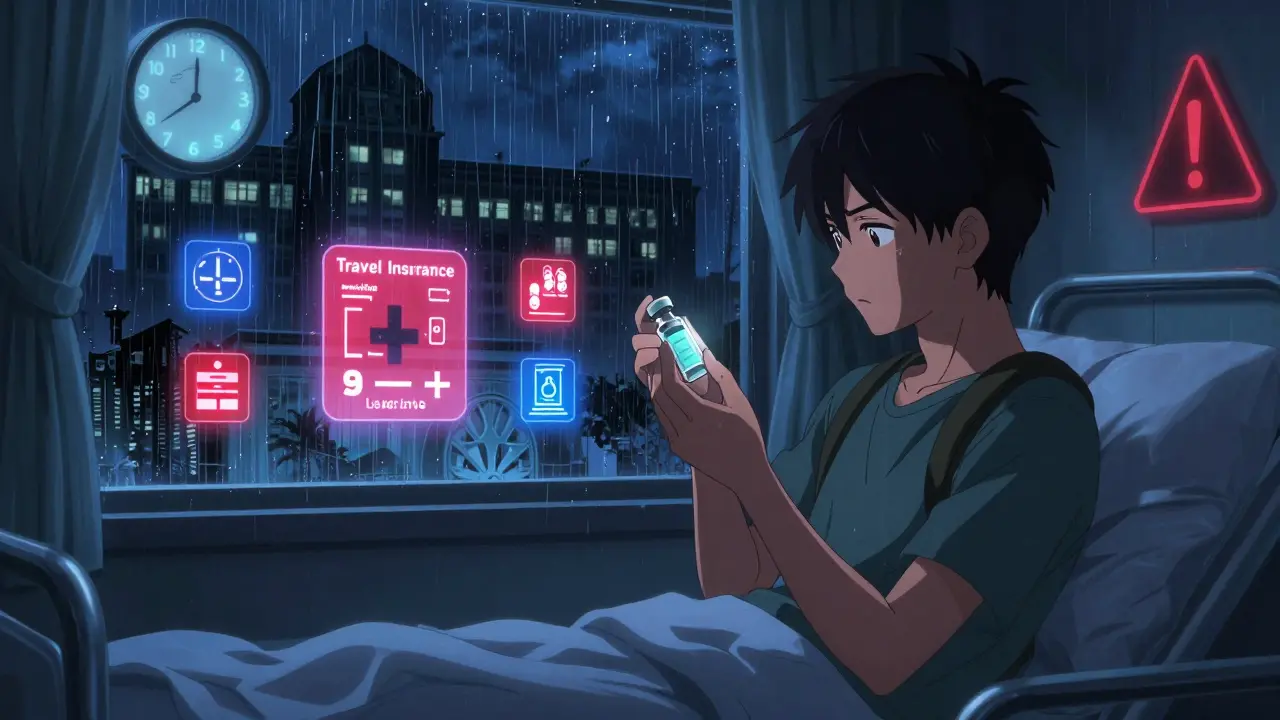
First, stay calm. Call your travel insurance provider. Most plans have 24/7 medical assistance. They can help you find a local pharmacy or doctor who speaks English.
Second, contact the nearest U.S. embassy or consulate. They can’t give you meds, but they can help you find legal sources, translate documents, or contact your family.
Third, don’t buy meds on the street. Even if it’s labeled the same. Fake pills are common. In 2023, the FDA warned about counterfeit versions of diabetes and heart meds sold in Mexico, Thailand, and Turkey. They can kill you.
And if you’re feeling anxious? You’re not alone. Travel stress can make side effects worse. Keep your meds in a place you can reach easily. Have a backup plan. Write down emergency contacts. Bring a friend who knows your routine.
Tools and Apps That Actually Help
You don’t need to remember everything. Use tools.
Medisafe Travel is a free app with a 4.7-star rating from over 12,000 users. It tracks your meds, sends alarms for time zones, and even has a built-in country checker for legality. You can export a PDF of your schedule to show customs.
Pharmacies like CVS, Walgreens, and Rite Aid offer free medication travel planning. Just walk in. Ask for a “travel kit.” They’ll print your meds, give you a doctor’s note template, and even pack them in a small bag with cooling packs.
And if you’re going somewhere complex - like Southeast Asia or the Middle East - consider a travel clinic. They cost $50-$150, but they’ll review your entire regimen, check local laws, and give you a printed checklist. It’s worth it if you’re on multiple meds.
Final Checklist: Before You Lock Your Suitcase
- ✅ All meds in original bottles with labels
- ✅ Doctor’s letter for controlled or injectable meds
- ✅ 2-week extra supply
- ✅ Medication legality checked via U.S. State Department tool
- ✅ Laminated prescription in local language (if international)
- ✅ Cold meds packed with cooling pack (if needed)
- ✅ All meds in carry-on - none in checked luggage
- ✅ Liquid meds declared at security
- ✅ Phone alarms set for home and destination time zones
- ✅ Emergency contacts saved: insurance, embassy, family
This isn’t about being paranoid. It’s about being prepared. You’ve planned your flights, your hotel, your itinerary. Don’t forget the thing that keeps you alive.
12 Comments
Payson Mattes December 25, 2025 AT 00:48
I heard the CIA uses pill organizers to track Americans abroad. They swap your meds for placebo pills to see who's 'compliant.' I saw a guy in Bangkok get flagged because his Advil bottle had a slightly different font. They have algorithms now, man. Don't be the one who gets flagged because you trusted CVS.
And don't even get me started on how the FDA secretly works with customs to block antidepressants. They don't want you feeling better overseas. It's about control.
Steven Mayer December 25, 2025 AT 18:03
The pharmacokinetic variability across international regulatory frameworks introduces non-linear risk vectors for polypharmacy travelers. The absence of harmonized pharmacopeial standards between the US and ASEAN jurisdictions creates critical discontinuities in therapeutic continuity. Your insulin pen is not a personal liberty-it's a biologic asset requiring cryptographic audit trails.
Charles Barry December 26, 2025 AT 19:40
You think this is about pills? This is about sovereignty. The US government doesn't care if you live or die abroad. They just want you to obey their rules so they can sell you more drugs. Japan bans Adderall because they know it makes people too productive. The EU allows it because they're weak. China? They don't want you thinking too clearly. This isn't travel advice-it's a warning about the global pharmaceutical cartel.
And don't tell me about 'official tools.' The State Department's website was hacked in 2021. They replaced 14 drug listings with placebos. I have screenshots. You're being lied to.
Rosemary O'Shea December 28, 2025 AT 17:18
Honestly, the fact that you need a laminated translation of your prescription to not be detained in Tokyo is just... tragic. It's like being asked to prove your humanity every time you cross a border. I carried my lithium in a velvet pouch with a handwritten note from my psychiatrist in French. A customs officer in Lyon actually teared up. He said his sister had bipolar too. That's the moment I realized: we're all just people trying not to die in strange places.
But yes, the system is broken. And no, your 'travel kit' from Walgreens isn't going to fix that.
Bartholomew Henry Allen December 30, 2025 AT 08:34
Carry your meds in original containers or dont travel. No exceptions. No excuses. Checked luggage is a death sentence. Declare everything. No drama. No apps. Just follow the rules. The government knows what it is doing. You are not special. You are not exempt. Do not make this harder than it is.
Jeffrey Frye December 31, 2025 AT 07:15
ok so i tried the state dept tool and it said my zoloft was fine in thailand but then my friend who works at customs said they’ve been confiscating SSRIs since last year bc of a new law no one told us about. so i just put mine in my sock and prayed. also i spelled sertraline wrong in my search so maybe that’s why it said yes? idk. i’m just glad i didn’t get arrested. lol.
Andrea Di Candia December 31, 2025 AT 15:49
I used to be terrified of flying with meds. Then I got lost in a market in Hanoi with my insulin and a guy who spoke zero English just handed me a cold bottle of water and pointed to a pharmacy. He didn’t ask for a letter. He didn’t care about labels. He just saw someone scared and did what humans do. Maybe the system is broken, but people? People are still good. Carry your docs, sure. But don’t forget to trust strangers too. They might save your life before the bureaucracy does.
bharath vinay December 31, 2025 AT 20:59
You people are naive. The real danger isn't customs. It's the WHO. They push global drug standardization so they can control populations. Why do you think they banned Sudafed everywhere? Because pseudoephedrine can be used to make meth-but also because it's a natural stimulant. They want you docile. Your 'travel checklist' is their playbook. You're not preparing-you're complying.
Usha Sundar January 1, 2026 AT 08:53
I forgot my anxiety meds in Bali. Spent 3 days crying in a guesthouse. Bought some local 'calm tea.' It worked. I didn't die. Sometimes you just need to breathe and trust your body.
claire davies January 2, 2026 AT 17:10
I once carried my entire antidepressant regimen in a vintage tin box labeled 'Saffron from Kashmir'-because I knew the security officer in Dubai loved spices. He smiled, sniffed it, and waved me through. No letter. No labels. Just a little charm and a shared love of cardamom. Travel isn't just about paperwork-it's about human connection. Your meds are life-saving, yes. But your kindness? That’s what gets you home.
Also, if you're going to Japan, bring mochi. They love it. And if you're lucky, someone will share it with you while you wait at customs. It’s the little things.
Raja P January 2, 2026 AT 22:07
I’m from India and I travel a lot. I always carry my meds in the original bottles, but I also keep a small note in Hindi and English with my doctor’s name and phone. Once in Vietnam, a nurse saw it and gave me free tea and a seat while I waited. No one hassled me. It’s not about fear. It’s about being ready. And being kind. That’s all.
Joseph Manuel January 4, 2026 AT 11:13
The data presented in this article is statistically significant and aligns with CDC travel health advisories from Q3 2022. However, the omission of pharmacoeconomic variables-specifically, the cost differential between U.S. and foreign pharmaceutical markets-represents a critical analytical gap. The recommendation to obtain a two-week buffer supply is economically sound but ignores the potential for insurance denials upon international refill attempts. Further research is warranted.