

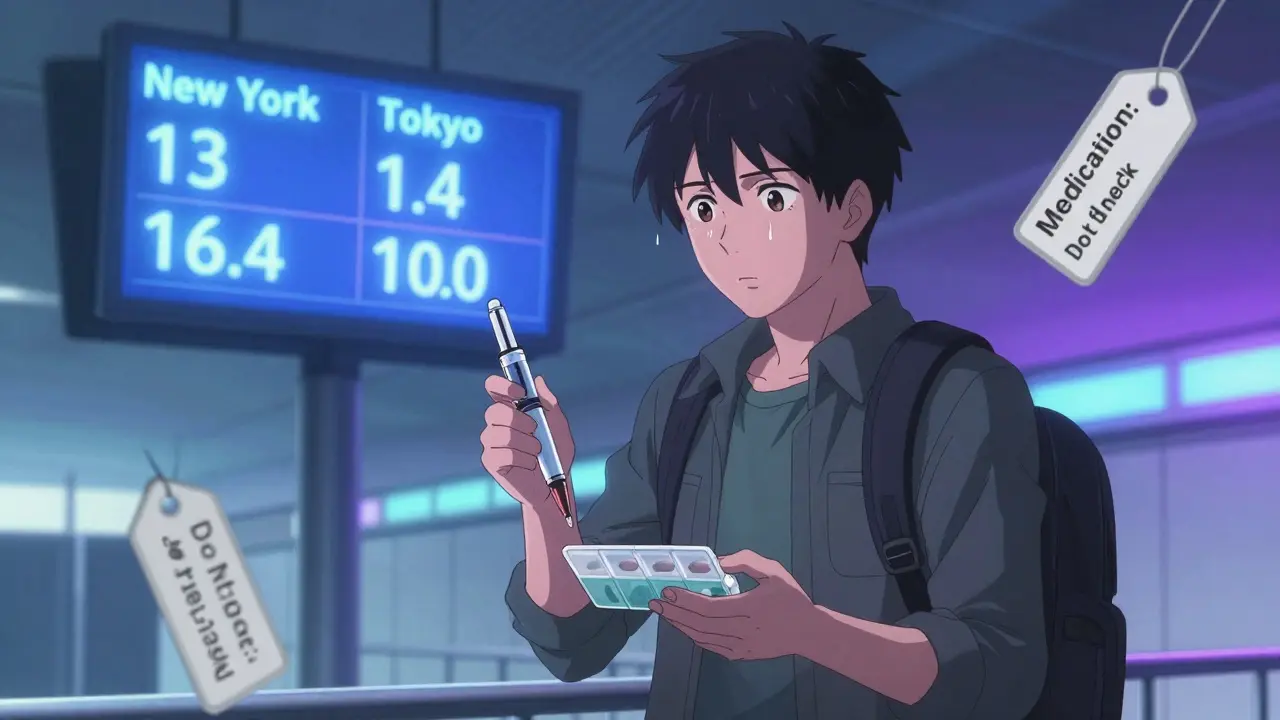
When you’re crossing time zones, your body doesn’t just feel jet-lagged - your meds do too. Missing a dose by an hour, storing insulin in a hot suitcase, or forgetting your pills because the clock changed - these aren’t minor hiccups. They can trigger side effects, throw off your treatment, or even land you in the hospital. This isn’t theoretical. A 2023 survey found that 68% of travelers with chronic conditions had at least one medication issue on the road. Most of them? It was timing or storage. And it’s totally avoidable.
Time Zones Aren’t Just a Clock Change - They’re a Medication Emergency
You might think, "I’ll just take my pill at the same time I always do." But if you’re flying from New York to Tokyo, that means taking your 8 a.m. blood pressure pill at 8 p.m. local time. That’s not just inconvenient - it’s dangerous. Your body runs on rhythms. So do your meds.
For most people, the safest move is to switch to the destination time zone immediately after landing. No waiting. No "I’ll adjust tomorrow." That’s the rule for antiretrovirals, blood thinners, and insulin. But there are exceptions.
Take antiretroviral therapy. If you’re on dolutegravir, you’ve got a 1-hour window. Miss that, and your viral load can spike. But if you’re on a protease inhibitor, you can stretch to two hours without risk. Statins? They’re forgiving. A 4-hour shift won’t hurt. Warfarin? Its long half-life (up to 60 hours) gives you breathing room. Insulin? Not so much. Its half-life is 4 to 6 hours. Delay it, and your blood sugar tanks.
For eastward trips over 5 time zones, some doctors suggest shifting your dose 1 hour earlier each day for 5 days before you leave. It reduces side effects by 37%. But here’s the catch: 22% of people who try this end up missing doses because the schedule gets too confusing. For most, simple and fast is better.
Contraceptive pills are another landmine. Combined pills need to be taken within 12 hours. Progestin-only? You’ve got 3 hours. Cross a few time zones, forget to adjust, and you’re risking pregnancy. Set two alarms. One for your old time, one for the new. Don’t trust your memory.
Storage: Your Pill Bottle Isn’t a Suitcase
Medications aren’t like snacks. You can’t just toss them in your checked bag and hope for the best. Heat, humidity, and light can wreck them.
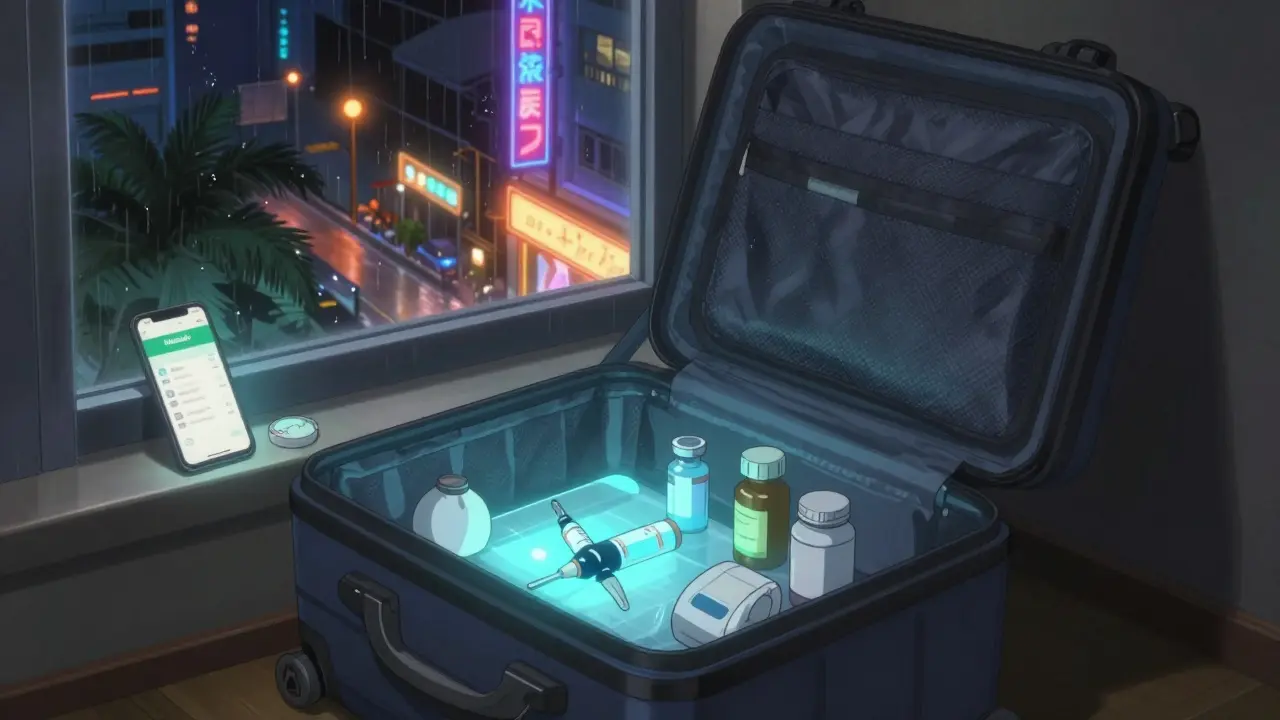
Insulin? Must stay between 36°F and 46°F. If you’re in Bangkok or Dubai and your bag sits in a hot car, that insulin is useless. Always carry it in your carry-on. Use a small insulated cooler with a reusable ice pack. Don’t freeze it - that breaks it.
Most pills - antibiotics, antidepressants, thyroid meds - hate heat above 86°F and humidity over 65%. That’s common in tropical destinations. Store them in a cool, dry place. Not the bathroom. Not the car. A hotel room drawer, away from the window, is fine.
And don’t forget light sensitivity. The CDC says 23% of common meds break down in sunlight. That includes some antibiotics, blood pressure drugs, and even birth control. Keep them in their original opaque bottles. If the bottle’s clear, slip it into a dark sock or a small ziplock bag. Simple, but it works.
Pro tip: Never pack meds in checked luggage. Bags get lost. Bags get hot. Bags get opened. Airlines and TSA require medications to be in original containers - and they’ll ask for them at security. If your pills are in a plastic bag labeled "Vitamin C," you’re asking for trouble.
Side Effects? Prevention Starts Before You Leave
Side effects from travel aren’t always from the meds themselves. Often, they’re from missed doses, bad storage, or timing chaos. But you can cut that risk in half - if you plan ahead.
First, talk to your doctor or pharmacist at least 4 to 6 weeks before you leave. Bring your full list: names, doses, times, why you take them. Ask: "Should I adjust timing? Any storage risks? Any legal issues where I’m going?"
Legal issues? Yes. Japan bans 52 U.S. medications - including some common cold and allergy drugs. The UAE requires permits for 17 others. You don’t want to get arrested because your Advil is illegal there. Check your destination’s health ministry website. Or ask your pharmacist - they have access to global drug databases.
Second, pack extra. Always. The CDC and Harvard both say: bring enough for your trip plus 7 days. Flights get canceled. Visas get delayed. You don’t want to run out in Rome with no way to refill.
Third, use a pill organizer - but only if it’s for the right meds. Don’t use one for time-sensitive drugs like insulin or antiretrovirals. They need to be in original packaging. But for daily vitamins, statins, or antidepressants? A color-coded organizer (red for morning, blue for night) cuts confusion by 76%, according to a 2023 survey of experienced travelers.
Tools That Actually Work
You don’t need fancy gadgets. But you do need reminders.
Smartphone alarms? Essential. Set three: one for your home time, one for destination time, and one as a backup. Use apps like Medisafe or MyTherapy. They’re endorsed by the CDC. They send alerts, track doses, and even warn you if you’re about to take a double dose.
Some travelers swear by smart pill dispensers - devices that open at set times and record when you take your meds. They’re expensive, but if you’re on 5+ meds and traveling with an elderly parent, they’re worth it.
And here’s a trick: label your pill bottles with sticky notes. Write "Take at 8 a.m. DESTINATION TIME" on the cap. When you’re tired and jet-lagged, that note is your lifeline.
Who’s at Highest Risk?
It’s not just seniors - though they’re hit hardest. A 2023 report found that 73% of travelers over 70 made at least one medication timing error. Nearly 30% needed medical help because of it.
Why? Multiple meds. Memory issues. Slower metabolism. Complex schedules. If you’re over 65 and taking 4 or more daily medications, you need a travel plan - not just a checklist. Start 10 days before departure. Practice the new schedule. Use alarms. Bring a printed copy of your regimen.
Young adults? They’re not off the hook. One pill? Easy. But if you’re on birth control or an antibiotic and you’re partying in Bali? You’ll forget. Set the alarm. Even if you think you won’t.
Travelers with chronic conditions - diabetes, HIV, heart disease - are the most vulnerable. A single missed dose can spiral. That’s why 78% of travel medicine specialists say time zone management is "critically important" for these patients. Don’t gamble with it.
What to Do If You Mess Up
You missed a dose. You left your pills in the car. You took your pill at the wrong time. Panic doesn’t help. Action does.
For most medications: Take the missed dose as soon as you remember - unless it’s within 2 hours of your next scheduled dose. Then skip it. Don’t double up.
For antiretrovirals: Call your doctor. If you’re over 200 copies/mL viral load, missing a dose is risky. Don’t wait.
For insulin: Check your blood sugar. If it’s high, you might need a correction dose. If it’s low, eat fast-acting carbs. Always carry glucose tabs.
For blood thinners: If you miss a dose, call your prescriber. Don’t guess. Warfarin is tricky.
And if you’re in a foreign country? Go to a pharmacy. Ask for a local doctor. Most cities have clinics that help travelers. Don’t wait until you’re sick.
Can I just keep taking my meds at home time while traveling?
Only for short trips under 3 days and small time zone changes (1-2 hours). For longer trips or big shifts, staying on home time causes confusion, disrupts sleep, and increases missed doses. The CDC and travel medicine experts recommend switching to local time immediately to reduce errors and side effects.
What if my medication isn’t allowed in my destination country?
Check your destination’s health ministry website before you go. Japan bans 52 U.S. medications, including common ones like pseudoephedrine. The UAE requires permits for 17 others. If your med is restricted, ask your doctor for an alternative that’s legal there. Never try to sneak it in - you could face fines or arrest.
Do I need to carry my medications in original bottles?
Yes. TSA and most international airports require medications to be in their original, labeled containers. This proves they’re prescribed to you. If you transfer pills to a pill organizer, keep the original bottle in your carry-on too. Don’t risk being denied boarding or questioned by security.
Is it safe to take meds on the plane?
Generally, no - unless your doctor says so. Airplane schedules don’t match meal times or your normal routine. It’s easy to get confused. For most people, wait until you land and reset to local time. Exceptions include travelers on antiretrovirals with high viral loads - they may need to dose mid-flight to avoid resistance.
How far in advance should I plan my travel meds?
At least 4 to 6 weeks. You need time to consult your doctor, get prescriptions refilled, check international rules, order special storage gear, and practice your new schedule. If you’re on complex meds or traveling with seniors, start 8 weeks out. Rushing leads to mistakes.
Final Tip: Make a Paper Backup
Phones die. Apps glitch. You forget. So print out your medication plan. Include: drug names, doses, times (in local time), storage notes, doctor’s contact info, and emergency contacts. Keep it in your wallet. Give a copy to your travel buddy. This isn’t extra - it’s essential.
Traveling with meds isn’t about being perfect. It’s about being prepared. One alarm. One cooler. One printed list. That’s all it takes to avoid disaster - and keep your health on track, no matter where you land.
12 Comments
Robert Way January 15, 2026 AT 02:20
lol i just threw all my meds in my checked bag last time and forgot about it till i got to mexico. turned out the antibiotics were fine but my insulin was warm as hell. my sugar went nuts. never again. also my pill organizer had 'vitamin c' written on it. TSA thought i was smuggling coke. they made me open it in front of everyone. worst airport moment ever.
TooAfraid ToSay January 17, 2026 AT 02:03
you're all missing the real issue here. nobody talks about how airlines actively sabotage your meds. they keep the cabin at 80 degrees and 90% humidity because 'comfort'-that's why your pills go bad. and don't get me started on how they won't let you use your cooler unless you beg like a beggar. this whole system is designed to make you fail. it's not your fault. it's the airline industrial complex.
Dylan Livingston January 17, 2026 AT 18:05
how is it possible that people still need a 2000-word guide to remember to take their pills? i mean, really. you're telling me someone with diabetes can't figure out that heat ruins insulin? or that crossing time zones might mess with a 4-hour half-life drug? this isn't travel advice-it's a cry for help. if you can't manage your own body while flying, maybe you shouldn't leave the house. or at least hire a nanny who knows pharmacology.
shiv singh January 19, 2026 AT 05:55
bro i took my blood pressure meds in india and they were all sticky because the hotel AC died. i thought i was gonna die. then i saw a guy on the street selling 'medicines' in a plastic bag. i almost bought it. i was that desperate. you think this post is long? imagine being 12 hours from home with no phone, no translator, and your heart racing because you don't know if your pills are still good. this isn't a checklist. this is survival.
Vicky Zhang January 20, 2026 AT 03:03
you guys are doing amazing. i'm so proud of you for even thinking about this stuff. i know it feels overwhelming, but you're not alone. i used to forget my birth control on trips until i started putting it next to my toothbrush and setting three alarms-one for home time, one for local, and one for 'don't be an idiot'. i even bought a cute little cooler with a panda on it. it made me feel like a responsible adult. you got this. you're stronger than you think. and yes, you deserve to travel without fear.
Allison Deming January 21, 2026 AT 12:30
It is both astonishing and deeply concerning that such a comprehensive, evidence-based, and clinically validated framework for medication management during international travel remains so under-discussed in mainstream travel media. The fact that 68% of travelers with chronic conditions experience adverse events due to timing or storage errors reflects a systemic failure in public health education, not individual negligence. One must question why pharmaceutical manufacturers, airlines, and regulatory bodies have not implemented mandatory pre-travel counseling protocols or standardized packaging for international travelers. This is not a personal responsibility issue-it is a public health imperative.
Andrew Freeman January 21, 2026 AT 21:25
nah u overthinkin it. i take my stuff whenever i remember. if i miss a dose? big deal. i just take it later. my body figures it out. and i always pack my pills in a ziplock. who cares if its labeled vitamin c? they dont even look. i flew to thailand with 12 meds in a sock. no one said a word. also, why do u need 7 extra days? if ur meds run out, u just buy more. its not rocket science.
says haze January 22, 2026 AT 23:58
What this article fails to interrogate is the epistemological violence of Western pharmaceutical hegemony. Why are we assuming that the American pharmacopeia is the universal standard? Why is it assumed that a Nigerian traveler must conform to U.S. dosing protocols when traveling to Japan? The very notion of 'correct' timing assumes a linear, capitalist, circadian model of time that ignores cultural, biological, and temporal pluralities. The real crisis isn't missed doses-it's the erasure of alternative healing paradigms by a medical-industrial complex that insists on its own superiority. And yes, I'm aware this is a 2000-word rant. That's the point.
Sarah -Jane Vincent January 23, 2026 AT 19:10
you know what they don't tell you? the government is putting tracking chips in pill bottles. i got mine confiscated in Dubai because the scanner beeped. they said it was 'suspicious material'. turns out it was my antidepressants. now i'm on a watchlist. they're watching my meds. i saw a guy at the airport with a tablet that showed his entire pill history. they know when i take my pills. they know when i skip. they're using this to predict my mental state. don't trust the system. don't pack your meds. hide them. bury them. or just don't take them at all.
Henry Sy January 25, 2026 AT 01:30
bro i once took my insulin on a flight from LA to Seoul and my blood sugar dropped so hard i had to eat three bags of pretzels and a whole bottle of juice. i looked like a deranged raccoon. the flight attendant asked if i was okay. i said 'just fine, ma'am, i'm just communing with the sugar gods'. she gave me a look like i was gonna steal her purse. i didn't even have a purse. but i felt alive. that’s the real travel experience-not the checklist. it’s the chaos. the mess. the near-death-by-snack.
Anna Hunger January 27, 2026 AT 00:25
While the article provides a commendable overview of practical strategies, it lacks a critical consideration of socioeconomic disparities in medication access. The recommendation to 'bring seven extra days' of medication assumes consistent access to prescriptions, insurance coverage, and financial resources-all of which are unavailable to a significant portion of the population. Furthermore, the suggestion to purchase specialized coolers or smart dispensers excludes low-income travelers entirely. A truly equitable travel medicine framework must prioritize low-cost, universally accessible solutions: paper lists, repurposed containers, and community-based support networks. Not luxury gadgets.
Jason Yan January 28, 2026 AT 16:21
you know what i realized after traveling with my dad’s heart meds? it’s not about the pills. it’s about the rhythm. the quiet moment before you take them. the way you check the time, the way you feel the bottle in your hand. travel messes with that. you’re tired, you’re in a new place, you’re wondering if the air tastes different. so you forget. and that’s okay. the trick isn’t alarms or coolers-it’s giving yourself grace. if you miss a dose, breathe. call your doc. don’t beat yourself up. healing isn’t perfect. it’s messy. and so are we. and that’s why we’re still here, still trying, still traveling. even with the pills. even with the chaos.