

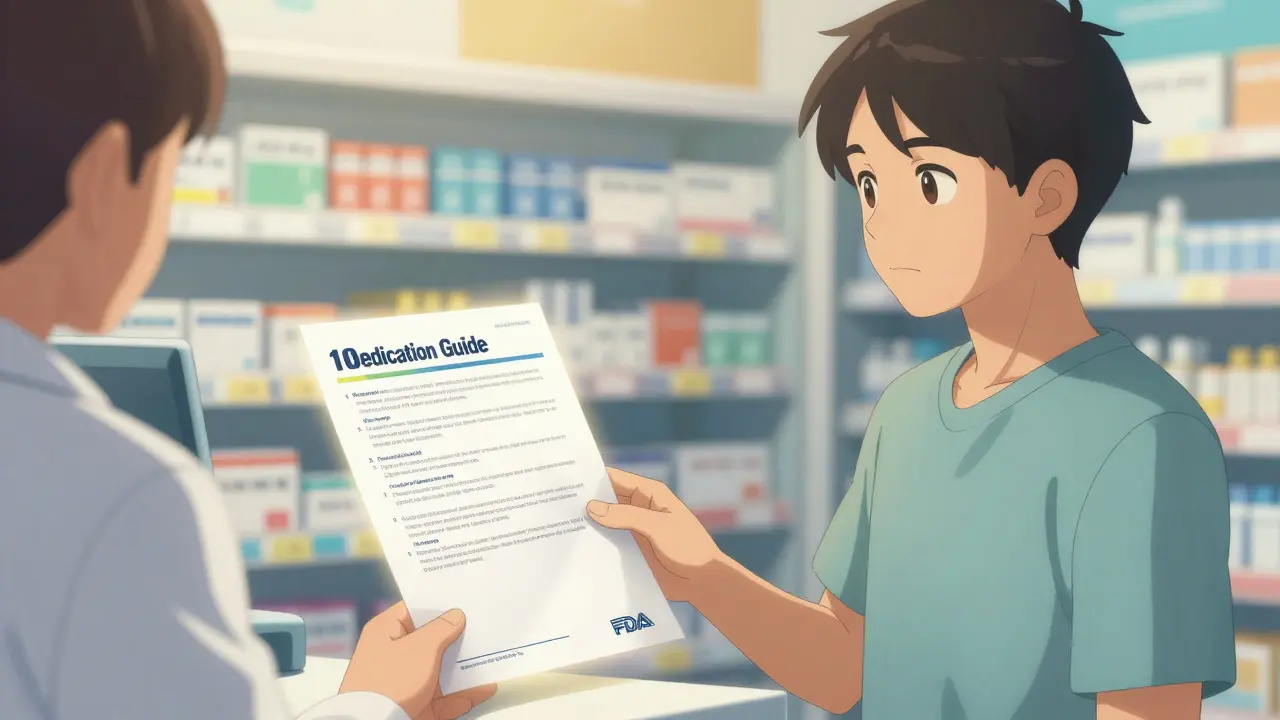
Medication Guide Checker
Check Your Prescription
You fill your prescription. The pharmacist hands you the bottle. You walk out. But did you get the Medication Guide? If you’re taking a drug that requires one, you have a legal right to it - and not just any version. It has to be the FDA-approved one, printed clearly, in plain language, and given to you at the time of pickup. No excuses.
Many people never see these guides. A 2022 survey found that 43% of patients never received one, even when their drug legally required it. That’s not an oversight. It’s a violation of federal law. And you don’t need to accept that.
What Exactly Is a Medication Guide?
A Medication Guide isn’t the little leaflet that comes with your pills. That’s usually just general usage info. A Medication Guide is something different - and more important. It’s a government-mandated document, approved by the FDA, meant to warn you about serious risks tied to certain prescription drugs. Think: life-threatening side effects, dangerous interactions, or instructions you absolutely can’t skip if you want the drug to work.
The FDA started requiring these in 1998 after realizing patients weren’t getting clear, critical safety info. Today, about 150 drugs - roughly 5% of all prescriptions - come with one. These include drugs for epilepsy, bipolar disorder, certain cancer treatments, blood thinners like warfarin, and some antidepressants. If your drug is on this list, the pharmacy must give you the guide.
These guides aren’t made by pharmacies. They’re written by drug companies, reviewed by the FDA, and must follow strict rules. The text must be in plain English - no medical jargon. The font can’t be smaller than 10-point. The words “Medication Guide” must appear at the top, followed by the brand name and generic name of the drug. And right at the bottom? It must say: “This Medication Guide has been approved by the U.S. Food and Drug Administration.” If it doesn’t, it’s not legitimate.
Your Legal Right to a Printed Copy
Under 21 CFR §208.24, pharmacies are required to give you the Medication Guide in paper form when you pick up your prescription. Not when you ask. Not if you’re “in a hurry.” Not because the pharmacist forgot. At the time of dispensing - that’s the rule.
But here’s the part most people don’t know: you can refuse the paper copy. Since May 2023, the FDA officially clarified that patients have the right to request an electronic version instead. That means the pharmacy can send you a link via text or email, or let you download it from their portal. But they can’t force you to take it digitally. If you say, “I want the paper one,” they have to give it to you. No pushback. No “We’re out.” No “We don’t have it.”
Pharmacies are required to keep enough guides on hand - either by ordering them from manufacturers or by having printers that can produce them on demand. Chain pharmacies like CVS and Walgreens have been using digital printing systems since 2015. Independent pharmacies might get them by mail, but they’re still legally obligated to have them ready.
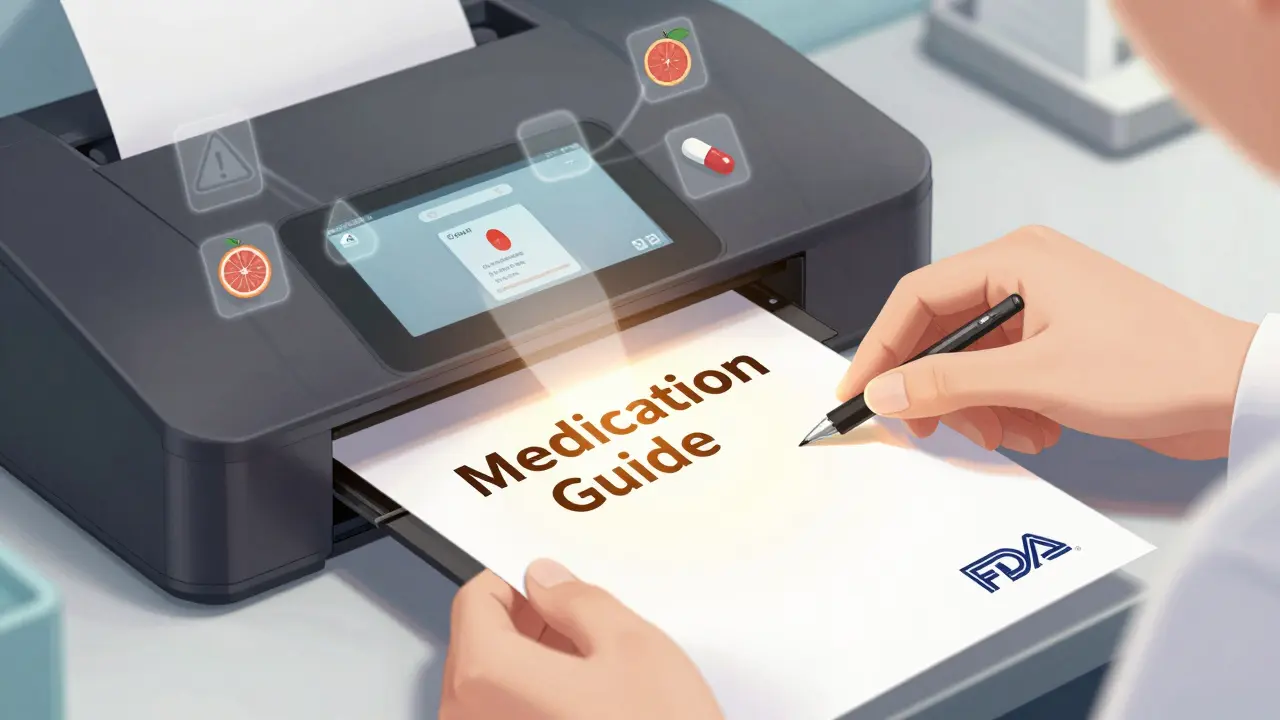
Why You Should Always Ask for It - Even If You Think You Don’t Need It
Some people think: “I’ve been on this drug for years. I know how it works.” But Medication Guides aren’t about general use. They’re about hidden dangers.
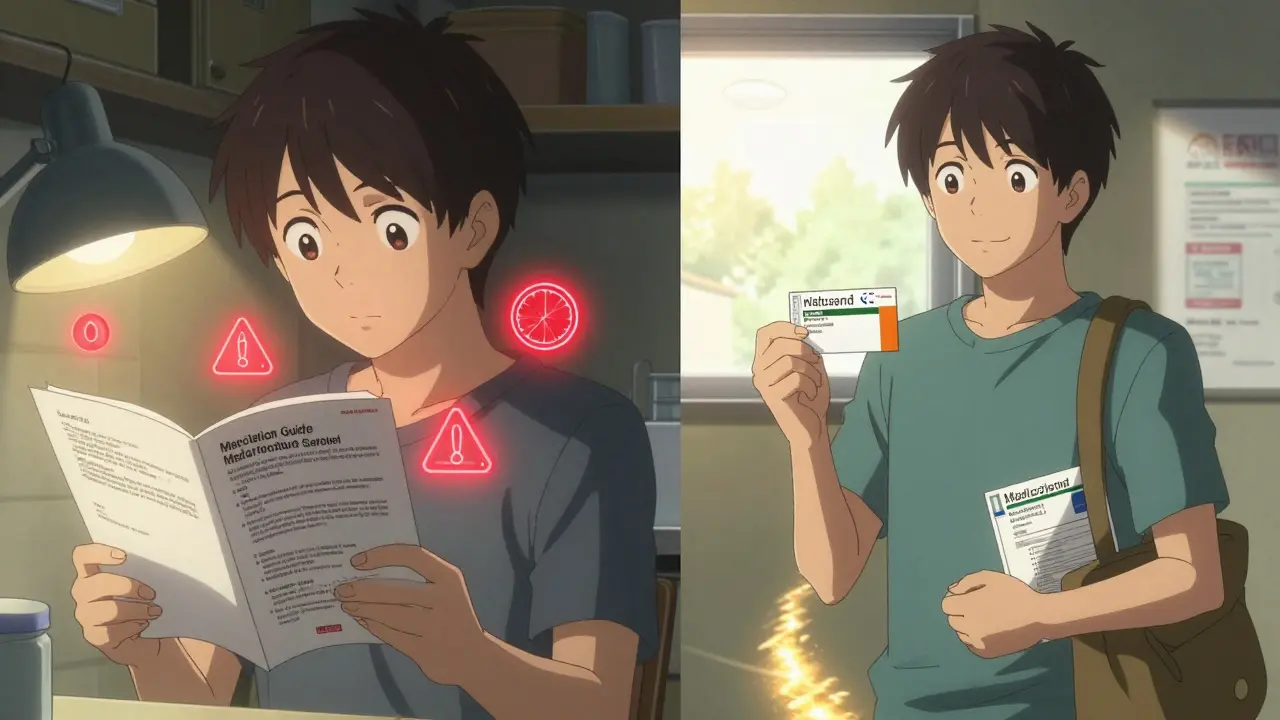
One patient in Arkansas stopped taking her antidepressant because she read the guide. It warned about serotonin syndrome - a rare but deadly reaction when combined with certain painkillers. She had been taking ibuprofen regularly. She didn’t know the risk. The guide saved her life.
Another patient in Ohio read the guide for his blood thinner and noticed a warning about grapefruit juice. He’d been drinking it every morning. He switched to orange juice. No hospital visit. No emergency.
According to a 2022 survey by Patients for Safer Drugs, 22.5% of people who received the guide said it helped them avoid a dangerous situation. That’s not a small number. And those are just the ones who spoke up.
On the flip side, 28% of patients say they found the guides “not helpful at all.” Why? Often because the font is too small, the language is still too technical, or they got the guide after the fact - tucked into the bag, not handed to them. But the problem isn’t the guide. It’s how it’s delivered.
What to Do If the Pharmacy Doesn’t Give You the Guide
If you’re entitled to a Medication Guide and they don’t give it to you, here’s what to do:
- Ask directly: “Is a Medication Guide required for this prescription?”
- If they say no, ask for the name of the drug and look it up on the FDA’s website. You can search for “FDA Medication Guides” and find the official list.
- If it’s on the list, say: “I’m entitled to this under federal law. Can you print it now?”
- If they say they don’t have it, ask: “Can you call the manufacturer or your wholesaler to get it shipped today?”
- If they still refuse, ask to speak to the pharmacist-in-charge. If that doesn’t work, ask for a complaint form - and fill it out. Write: “Failure to provide FDA-mandated Medication Guide.”
Pharmacies get audited. The Department of Health and Human Services found that 31% of pharmacy sites had serious compliance gaps. That means they’re being watched. Your complaint matters.
What’s Changing in 2027 - and Why It Matters
The FDA isn’t done. In May 2023, they announced plans to replace the current Medication Guides with something called Patient Medication Information (PMI). Starting around 2027, every drug that needs a guide will use one standardized, single-page format.
Why? Because today’s guides vary wildly. One might be 12 pages long. Another is three. Some use bold text. Others use tiny footnotes. A 2019 GAO report found this inconsistency makes it hard for patients to understand anything. The FDA tested new PMI templates and saw a 37% improvement in patient comprehension.
When PMI rolls out, you’ll still have the right to get it in paper or digital form. But now, it’ll be easier to read. The same structure. The same key sections: risks, how to take it, what to avoid. No more guessing.
Final Reminder: You’re Not Asking for a Favor
You’re not asking the pharmacist to do something extra. You’re asking them to follow the law. Medication Guides exist because people got hurt - sometimes fatally - because they didn’t know the risks. The FDA didn’t create them to make paperwork. They created them to save lives.
If you’re taking a drug that requires a Medication Guide, get it. Print it. Read it. Keep it. And if you don’t get it, say something. The system only works if patients hold it accountable.
Do all pharmacies have to provide Medication Guides?
Yes. All pharmacies that dispense prescription drugs - whether they’re CVS, a local independent pharmacy, or a hospital outpatient clinic - must provide FDA-approved Medication Guides when required. The law applies to every licensed pharmacy in the U.S. under 21 CFR §208.24. If they don’t have them on hand, they’re required to have the means to print them or obtain them immediately.
Can I get a Medication Guide after I’ve already picked up my prescription?
Yes. If you didn’t get it at pickup, you can return anytime to request it. The FDA rule requires the guide to be given at the time of dispensing, but if you didn’t receive it then, the pharmacy is still obligated to provide it upon your request. Many pharmacies will mail or email it to you if you can’t come back. Keep a record of your request.
What if the guide is in tiny print or hard to read?
The FDA requires all text to be at least 10-point font. If the print is smaller, it’s a violation. You can ask the pharmacy to reprint it. If they can’t, ask for a digital copy or contact the FDA’s MedWatch program to report the issue. Pharmacies are required to ensure legibility - not just provide the guide.
Can I refuse the Medication Guide if I don’t want it?
Yes. You have the right to decline the paper version. Since May 2023, the FDA allows patients to request an electronic version instead. The pharmacy must honor that request. But they cannot refuse to give you the guide just because you don’t want it - they must still offer it in at least one format (paper or digital).
How do I know if my drug requires a Medication Guide?
Visit the FDA’s website and search for “Medication Guides” in the Drug Safety section. You can search by drug name or browse the full list. There are about 150 drugs currently requiring one. Common ones include warfarin, clozapine, isotretinoin, and certain epilepsy medications. If you’re unsure, ask your pharmacist or check the drug’s FDA-approved prescribing information.
12 Comments
Philip Blankenship February 17, 2026 AT 07:33
So I just got my new blood thinner script last week and didn’t even think to ask for the guide. I mean, I’ve been on it for 3 years, right? But after reading this, I went back to the pharmacy and asked. They handed it to me like I was some kind of nuisance. Then I read it. Holy crap. It said not to take with grapefruit. I drink grapefruit juice every morning. Like, every single morning. I almost had a stroke from shock. Thanks for the wake-up call, whoever wrote this.
Oliver Calvert February 19, 2026 AT 04:05
Been a pharmacist for 18 years. We print these guides on demand. Most patients don’t want them. But if you ask? We’ll print ten. The system’s not broken. It’s just underused. People think it’s a pamphlet. It’s not. It’s a legal document. And yeah, we’ve got printers in the back. No excuse.
Agnes Miller February 19, 2026 AT 10:53
OMG I just realized I never got one for my antidepressant. I’ve been on it for 4 years. I’m going back tomorrow. I don’t care if they roll their eyes. I’m getting that paper. Also - typo in the post: ‘medication’ is misspelled as ‘medicaion’ in the first paragraph. Just saying. 😅
guy greenfeld February 19, 2026 AT 16:25
This is all part of the Great Pharmaceutical Control Agenda. The FDA doesn’t want you to know what’s really in these drugs. They print these guides to make you feel safe while they quietly add neurotoxins. The real danger? They’re tracking who reads them. Your phone, your pharmacy, your doctor - all synced to Big Pharma’s central database. You think you’re getting information? You’re being profiled. And now they’re pushing digital versions so they can monitor your clicks. Wake up. This isn’t about safety. It’s about control.
Tony Shuman February 19, 2026 AT 20:04
Ugh. Another ‘you have a right’ article. Newsflash: you don’t have a right to anything in America anymore. Pharmacies are overworked. Nurses are quitting. They’re not here to hand you pamphlets. You want it? Ask. And if they say no? Tough. Stop whining. This country’s falling apart because people think they’re owed stuff. You’re not special. Just take your pills and go.
Jonathan Ruth February 20, 2026 AT 12:24
Let me be real here. I work in pharma compliance. These guides are mandatory. But here’s the real issue: 60% of the time the guides are outdated. The drug’s label changed 6 months ago but the guide hasn’t been updated. Pharmacies don’t even check. They just print the same one from 2019. The FDA doesn’t enforce updates. So technically you’re getting a legal document… that’s factually wrong. That’s not safety. That’s liability theater.
Haley DeWitt February 20, 2026 AT 19:11
I’m so glad this was posted!! I just asked for my guide yesterday and the pharmacist said ‘Oh, we don’t have that one.’ I said ‘Wait, is this warfarin?’ and she went pale. Turned out they’d run out and didn’t know they could print it. I waited 20 minutes while she called the distributor. She apologized. I got it. And I cried. Not because I’m emotional - because I realized how many people just give up. Don’t give up. You’re not being annoying. You’re being smart. 💪❤️
PRITAM BIJAPUR February 21, 2026 AT 14:36
Life is not about pills and papers. Life is about awareness. When you hold that Medication Guide in your hand, you’re holding a piece of truth. A truth that corporations tried to bury. A truth that the FDA fought to protect. Don’t just read it. Reflect on it. Let it change how you see your body, your choices, your power. 🌱✨ The guide isn’t a leaflet - it’s a mirror. And you? You’re the one who has to look into it. You are the medicine. You are the cure. You are the revolution. 🙏
Geoff Forbes February 22, 2026 AT 09:26
Wow. This is why America is collapsing. People think they’re entitled to paper leaflets like it’s some kind of constitutional right. Do you know how much it costs a pharmacy to print, store, and track these things? Millions. And now we’re supposed to hand them out like candy? Meanwhile, people are dying from opioid overdoses and no one’s talking about that. This is performative safety. You want real change? Stop asking for paper. Start asking for better drugs. Or better doctors. Or better insurance. But no. You want your 10-point font.
Kancharla Pavan February 22, 2026 AT 22:34
How can you be so irresponsible? You don’t read the guide? You don’t ask? You just take the pill and walk away like a zombie? This is why India has better health outcomes than America - we teach our children to read instructions. We respect medicine. We don’t treat it like a vending machine. If you don’t read the guide, you deserve to get sick. And if you don’t speak up? You deserve to be ignored. Wake up. Your life is not a Netflix show.
Adam Short February 24, 2026 AT 14:32
As a Brit, I find this absolutely ridiculous. In the NHS, we don’t hand out leaflets. We have conversations. We have pharmacists who explain risks. We don’t need 12 pages of FDA-approved text. We have trust. We have training. We have professionalism. America’s obsession with paperwork is a symptom of its broken system. You don’t need a guide. You need a pharmacist who cares. And if they don’t? Change pharmacists. Don’t demand paper.
Dennis Santarinala February 25, 2026 AT 07:24
Just wanted to say - I’m so glad someone finally talked about this. I used to ignore these guides too. Thought they were boring. Then my mom had a bad reaction because she didn’t know about the interaction with her herbal tea. She’s fine now. But I read the guide. I printed it. I laminated it. I keep it in my wallet. I even showed my sister. It’s not about being paranoid. It’s about being prepared. And honestly? The system works better when people like you and me ask for it. Keep asking. You’re doing good.