

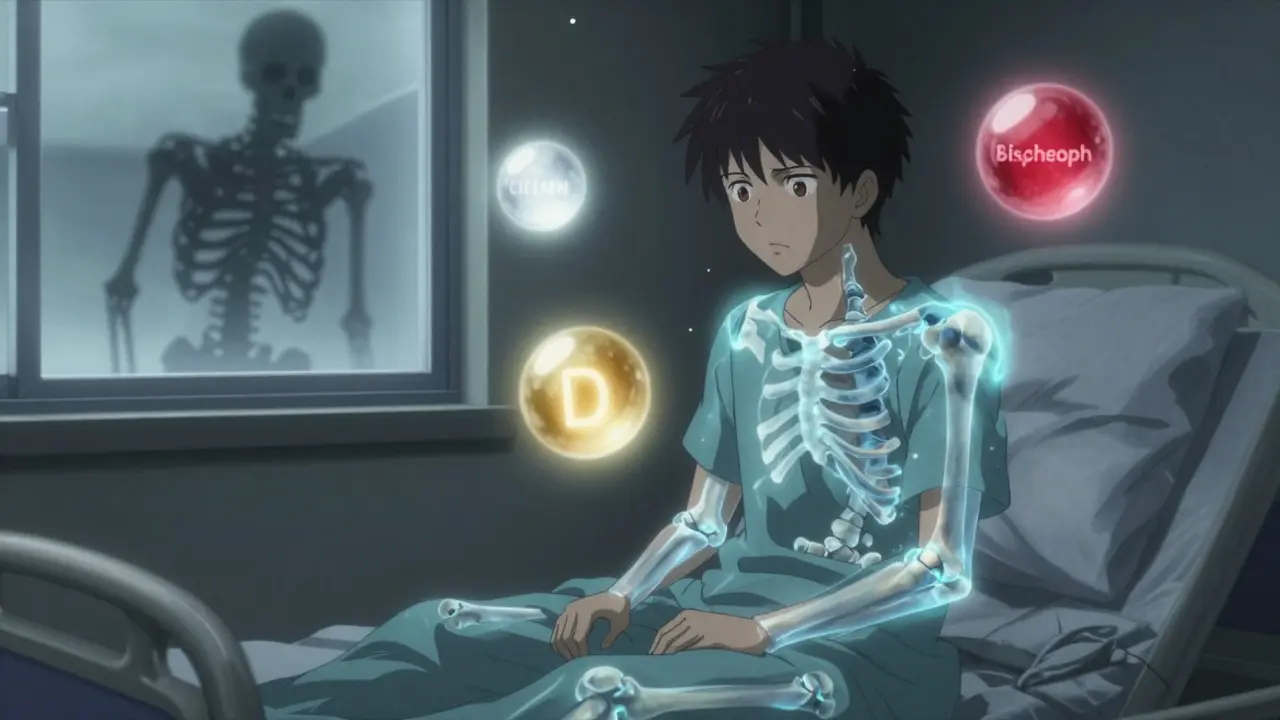
Steroid-Induced Osteoporosis Risk Assessment Tool
Assess Your Osteoporosis Risk
Determine if you need calcium, vitamin D, or bisphosphonates based on your steroid treatment
Risk Assessment Results
Enter your treatment details to see your risk level
Recommendations
Your personalized prevention plan will appear here
Calcium & Vitamin D Recommendations
For optimal bone protection, ensure you're getting:
• Calcium: 1,000-1,200 mg daily (about 3-4 servings of dairy or fortified foods)
• Vitamin D: 600-800 IU daily (800-1,000 IU if blood level below 30 ng/mL)
When Bisphosphonates Are Recommended
Bisphosphonates are recommended if:
• You're taking ≥2.5 mg prednisone daily for ≥3 months
• You're over 40 with additional risk factors
• You have a prior fracture or T-score ≤ -2.5 on DXA scan
When you’re on long-term steroid therapy - whether for asthma, rheumatoid arthritis, lupus, or another autoimmune condition - your bones are under silent attack. Steroids like prednisone don’t just calm inflammation. They also trigger a chain reaction in your skeleton that can lead to fractures, often before you feel any pain. This isn’t rare. Studies show that 30-50% of people on chronic steroid treatment develop osteoporosis. And it happens fast: bone loss can begin in as little as 3-6 months. The good news? You can stop it. Not with magic, but with three proven tools: calcium, vitamin D, and bisphosphonates.
Why Steroids Destroy Bone
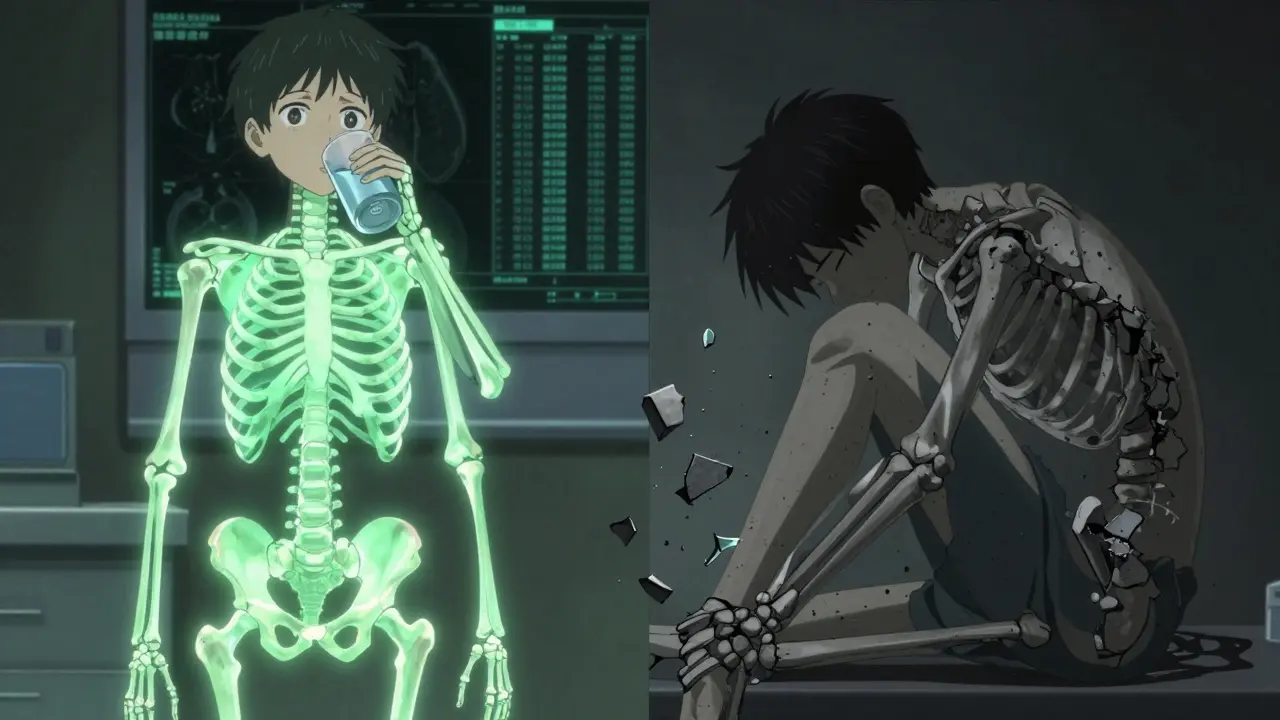
Steroids don’t just make your bones weaker - they actively break them down and stop them from rebuilding. It’s a double hit. About 70% of the damage comes from shutting down bone-building cells called osteoblasts. These cells normally lay down new bone tissue, but steroids make them die off faster and work slower. The other 30% comes from waking up bone-eating cells, osteoclasts, which chew through existing bone. The result? You lose bone density without noticing, and your risk of breaking a hip, spine, or wrist skyrockets - up to 17 times higher than someone not on steroids.Fractures aren’t just painful. They’re life-changing. A spinal fracture can shorten your height, curve your back, and make breathing harder. A hip fracture often means surgery, long recovery, and sometimes never walking again. And here’s the worst part: many people don’t even know they’re at risk until they break a bone.
Calcium and Vitamin D: The Non-Negotiable Base
No matter what else you do, you need calcium and vitamin D. These aren’t optional supplements. They’re the foundation. Think of them like bricks and mortar. Without enough of them, even the strongest drugs can’t rebuild bone properly.The American College of Rheumatology (ACR) recommends 1,000 to 1,200 mg of calcium daily for anyone starting long-term steroid therapy. That’s about the same as 3-4 servings of dairy or fortified plant milk, plus a supplement if needed. Most people get less than half that from food alone.
Vitamin D is just as critical. It’s not just about sunlight. Steroids interfere with how your body uses vitamin D, so you need more. The ACR says 600-800 IU per day is the minimum. If your blood level is below 30 ng/mL - which is common - you’ll need 800-1,000 IU daily. Many doctors now test your vitamin D level before starting steroids and adjust doses accordingly.
Skipping these two? You’re setting yourself up for failure. Even if you take a powerful bone drug, it won’t work well if you’re low on calcium or vitamin D. It’s like trying to build a house without nails.
Bisphosphonates: The First-Line Shield
When you’re on steroids for more than 3 months at a dose of 2.5 mg or more of prednisone daily (or the equivalent), guidelines say you need more than just supplements. You need a drug that stops bone loss in its tracks. That’s where bisphosphonates come in.These are oral medications like alendronate (Fosamax) and risedronate (Actonel). They work by sticking to bone surfaces and blocking osteoclasts - the cells that break bone down. They don’t build new bone, but they slow the destruction enough to let your body catch up.
The data is clear. In clinical trials, alendronate increased spine bone density by 3.7% in one year - while the placebo group lost bone. Risedronate cut vertebral fracture risk by 70%. These aren’t small improvements. They’re life-saving.
And they’re affordable. Generic alendronate costs about $250 a year in the U.S. That’s less than a daily coffee habit. That’s why they’re the first choice for most people - even though newer drugs exist.
When Bisphosphonates Aren’t Enough
Not everyone responds the same. If you’re over 65, have had a prior fracture, or your bone density scan (DXA) shows a T-score below -2.5, bisphosphonates might not be enough. That’s where teriparatide (Forteo) comes in.Teriparatide is different. Instead of just slowing bone loss, it actually stimulates new bone growth. It’s a synthetic version of parathyroid hormone, given as a daily injection. In one study, people on teriparatide had 10 times fewer spinal fractures than those on alendronate over 18 months.
But it’s expensive - around $2,500 a month. And you can only use it for two years. After that, you switch to a bisphosphonate to hold onto the gains. It’s not for everyone. But for high-risk patients - especially those with severe bone loss - it’s the best tool we have.
Another option is zoledronic acid (Reclast), a yearly IV infusion. It’s more effective than oral bisphosphonates at protecting the hip and spine. It also improves adherence - no remembering daily pills. If you can’t swallow pills or have stomach issues, this is a great alternative.
Who Should Get Treatment - And When
Not everyone on steroids needs a drug. But many people don’t get screened at all. The ACR guidelines are clear:- Everyone starting long-term steroids (≥3 months) should get calcium and vitamin D.
- If you’re 40 or older and taking ≥2.5 mg prednisone daily, start a bisphosphonate.
- If you’re under 40 but have had a prior fragility fracture, or have other risk factors (smoking, low body weight, family history), you still need a drug.
- If you’re on high doses (≥7.5 mg/day), you’re at high risk - don’t wait. Start treatment immediately.
And yes - even if you feel fine. Osteoporosis doesn’t hurt until you break a bone.
How to Take Bisphosphonates Right
These drugs are powerful - but only if taken correctly. If you mess up the dosing, you risk side effects and reduced effectiveness.For oral bisphosphonates like alendronate:
- Take it first thing in the morning, on an empty stomach.
- Swallow it with a full glass of plain water (not coffee, juice, or soda).
- Stay upright (standing or sitting) for at least 30 minutes.
- Don’t eat or drink anything else for 30-60 minutes.
Why? Because if you lie down too soon, the pill can irritate your esophagus. About 1 in 5 people have stomach upset. Following these steps cuts that risk in half.
If you have kidney problems (eGFR under 30), avoid oral bisphosphonates. IV zoledronic acid or teriparatide are safer. If you’re on dialysis, talk to your doctor - your options change.
Monitoring and Long-Term Use
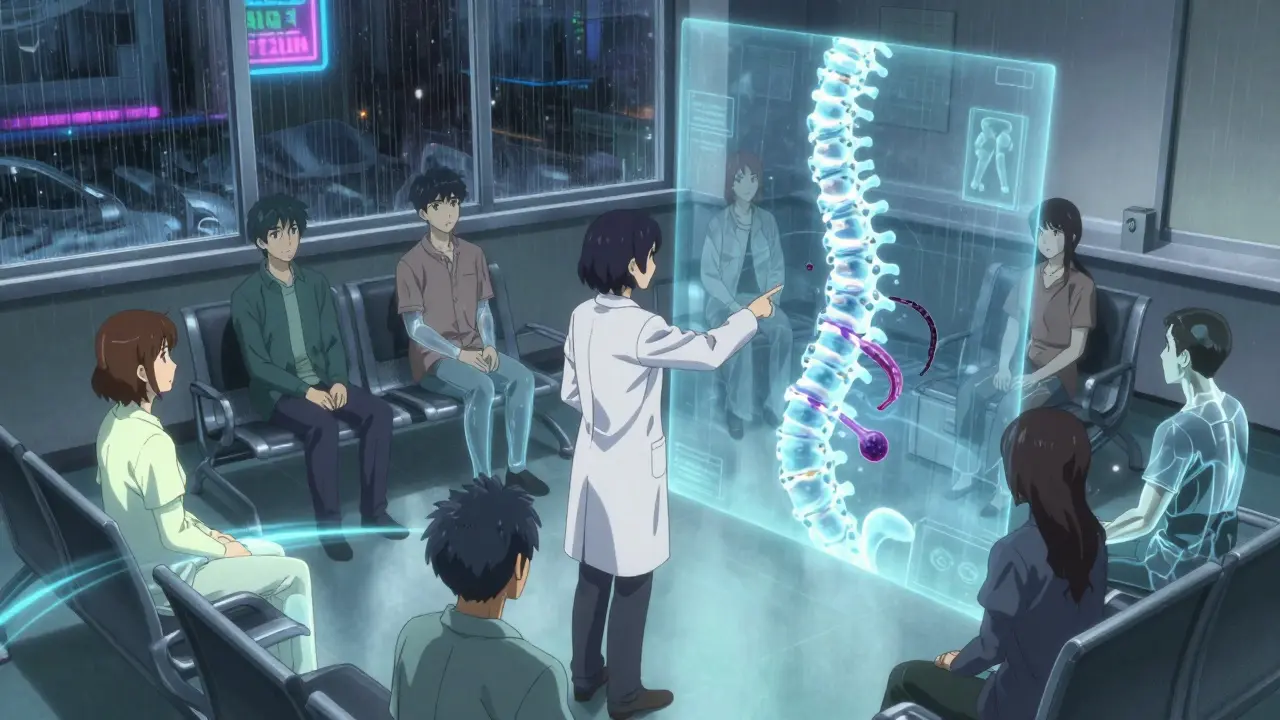
You can’t just start a drug and forget it. Bone density should be checked with a DXA scan after one year. If your bone density drops more than 5%, your treatment needs to change.Bisphosphonates are usually safe for 3-5 years. After that, the risk of rare side effects - like atypical femur fractures or jaw bone death - slowly increases. That’s why many doctors switch patients to a break (a “drug holiday”) or to another drug like denosumab after 5 years.
Denosumab (Prolia) is another option. It’s a twice-yearly injection that works differently than bisphosphonates. It’s not first-line, but it’s a solid backup if you can’t tolerate oral meds.
The Big Problem: Under-Treatment
Here’s the scary truth: only about 19% of people who should be getting treatment actually are. Doctors miss it. Patients don’t know. Pharmacies don’t remind. It’s a system failure.One study of over 150,000 patients found that most didn’t get a bone scan or any medication within 3 months of starting steroids. That’s not negligence - it’s ignorance. And it’s fixable.
If you’re on steroids, ask your doctor: “Do I need a bone density test?” and “Should I be on calcium, vitamin D, or a bone drug?” Don’t wait for them to bring it up. Be proactive. Your bones will thank you.
The Future: What’s Next?
New drugs are coming. Abaloparatide, a newer injectable, shows even better bone-building results than teriparatide. Studies are testing whether using teriparatide first, then switching to a bisphosphonate, gives even better long-term results.But for now, the best strategy hasn’t changed: start calcium and vitamin D the day you start steroids. Get a bone scan if you’re over 40 or have risk factors. If you’re at high risk, start a bisphosphonate. Don’t delay. Don’t assume you’re fine. Bone loss doesn’t wait.
How soon after starting steroids does bone loss begin?
Bone loss can start within 3 to 6 months of beginning steroid therapy. The biggest drop happens in the first year, especially if you’re taking 7.5 mg or more of prednisone daily. That’s why prevention needs to begin right away - not after a fracture.
Can I get enough calcium and vitamin D from food alone?
It’s very hard. You’d need about 3-4 servings of dairy or fortified foods daily for calcium, and even more sun exposure for vitamin D - which isn’t reliable in many climates. Most people need supplements to hit the recommended levels. Relying on diet alone puts you at risk.
Are bisphosphonates safe for long-term use?
Yes, for most people - but not forever. After 3-5 years, the risk of rare side effects like atypical femur fractures or osteonecrosis of the jaw increases slightly. Doctors often recommend a break after 5 years or switch to another drug. The benefits still outweigh risks for most high-risk patients.
What if I can’t swallow pills?
You have options. Zoledronic acid is an IV infusion given once a year. Denosumab is a shot every 6 months. Both avoid the digestive tract entirely. Talk to your doctor - there’s a solution that fits your needs.
Do I still need these treatments if I’m young?
Yes - if you’re on long-term steroids. Age isn’t the only factor. If you’ve had a prior fracture, have low body weight, smoke, or have a family history of osteoporosis, you’re at risk no matter your age. Guidelines recommend treatment based on risk, not just age.
12 Comments
Justin Archuletta March 18, 2026 AT 05:47
Just started prednisone last month. Took your advice and hit the calcium + D3 hard. No more feeling like my bones are made of styrofoam. Seriously, do this. It’s not optional.
jared baker March 20, 2026 AT 02:31
If you’re on steroids, get the bone scan. Don’t wait. It’s a 10-minute test. Saves you from a lifetime of pain. Simple.
cara s March 21, 2026 AT 19:29
I’ve been on maintenance prednisone for 7 years now. Started at 5mg, now down to 2.5. The calcium and D3 were non-negotiable-my DXA scan went from -2.8 to -1.9 over three years. But here’s the thing: I also switched to almond milk fortified with 450mg calcium per cup, took 1200mg supplemental calcium, and got 1000 IU D3 daily. My doctor said I’m doing better than 90% of patients. It’s not magic. It’s consistency. And yes, I still take the alendronate. Every Sunday. No excuses.
Aileen Nasywa Shabira March 21, 2026 AT 23:04
Oh wow, so now we’re all supposed to believe Big Pharma’s ‘bone health’ fairy tale? Let me guess-you also brush your teeth with fluoride toothpaste and drink fluoridated water because ‘science’ says so? I’ve been on steroids for 12 years. No fractures. No supplements. Just pure ancestral wisdom. Your bones don’t need chemicals. They need rest. And maybe less sugar.
Kyle Young March 23, 2026 AT 22:44
It’s fascinating how we’ve reduced a deeply physiological process-bone remodeling under glucocorticoid suppression-to a checklist of pharmaceutical interventions. Calcium and vitamin D are foundational, yes-but are we not also ignoring the role of mechanical loading, circadian rhythm disruption, and systemic inflammation in steroid-induced bone loss? The data on bisphosphonates is compelling, but it’s a band-aid on a wound caused by systemic immunosuppression. Shouldn’t we be asking why we’re prescribing long-term steroids in the first place?
Amadi Kenneth March 24, 2026 AT 19:27
Wait… so you’re telling me the government and Big Pharma are teaming up to sell us pills so they can control our bones?? I read a guy on TruthSocial who said bisphosphonates contain nano-robots that track your bone density and report to the FDA. And calcium? It’s just powdered chalk from the same factories that make the 5G towers. I’ve been taking magnesium citrate and hanging upside down for 20 mins a day. My bones feel like titanium. You’re all being played.
Shameer Ahammad March 25, 2026 AT 08:36
I must respectfully disagree with the assertion that bisphosphonates are ‘affordable.’ In India, where I practice, alendronate is priced at INR 4,200 per month-equivalent to nearly 40% of the average monthly wage. Meanwhile, vitamin D deficiency is rampant due to pollution, indoor lifestyles, and cultural norms around sun exposure. The guidelines are scientifically sound, but culturally and economically inaccessible to the majority. We must advocate for public health interventions-not just individual compliance.
Manish Singh March 26, 2026 AT 18:02
As someone from India who’s been on steroids for lupus since 2018, I want to say-this article saved my life. My mom used to say, ‘Bones don’t scream until they break.’ I didn’t listen. Broke my wrist in 2020. Now I take my D3 and calcium like it’s my daily prayer. And yes, I take the alendronate. I don’t care if it’s ‘just a pill.’ I care that I can still hug my daughter without wincing. This isn’t medicine. It’s dignity.
Nilesh Khedekar March 28, 2026 AT 04:49
i heard that bisphosphonates can make your jaw fall off lol. also i think the whole bone loss thing is a scam. my cousin took prednisone for 5 years and he’s still running marathons. maybe its just the sugar in the pills? or maybe its all about vibes? i stopped taking my calcium because i felt ‘energetically blocked’. now i do yoga facing the sun. my bones feel more aligned. peace.
Alexander Pitt March 28, 2026 AT 16:14
The most critical point often missed: if you’re on prednisone ≥2.5 mg/day for >3 months, you are at risk. Period. No exceptions. The ACR guidelines exist for a reason. Delaying intervention increases fracture risk exponentially. Calcium and vitamin D are necessary but insufficient. Bisphosphonates are first-line. Evidence is robust. Action is urgent.
Justin Archuletta March 30, 2026 AT 03:58
I just read someone say they hang upside down for bone health. Bro. I take a pill. I eat yogurt. I walk. I’m not a human pendulum.
Robin Hall April 1, 2026 AT 02:48
I have reviewed the FDA’s Adverse Event Reporting System (FAERS) database for 2015–2023. There are 1,847 documented cases of atypical femoral fractures associated with bisphosphonate use. This is not ‘rare.’ This is a pattern. And the correlation with long-term use is statistically significant (p < 0.001). The ACR guidelines downplay this. The pharmaceutical industry funds their research. We must question the institutional narrative.