

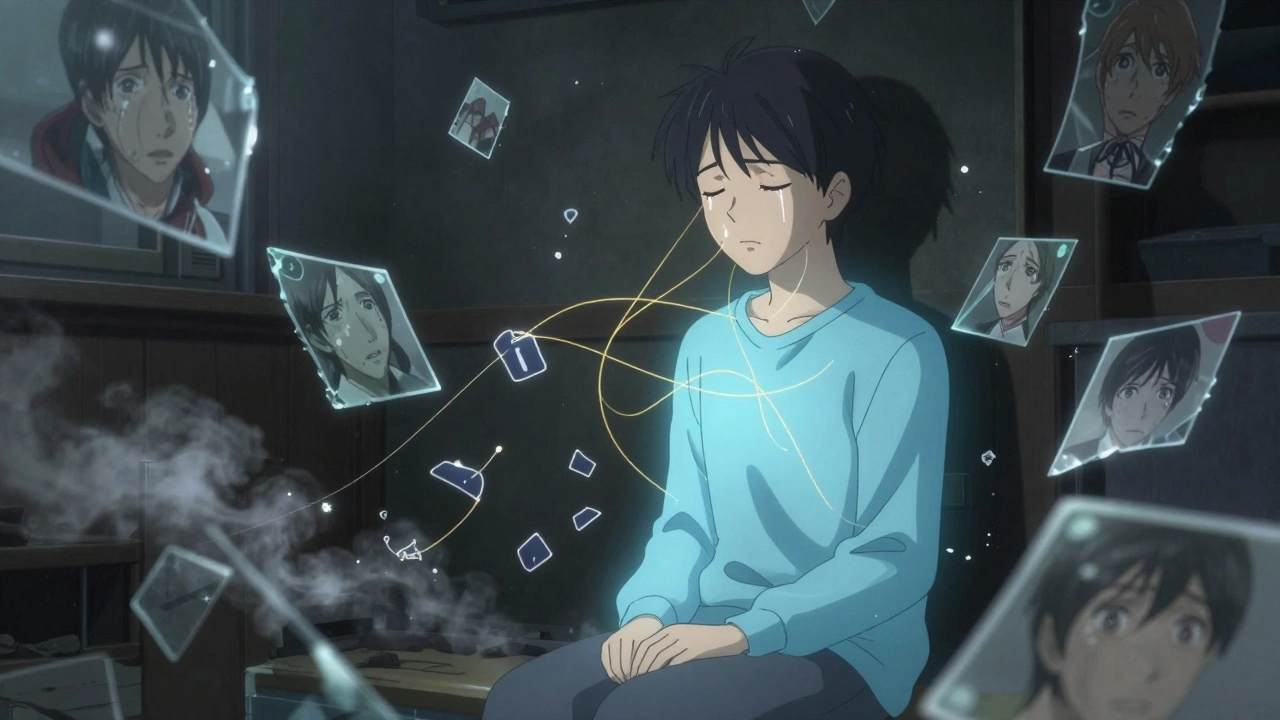
When you’ve been through something terrible-combat, assault, a car crash, or the sudden loss of someone you love-it doesn’t always end when the event does. For about 1 in 3 people who experience trauma, the mind keeps reliving it. Flashbacks. Nightmares. Jumping at loud noises. Avoiding places, people, even thoughts that remind you of what happened. This isn’t weakness. It’s Post-Traumatic Stress Disorder, or PTSD. And it’s treatable.
What PTSD Really Feels Like
PTSD isn’t just being stressed out. It’s a brain that got stuck in alarm mode. The four main signs are: intrusions (like flashbacks or nightmares), avoiding anything tied to the trauma, negative changes in how you think or feel (guilt, numbness, detachment), and being on edge all the time-hypervigilant, easily startled, unable to sleep. These symptoms last longer than a month and mess with your job, relationships, and daily life. The DSM-5-TR (2022) sets the official standard: if you’ve had these symptoms for over 30 days and they’re causing real trouble, you’re likely dealing with PTSD.Trauma Processing: The Core of Healing
Medication can calm the storm, but it doesn’t fix the root. That’s where trauma-focused therapy comes in. Two approaches have the strongest evidence: Cognitive Processing Therapy (CPT) and Prolonged Exposure (PE). CPT helps you challenge the thoughts that got stuck after the trauma-like “It was my fault” or “The world is completely dangerous.” You work with a therapist to rewrite those beliefs with facts, not fear. PE slowly brings you back to the memories and places you’ve been avoiding, not to hurt you, but to show your brain that those triggers aren’t still dangerous. Studies show CPT leads to remission in 60-70% of people after 12 sessions. That’s better than medication alone. And the gains last. Unlike pills, therapy rewires your brain. You don’t need to keep going forever.Medication: Not a Cure, But a Bridge
The FDA has only approved two drugs specifically for PTSD: sertraline (Zoloft) and paroxetine (Paxil). Both are SSRIs-selective serotonin reuptake inhibitors. They don’t erase the trauma. They help reduce the noise: less anxiety, fewer nightmares, better sleep, more ability to focus. Sertraline works for about 53% of people. Paroxetine? Around 60%. But here’s the catch: only 20-30% of people get complete relief. Most see improvement, not total recovery. Other meds are used off-label because they help too. Venlafaxine (Effexor XR), an SNRI, shows similar results. Prazosin, a blood pressure drug taken at night, cuts trauma-related nightmares by half in veterans. It’s not FDA-approved for PTSD, but VA doctors prescribe it all the time. Atypical antipsychotics like risperidone and quetiapine are sometimes added for severe hyperarousal, but evidence is mixed. They’re not first-line. They’re for when everything else hasn’t worked.Medication vs. Therapy: The Real Comparison
Therapy takes longer-8 to 12 weeks to start seeing real change. Medication can kick in faster: 4 to 6 weeks. That’s why some people start with pills to get stable enough to show up for therapy. But therapy wins in the long run. A 2022 VA/DoD guideline found CPT and PE led to higher remission rates than SSRIs alone. Plus, therapy has no side effects like weight gain, sexual dysfunction, or emotional numbness-common with SSRIs. On Reddit’s r/ptsd community, 42% of users quit SSRIs because of sexual side effects. One person wrote: “I felt like I was just floating through life, not living it.” That’s emotional blunting. A real cost.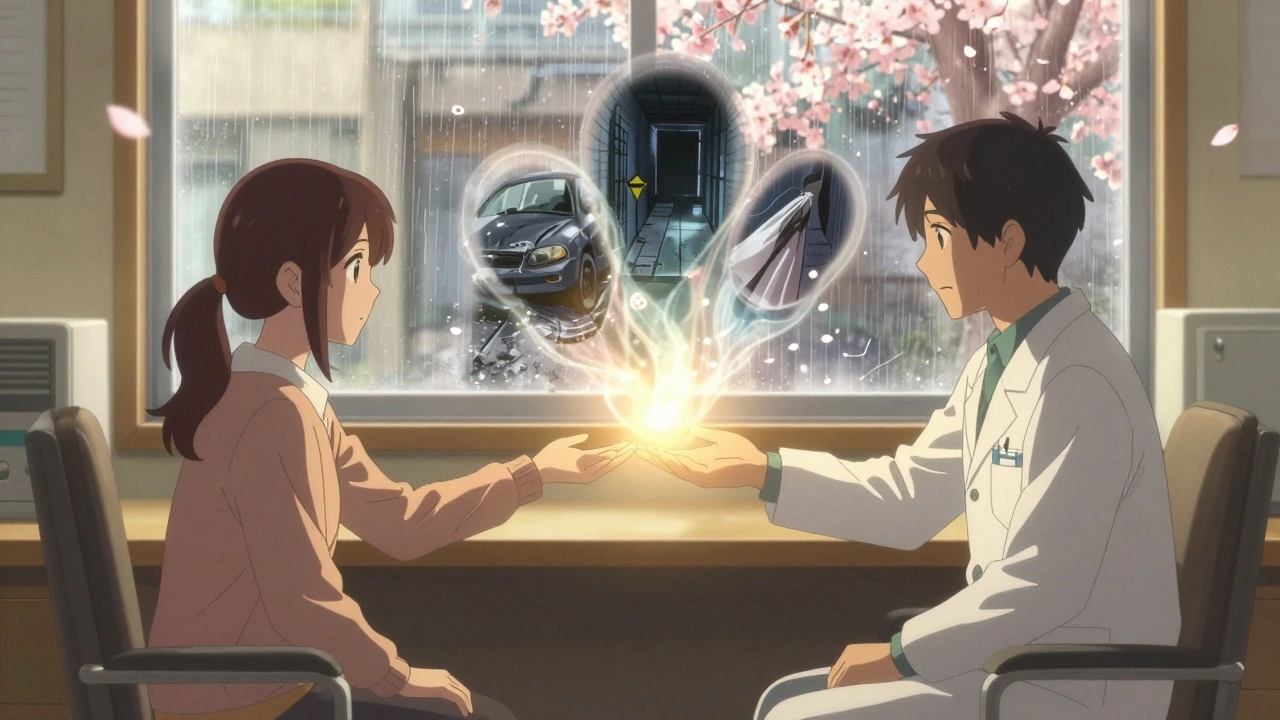
Combining Both: The Best of Both Worlds?
Some experts say start with therapy. Others say combine them from day one. The 2021 JAMA Psychiatry study found people on sertraline + PE had a 72% response rate-better than either alone. It makes sense. If you’re so overwhelmed by panic and nightmares that you can’t sit still for therapy, a little help from prazosin or sertraline might get you there. Once you’re stable, therapy can do the heavy lifting. The VA now recommends trying therapy first. If it doesn’t work-or if you’re too unstable to even begin-then add medication. Not the other way around.What Works for One Person Might Fail for Another
There’s no one-size-fits-all. A combat veteran might respond beautifully to paroxetine and CPT. A survivor of childhood abuse might try three SSRIs, venlafaxine, even prazosin-and still feel stuck. The International Society for Traumatic Stress Studies has case records of people who didn’t respond to any medication. That’s treatment-resistant PTSD. It’s rare, but it happens. Genetics might play a role. The 2023 Psychiatric Genomics Consortium found 95 genetic variants linked to how well someone responds to SSRIs. We’re not testing for them yet-but we will be.Cost, Access, and Real-World Barriers
Generic sertraline costs $4 to $10 a month. One therapy session? $100 to $200. That’s why meds are tempting. But therapy’s effects last. Medications? You have to keep taking them. Stop them, and 55% of people relapse within a year. Access is another hurdle. In rural areas, finding a therapist trained in CPT or PE is hard. The VA offers free telehealth consultations for PTSD. Private practices? Not always. And 78% of primary care doctors say they don’t feel trained to manage PTSD meds properly.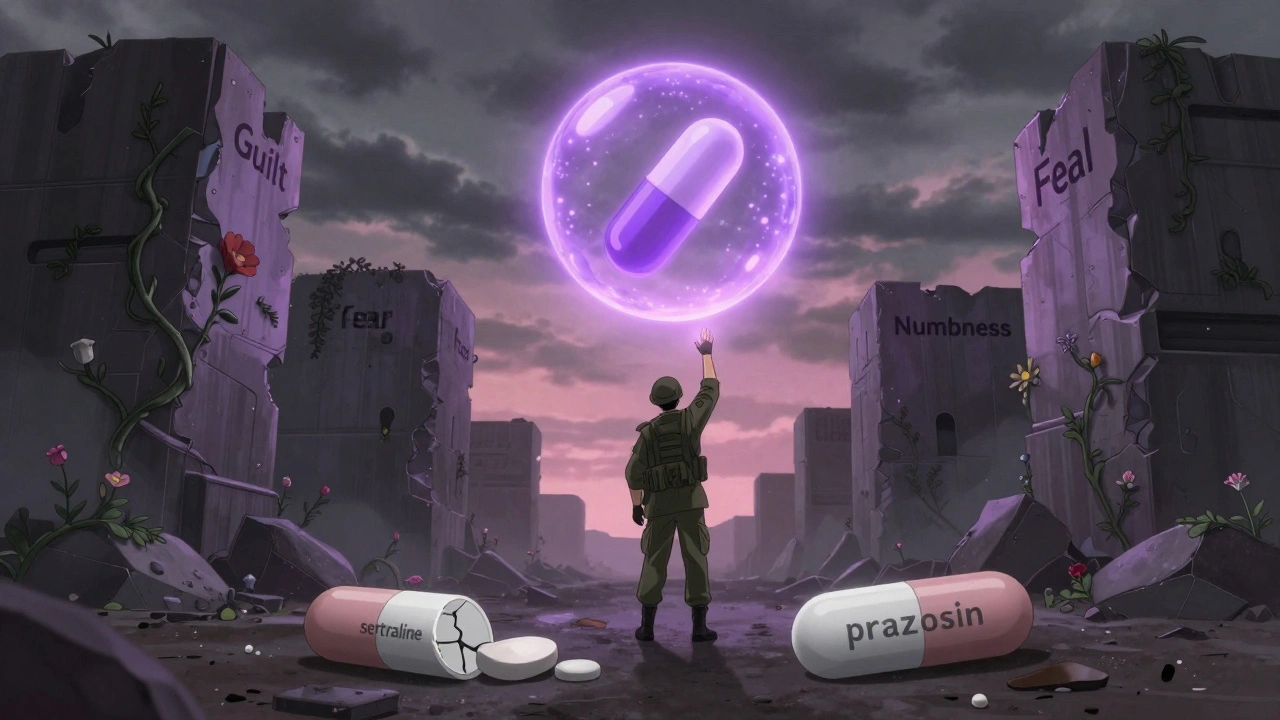
What’s Coming Next?
The biggest shift on the horizon? MDMA-assisted psychotherapy. The FDA gave it Breakthrough Therapy status in 2017. Phase III trials in 2023 showed 67% of participants no longer met PTSD criteria 18 weeks after treatment. That’s not improvement. That’s remission. The VA/DoD guidelines will update in 2024 to include it. It’s not a magic bullet-it’s still therapy, just with MDMA helping you stay present with painful memories without getting overwhelmed. Also in the pipeline: brexpiprazole (Rexulti) as an add-on to SSRIs. Early data shows a 35% symptom reduction when added to sertraline.What to Do If You’re Struggling
If you think you have PTSD:- Don’t wait for it to go away. It rarely does.
- Find a therapist trained in CPT or PE. Ask your doctor for referrals or check the National Center for PTSD website.
- If you’re too overwhelmed to start therapy, talk to a provider about short-term medication to help you get there.
- Don’t give up if one med doesn’t work. Try another. Dosing matters-sertraline needs to be at least 150 mg daily for a fair trial.
- Track your symptoms. Use the PTSD Checklist (PCL-5) from the VA. It’s free and helps you see progress.
Final Thought: Healing Isn’t Linear
PTSD doesn’t disappear overnight. Some days, you’ll feel fine. Others, you’ll be back in the trauma. That’s normal. Healing isn’t about erasing the past. It’s about reclaiming your present. Medication can help you breathe again. Therapy helps you understand why you stopped breathing in the first place. Together, they’re powerful. But therapy is where the real change happens. Don’t settle for just managing symptoms. Aim for recovery.Can PTSD be cured without medication?
Yes. Many people recover fully with trauma-focused therapy like CPT or PE alone. Medication isn’t required. Therapy helps rewire how your brain responds to trauma memories, leading to lasting change. About 60-70% of people who complete therapy reach remission without any drugs.
Why are only two medications FDA-approved for PTSD?
The FDA requires strong, consistent evidence from large clinical trials. Sertraline and paroxetine met that bar. Other drugs like venlafaxine or prazosin help, but manufacturers didn’t spend the money to get formal approval for PTSD. That doesn’t mean they’re ineffective-it just means they’re used off-label, which is common in psychiatry.
Do SSRIs make PTSD worse?
They don’t make PTSD worse, but they can make some symptoms feel duller. Some people report emotional blunting-feeling less joy, less sadness, less everything. That’s not the trauma returning; it’s the medication dampening emotions overall. If this happens, talk to your doctor. Dose adjustments or switching meds can help.
How long should I stay on PTSD medication?
Most experts recommend staying on medication for at least 12 months after symptoms improve. Stopping too soon leads to relapse in 55% of cases. If you’re doing therapy and feeling stable, you and your doctor can plan a slow taper. Never stop suddenly-SSRIs can cause withdrawal symptoms like dizziness, nausea, or brain zaps.
Is prazosin safe for long-term use?
Yes. Prazosin is used long-term in veterans for trauma-related nightmares. It’s not addictive and doesn’t cause tolerance. Side effects include dizziness or low blood pressure, especially when starting. Start low (1 mg at bedtime) and increase slowly. It’s one of the safest off-label options for PTSD.
Can I use marijuana or CBD for PTSD?
Some people report short-term relief from anxiety or sleep issues with CBD or marijuana. But research is limited and mixed. The VA doesn’t recommend it due to lack of consistent data and potential for worsening symptoms over time. It’s not a substitute for proven treatments like therapy or FDA-approved meds.
What if therapy doesn’t work for me?
It’s not failure. PTSD is complex. If standard therapies haven’t helped, ask about alternatives: EMDR, somatic experiencing, or MDMA-assisted therapy (when available). Also consider a second opinion from a PTSD specialist. Treatment resistance doesn’t mean no hope-it means you need a different approach.
15 Comments
Declan O Reilly December 2, 2025 AT 14:27
Man, I read this whole thing and just felt seen. I did CPT after my tour and it didn't fix everything, but it made me stop hating myself for surviving. Therapy didn't erase the memories, but it stopped them from running my life.
And yeah, SSRIs made me feel like a zombie on a Sunday afternoon. No joy, no rage, just... flat. Like my emotions got put on mute. I quit after six months. Didn't regret it.
Conor Forde December 3, 2025 AT 07:11
Ohhh here we go again with the ‘therapy is magic’ fairy tale. Let me guess-next you’ll say meditation cures cancer? I’ve seen guys on sertraline who could finally hold a job, sleep through the night, and not scream at their kids. You think that’s not worth it? You’re romanticizing suffering.
And don’t get me started on MDMA. ‘Oh it’s just therapy with a party drug!’ Yeah, and LSD was ‘just a hallucinogen’ until people started having psychotic breaks. Progress isn’t always pretty, but it’s real.
patrick sui December 5, 2025 AT 05:20
Interesting breakdown! 🤔 The neuroplasticity angle is key-therapy literally rebuilds neural pathways, while meds just tweak neurotransmitter levels. It’s like fixing a leaky roof vs. using a bucket to catch rain.
Also, prazosin for nightmares? Game-changer. My cousin, a vet, went from 5 nightmares/night to 1 every 2 weeks. No euphoria, no dependency. Just quiet nights. Why isn’t this frontline? 🤷♂️
And the genetic variants? So exciting. We’re entering personalized PTSD care. Soon, your DNA might tell you if sertraline will work-or if you need to skip straight to PE.
Also, CBD? I tried it. Felt like a warm blanket, but didn’t touch the core trauma. Still, for sleep? Sometimes that’s enough to get you to therapy tomorrow.
Shannon Gabrielle December 6, 2025 AT 23:48
Wow. Another feel-good article from the therapy-industrial complex. Meanwhile, in the real world, people are paying $200/hour to talk about their feelings while their rent doubles. You think PTSD is a problem? Try being poor and having a therapist who doesn’t even know what ‘food stamps’ are.
And yes, SSRIs cause emotional blunting. So does being broke. Guess which one we’re supposed to fix first?
Also, MDMA-assisted therapy? Of course it works. It’s literally a hallucinogen in a lab coat. Next you’ll tell me we should give veterans LSD and call it ‘reintegration.’
ANN JACOBS December 8, 2025 AT 07:27
As someone who has walked this path for over a decade, I want to extend my heartfelt appreciation to the authors of this deeply compassionate and meticulously researched piece. The integration of evidence-based clinical frameworks with humanistic empathy is not merely commendable-it is revolutionary in an era where mental health discourse is often reduced to algorithmic soundbites.
It is imperative that we recognize the profound dignity inherent in each individual’s struggle, and that healing, while nonlinear, is indeed possible through disciplined, trauma-informed engagement with therapeutic modalities that honor the complexity of the human psyche.
Let us not mistake symptom suppression for transformation. The soul does not heal through chemical sedation alone. It heals through courage, through narrative, through the quiet, courageous act of remembering-and surviving-without being consumed.
Thank you for this beacon of clarity in a storm of misinformation.
Nnaemeka Kingsley December 8, 2025 AT 19:15
Bro, I been there. Nigeria, no therapists, no meds, just me and my thoughts. I read your post and I felt something. CPT? Never heard of it. But I started writing letters to my dead brother. Not sending them. Just writing. One day I stopped crying while I wrote. That was my PE.
Medicine? I can't afford. But talking? I can. Even if it's to myself.
God bless you for writing this. Someone out there needs to hear it.
Kshitij Shah December 9, 2025 AT 14:48
USA thinks it owns PTSD. Meanwhile in India, we call it ‘ghost in the mind’ and just pray. No therapy, no SSRIs. Just chai, family, and silence.
But hey-your 72% response rate with sertraline + PE? That’s beautiful. But what about the 28%? The ones who still wake up screaming? You don’t talk about them. You talk about ‘remission’ like it’s a trophy.
And MDMA? Sounds like a Silicon Valley startup pitch. ‘Let’s monetize trauma with a psychedelic.’
Meanwhile, my uncle’s PTSD? He works 16 hours a day. That’s his therapy. No insurance. No journal. Just exhaustion.
Sean McCarthy December 10, 2025 AT 20:47
Wait. Let me get this straight. You’re saying that people who can’t afford $150/hour therapy should just wait until they’re ‘stable enough’ to start? And meanwhile, they’re stuck with $10/month SSRIs that make them emotionally dead?
Also, ‘therapy rewires your brain’-so what? That’s not a treatment. That’s a buzzword. And ‘60-70% remission’? Remission from what? From feeling human? Or from being functional enough to hold a job?
And why are you ignoring the fact that 78% of primary care doctors don’t know how to manage PTSD meds? That’s not a gap. That’s a failure of the system.
Also, ‘don’t give up’? What if you’ve tried everything? What then? You just die quietly?
Jaswinder Singh December 10, 2025 AT 22:01
Bro, you’re talking like this is a choice. Like we can just ‘do therapy’ and fix it. I lost my sister in a bombing. I tried CPT. I cried for 3 hours. Then I went home and punched a wall for 20 minutes. That’s my PE. No therapist. No meds. Just me and the rage.
And yeah, SSRIs made me feel like a ghost. I stopped taking them. My wife said I was ‘more present’-but also more volatile. So what? I’d rather feel everything than nothing.
Stop selling hope like it’s a product. Some of us don’t want to be ‘fixed.’ We just want to be heard.
Bee Floyd December 11, 2025 AT 23:44
I’ve been on sertraline for 18 months. It didn’t make me happy. But it made me able to get out of bed. And that’s enough for now.
I’m starting therapy next month. Not because I’m ‘ready’-I’m not. But because I’m tired of being a ghost in my own life.
Thanks for writing this. I needed to read it.
Jeremy Butler December 13, 2025 AT 04:18
The epistemological framework underlying the therapeutic efficacy of CPT and PE is predicated upon the ontological assumption that trauma is a cognitive distortion rather than a somatic imprint. This Cartesian bifurcation, while clinically expedient, may inadvertently pathologize the embodied memory of survival, reducing the phenomenological totality of traumatic experience to propositional belief revision.
Furthermore, the pharmacological paradigm, anchored in monoaminergic modulation, reflects a biomedical reductionism that neglects the intersubjective dimensions of healing. The imperative to ‘reclaim the present’ presumes an epistemic autonomy that is often structurally foreclosed by socioeconomic precarity, institutional neglect, and historical trauma.
Thus, while the data are compelling, the narrative remains incomplete without a critical theory of power, access, and embodiment.
Courtney Co December 14, 2025 AT 16:51
Wait, so you’re saying MDMA is the new miracle cure? But what about the people who tried it and ended up worse? I had a friend who did it and now she can’t trust anyone. Not even her dog. And you’re just gonna hand it out like candy?
And why do you always assume people want to ‘recover’? What if they just want to be left alone? What if they don’t want to ‘rewrite their beliefs’? What if they just want to scream into the void and have someone say, ‘Yeah, that sucks’?
You’re so obsessed with fixing people you forget they might not want to be fixed.
Shashank Vira December 15, 2025 AT 19:23
How quaint. You speak of CPT as if it were the divine revelation of modern psychiatry. But let us not forget: the Greeks had their catharsis. The Sufis, their whirling. The shamans, their drums. You merely dress ancient rituals in the garb of peer-reviewed journals.
And SSRIs? A pharmaceutical placebo dressed as science. The real miracle? The human will to survive. Not your 72% response rate. Not your FDA approvals. Not your $200/hour therapists.
Healing is not a metric. It is a rebellion.
Eric Vlach December 16, 2025 AT 22:43
My brother did PE. He cried for the first time in 12 years. Didn’t take a single pill. Just sat with his memories until they didn’t break him anymore.
He’s not ‘cured.’ But he plays with his kids now. He laughs. He forgets to check the locks sometimes.
That’s enough.
Thanks for saying this out loud.
Souvik Datta December 18, 2025 AT 12:57
Let’s be real-this whole system is broken. We treat PTSD like a math problem: trauma + therapy = recovery. But trauma isn’t a variable. It’s a wound that never fully closes. Some days, you’re fine. Other days, you’re back in the alley, the battlefield, the hospital room.
Therapy doesn’t erase it. It teaches you to carry it differently.
And meds? They’re not the enemy. They’re the crutch that lets you walk to the therapist’s office.
I’ve tried everything. Still wake up sweating sometimes. But now I know-I’m not broken. I’m still here.
And that’s the real victory.