

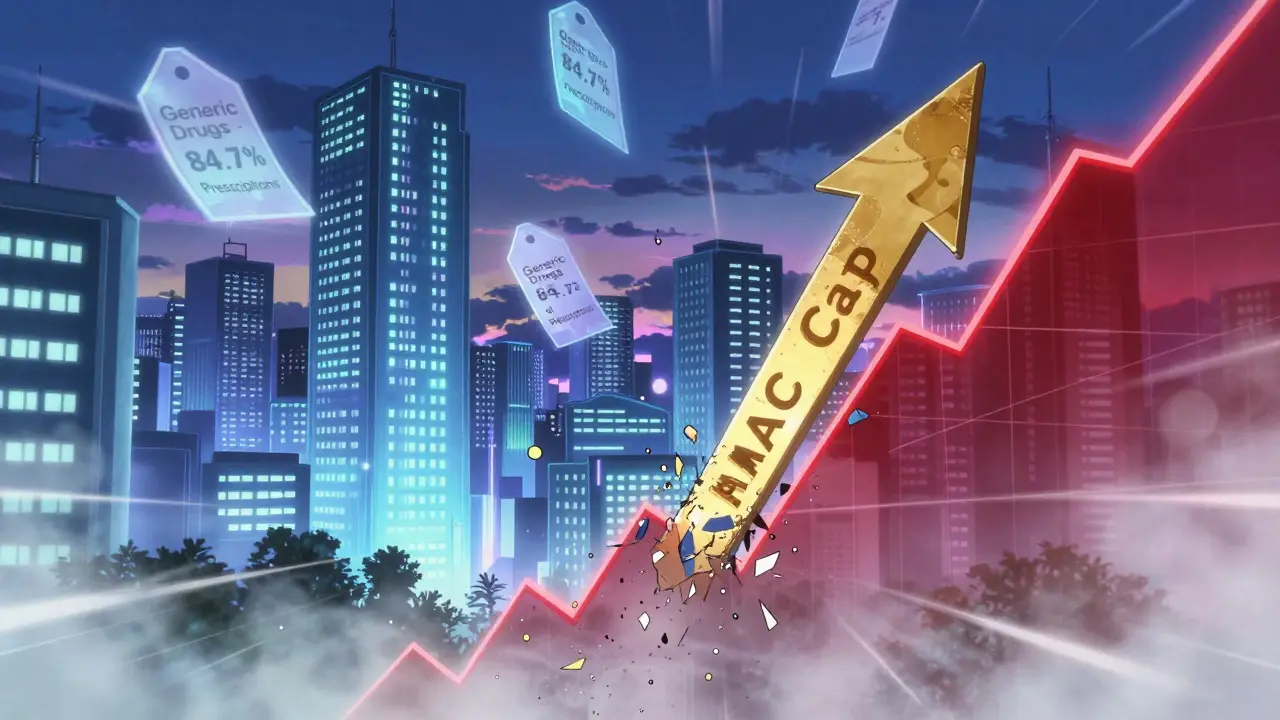
Medicaid spends billions on prescription drugs every year - but most of that money isn’t going to brand-name pills. In 2023, generic drugs made up 84.7% of all Medicaid prescriptions, yet they accounted for just 15.9% of total drug spending. That’s the power of generics: they’re cheap, effective, and the main reason Medicaid hasn’t collapsed under the weight of rising drug prices. But here’s the catch - even generics aren’t immune to price spikes. Some manufacturers have raised prices on old, off-patent drugs by 500%, 1,000%, even more - with no new research or clinical benefit to justify it. So states are stepping in. Not with federal mandates, but with their own rules, tools, and sometimes, lawsuits.
How Medicaid Gets Its Generic Drug Discounts
The federal Medicaid Drug Rebate Program (MDRP) is the backbone of generic pricing. Since 1990, drug makers have been required to give Medicaid a discount on every generic drug they sell. For generics, that’s at least 13% of the average price manufacturers charge pharmacies. That sounds simple, but it’s not enough anymore. States can’t negotiate extra rebates on generics like they can with brand-name drugs. The rules are locked in. So states have to get creative.
What they’ve done is build layers on top of that federal system. Forty-two states now use Maximum Allowable Cost (MAC) lists - basically, price caps on generic drugs. If a pharmacy tries to bill Medicaid for a generic that costs more than the MAC limit, the state pays the cap amount, not the full price. These lists aren’t static. Thirty-one states update them quarterly or more often. But here’s the problem: if a drug’s price drops suddenly, and the state hasn’t updated the list yet, pharmacies get stuck. They can’t charge more than the MAC, but they also can’t get reimbursed for what they actually paid. That’s led to delayed payments, denied claims, and frustrated pharmacists. A 2024 survey found 74% of independent pharmacies had been hit by these mismatches.
State-Level Tactics Beyond Price Caps
MAC lists are just one tool. Forty-nine states require pharmacists to substitute a generic when a brand-name drug is prescribed - unless the doctor says no. That’s mandatory generic substitution. It’s not controversial. It’s standard. But states are going further.
Thirty-seven states restrict which drugs can be prescribed within certain therapeutic classes. For example, if there are five equally effective generic blood pressure pills, the state might only cover the cheapest one unless the doctor proves the patient needs another. That’s called therapeutic interchange. It’s not about limiting choice - it’s about steering patients toward the most cost-effective option.
Then there’s the rise of Prescription Drug Affordability Boards (PDABs). By 2024, nine states - including California, Colorado, and Maryland - created these panels. Their job? Review drug prices and set upper limits for what Medicaid (and sometimes commercial insurers) will pay. Maryland went even further in 2020, passing a law that fines drugmakers for unjustified price hikes on old generics. No new data? No justification? Big price jump? You’re fined. It’s a direct attack on price gouging.
The Hidden Players: PBMs and Supply Chains
It’s easy to blame drugmakers. But the real money trail often goes through Pharmacy Benefit Managers - or PBMs. These middlemen negotiate prices between drugmakers and pharmacies, collect rebates, and set reimbursement rates. States have learned that PBMs can hide markups. So 27 states passed new rules in 2024 requiring PBMs to disclose what they actually pay for generic drugs. Nineteen of those states now demand transparency on acquisition costs. That’s a big deal. It’s like forcing a broker to show you the invoice before they charge you.
And then there’s the supply chain. Three companies control 65% of the generic injectable market. When one of them has a production issue - a factory shutdown, a quality control failure - shortages ripple across the country. In 2023, 23 states reported shortages of critical generic drugs. The average shortage lasted nearly five months. That’s not just inconvenient. It’s dangerous. Patients on dialysis, heart medications, or antibiotics can’t wait. So 12 states passed laws in 2024 to build emergency stockpiles of high-risk generics. Oregon and Washington are leading a multi-state purchasing pool to buy 47 high-volume generics together - giving them more leverage to negotiate lower prices.
What’s Working - and What’s Backfiring
States have saved billions. The Congressional Budget Office estimates state-level policies could cut generic drug spending by 5-8% annually. That’s billions. But there’s a flip side. The Pharmaceutical Care Management Association warns that aggressive price controls could make it unprofitable to make certain generics. If a drug costs $0.10 a pill to make but the state only pays $0.08, manufacturers walk away. And once they leave, they don’t come back quickly. Avalere Health found that changing rebate rules during shortages could push companies out of the market entirely - leaving states with fewer options, not more.
Some states are learning from mistakes. Texas and Oregon stopped using risk-based programs for hepatitis C drugs in 2024 because prices stabilized. They realized their old strategy was overkill. Meanwhile, New Hampshire and Maryland are launching new risk pools to protect against future spikes.
And then there’s the GLP-1 wave. Drugs like Ozempic and Wegovy cost $12,000 a year. Thirteen states now cover them for obesity under strict prior authorization. But if a new federal rule forces Medicaid to cover them broadly, states could face an extra $1.2 billion in annual costs. That’s why many are watching - and preparing.
The Road Ahead: More States, More Pressure
The number of states with at least one drug affordability policy jumped from 12 in 2020 to 34 in 2024. By 2025, the Congressional Budget Office expects 15 more to join. But legal battles are coming. Drugmakers are suing states over price caps, claiming they violate federal law. So far, courts have mostly sided with states - but the fight isn’t over.
Looking ahead, 22 states are planning strategic stockpiles of critical generics by 2026. More will adopt PDABs. More will demand PBM transparency. The goal isn’t to eliminate drug spending - it’s to make sure it’s fair. Generics should be affordable. Not because the federal government says so, but because states are willing to fight for it.
The truth? Medicaid’s savings aren’t coming from cutting care. They’re coming from cutting greed. And for now, states are the only ones stepping up to do it.
11 Comments
Vanessa Barber January 23, 2026 AT 21:06
I get why states are doing this, but honestly? It feels like we're just moving the pain around. Pharmacies are getting squeezed, patients are getting delayed refills, and the big guys just find loopholes. Not sure this is fixing anything, just reshuffling the deck chairs.
Kerry Evans January 25, 2026 AT 14:34
This is what happens when you let bureaucrats play economist. You don't fix a broken system by capping prices-you fix it by letting the market work. If generics are profitable, companies will make them. If they're not, then maybe we shouldn't be using them. Simple.
Kerry Moore January 27, 2026 AT 05:37
The structural complexity of Medicaid's generic drug ecosystem is remarkable. The interplay between federal rebate mandates, state-level MAC lists, PBM opacity, and supply chain concentration creates a multi-layered policy challenge. Empirical evidence suggests that while cost containment is achieved, unintended consequences such as therapeutic substitution barriers and manufacturer withdrawal require longitudinal monitoring.
Janet King January 28, 2026 AT 18:55
States are doing the right thing. Generic drugs should be cheap. If a company hikes the price of a 50-year-old pill with no new science, they're not innovating-they're exploiting. Price caps aren't socialism. They're common sense.
Stacy Thomes January 29, 2026 AT 19:35
THIS IS HUGE. PEOPLE NEED TO KNOW THIS. STATES ARE FIGHTING BACK AGAINST GREEDY PHARMA AND WINNING. WE NEED MORE OF THIS. NO MORE PRICE GAUGING ON LIFE-SAVING MEDS. #STANDWITHSTATES
dana torgersen January 30, 2026 AT 10:43
i mean... like... why do we even have PBMs?? they're just middlemen taking a cut, right?? and then they hide the real costs?? it's like buying a sandwich and the guy at the counter says 'oh, the bread cost $3 but i'm charging you $7'... and no one questions it??
Dawson Taylor January 30, 2026 AT 11:19
The market doesn't always self-correct. Sometimes, it needs a nudge. States are that nudge.
Sallie Jane Barnes January 30, 2026 AT 22:54
I appreciate the nuance here. It's easy to call this 'government overreach' but the reality is, without these policies, people skip doses or go without. That’s not a trade-off we should accept.
Andrew Smirnykh January 31, 2026 AT 06:41
In many developing countries, generics are the backbone of public health. It’s encouraging to see U.S. states finally treating them with the same seriousness. The supply chain issues, though-those are global. We can’t fix them alone.
Laura Rice February 1, 2026 AT 06:16
i just had to refill my blood pressure med last week and the pharmacy said 'oh, the state capped it at 3 bucks but we paid 5'... so i had to pay the diff outta pocket?? that's not fair. why does the patient always pay for the mess?
charley lopez February 2, 2026 AT 07:45
The efficacy of MAC lists is contingent upon dynamic pricing algorithms and real-time acquisition cost integration. Current implementation lags behind market volatility, resulting in reimbursement asymmetry and incentive misalignment among retail pharmacy stakeholders.