

Why generic drugs cost a fraction of branded ones
Look at any pharmacy shelf. You’ll see the same medicine in two forms: a flashy branded pill and a plain, no-name version. The branded one might cost $100. The generic? $5. What’s going on? It’s not magic. It’s manufacturing cost analysis - and the numbers don’t lie.
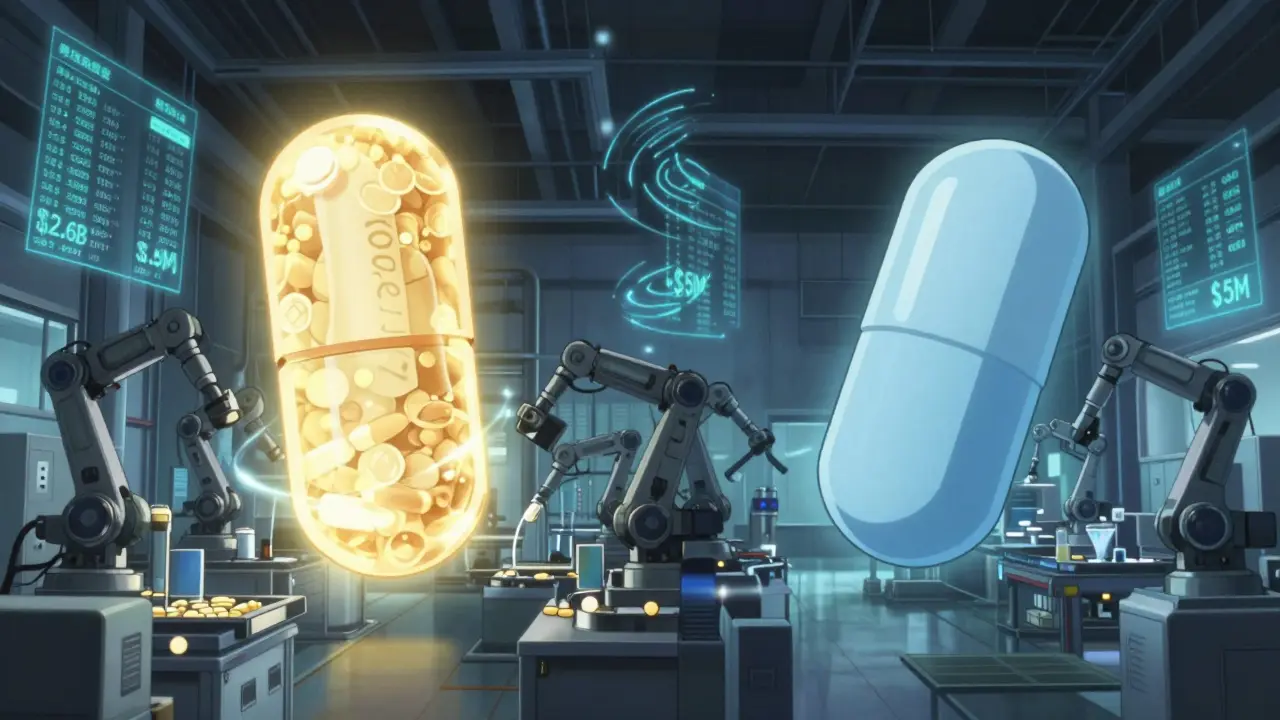
Generic drugs aren’t cheaper because they’re lower quality. They’re cheaper because they skip the most expensive parts of drug development. While branded drugs spend $2.6 billion and over a decade on research, clinical trials, and marketing, generics only need to prove they work the same way. That’s it. No new science. No big advertising campaigns. Just a straightforward bioequivalence test that costs between $2 million and $5 million.
The hidden cost structure of generic production
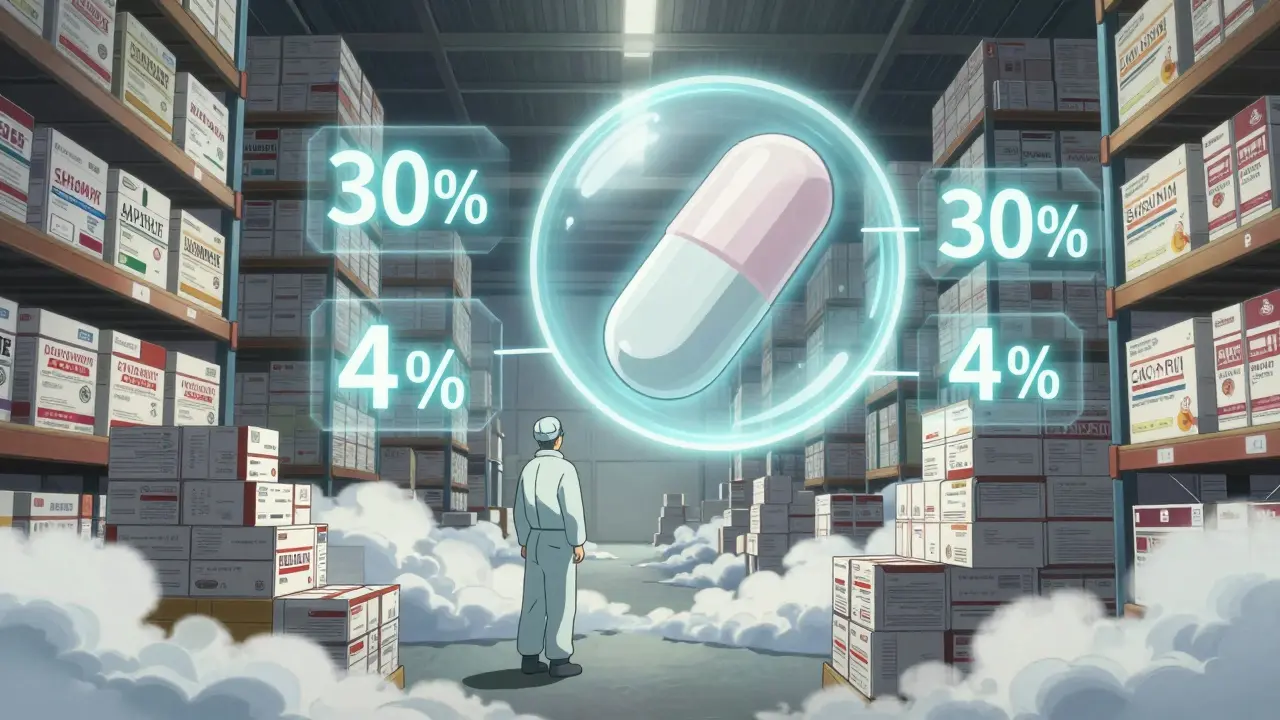
When you break down how much it actually costs to make a generic pill, the numbers are surprisingly tight. About 30% of the total production cost goes into manufacturing the active ingredient - the part that actually treats your condition. Another 4% covers logistics and supply chain. Packaging and quality checks take up another 3-5%. That’s it. No R&D. No patent lawyers. No celebrity endorsements.
The biggest variable? The active pharmaceutical ingredient (API). Its price can swing up or down by 20-30% in a single year based on where raw materials are sourced, weather disruptions, or geopolitical issues. But even with that volatility, the total cost per unit stays low because of scale.
Scale is the real advantage
One of the most powerful forces in generic manufacturing is volume. For every time a company doubles its production of a specific drug, the cost per unit drops by 18%. If they double production for a single pill type - say, 10mg lisinopril - the cost per pill can fall by as much as 45%.
This is why the biggest generic makers, like Teva and Sandoz, produce billions of pills a year. They don’t just make one drug. They make hundreds. That spreads fixed costs like quality control systems, regulatory compliance, and factory maintenance across a massive number of units. The result? A single tablet can cost less than a penny to produce.
Why branded drugs cost so much more
Branded drugs aren’t expensive because they’re better. They’re expensive because they have to pay back the cost of failure. For every drug that makes it to market, pharmaceutical companies spend years and billions on dozens of candidates that never work. That’s built into the price.
Plus, branded companies spend heavily on marketing - doctors’ visits, TV ads, patient support programs. They need to convince people to ask for their name-brand pill, even when a generic exists. That’s where the real markup happens. A branded version of cetirizine (an allergy drug) can cost 41% more than its generic twin. For fluoxetine (Prozac), it’s 33% higher. And those numbers aren’t outliers - they’re the norm.
Competition drives prices down - fast
Once a brand patent expires, the floodgates open. The first generic maker might price the drug at 50% below brand. The second? 60%. By the time six or more companies are making it, prices can drop by over 95%.
The FDA tracked 1,200 drugs and found that with just two generic competitors, prices were already 54% lower than the brand. With five or more, they often fall below 10% of the original price. That’s not just competition - it’s a race to the bottom, and patients win.
But it’s not all cheap and easy
Not every generic is simple. Inhalers, injectables, and complex topical creams are harder to copy. The manufacturing process needs precision equipment, sterile environments, and specialized expertise. That’s why fewer companies make these types of generics - and why they cost more.
And there’s a dark side. The pressure to cut costs has led to supply chain fragility. In 2022, there were 350 drug shortages in the U.S., many tied to generic manufacturers shutting down plants because margins were too thin. When a single factory in India or China has a quality issue, it can knock out a whole class of pills nationwide.
Who’s really making money?
Here’s the twist: the biggest profit isn’t always with the generic maker. Sometimes, the same company that makes the branded drug also makes the generic version. In those cases, the retailer’s margin on the generic can be 201% to 1,016% higher than on the branded version. That’s because pharmacies know patients will choose the cheap option - and they mark it up accordingly.
Meanwhile, the generic manufacturer is barely breaking even. They’re running factories at full capacity, squeezing every penny out of production, and betting that volume will keep them alive. One percentage point of efficiency can mean the difference between staying in business or shutting down.
What’s changing now?
The game is shifting. In 2023, the FDA launched GDUFA III, a program that increases fees on generic manufacturers but also promises faster approvals - cutting review times from 40 months to 24. That means more generics hit the market faster, keeping prices low.
The Inflation Reduction Act is also forcing Medicare to negotiate drug prices. While it targets brand drugs first, the pressure will spill over. If Medicare pays less for a branded version, pharmacies will demand even lower prices for the generic.
Automation is another big factor. Companies are investing in continuous manufacturing - machines that run 24/7, producing pills without stopping. By 2027, this could cut generic production costs by another 20-25%.
The big picture: savings that matter
Generic drugs aren’t just a convenience. They’re a lifeline. In the U.S., generics make up 90.1% of all prescriptions filled - that’s over 8.9 billion pills a year. Yet they account for only 15.8% of total drug spending.
From 2023 to 2027, generic drugs are projected to save the U.S. healthcare system $1.7 trillion. That’s not a guess. It’s a projection based on real data from IQVIA and the Congressional Budget Office.
And it’s not just America. In India, 80% of prescriptions are for generics. In China, it’s 65%. People everywhere want affordable medicine. And generics deliver it.
What this means for you
If you’re paying for a brand-name drug, ask your pharmacist: is there a generic? More often than not, the answer is yes. And the difference isn’t just a few dollars - it could be hundreds or even thousands per year.
Don’t assume the branded version is better. It’s not. The FDA requires generics to be identical in active ingredient, strength, dosage, and performance. The only differences are the color, shape, or inactive fillers - none of which affect how the drug works.
Choosing a generic isn’t a compromise. It’s a smart financial decision that doesn’t cost you anything in quality - and saves you a lot in cash.
Are generic drugs as effective as brand-name drugs?
Yes. The FDA requires generic drugs to have the same active ingredient, strength, dosage form, and route of administration as the brand-name version. They must also be bioequivalent - meaning they work the same way in the body. Studies show no meaningful difference in effectiveness or safety between generics and their branded counterparts.
Why do generic pills look different from brand-name ones?
By law, generic drugs can’t look identical to the brand-name version, even if they work the same. This is to avoid trademark infringement. So manufacturers change the color, shape, or markings. But the active ingredient and how it’s absorbed by your body are identical. The differences are purely cosmetic.
Are there times when I should stick with the brand-name drug?
Rarely. For most medications - like blood pressure pills, antidepressants, or antibiotics - generics are the clear choice. But for drugs with a narrow therapeutic index (like warfarin or levothyroxine), some doctors prefer to keep patients on the same brand to avoid even tiny variations in absorption. If your doctor recommends sticking with brand, ask why - and whether switching is still safe.
Why do generic drug prices vary so much between pharmacies?
Generic prices vary because pharmacies negotiate different wholesale rates and set their own markups. Some discount chains offer generics for as little as $4 for a 30-day supply. Others charge more. Always compare prices - even between nearby pharmacies. Many pharmacies offer loyalty programs or discount cards that slash the cost further.
Do generic drugs have more side effects?
No. The FDA monitors adverse events for both brand and generic drugs. There’s no evidence that generics cause more side effects. If you notice a change after switching, it could be due to inactive ingredients (like dyes or fillers), which are harmless for most people but can rarely cause reactions. Talk to your doctor or pharmacist if you suspect an issue.
Is it true that generic drugs are made in the same factories as brand-name drugs?
Yes, often. Many brand-name companies also produce generics under different labels. Even the same production line might make both versions. The FDA inspects all facilities - whether they make brand or generic drugs - and holds them to the same standards. Where a drug is made doesn’t determine its quality.
9 Comments
Chuck Dickson January 19, 2026 AT 11:30
I used to think generics were sketchy until my dad switched to generic lisinopril and saved $200 a month. Same pill, same results. Why pay more when the science says it’s identical?
Pharmacies make bank on this. I’ve seen $4 generics at Walmart while CVS charges $15 for the same thing. Shop around, folks.
rachel bellet January 19, 2026 AT 20:25
The cost structure is misleading. You’re ignoring the opportunity cost of regulatory arbitrage. Generic manufacturers leverage FDA loopholes in bioequivalence protocols to bypass full pharmacokinetic profiling. This isn’t efficiency-it’s regulatory capture disguised as consumer savings.
And let’s not pretend the API cost volatility is benign. When China restricts export quotas for penicillin precursors, the entire U.S. supply chain destabilizes. This isn’t sustainable-it’s systemic fragility masked as affordability.
Pat Dean January 20, 2026 AT 03:49
China makes 80% of our generic APIs. Do you know what that means? We’re literally dependent on a hostile foreign power for our medicine.
And you’re celebrating this? This isn’t ‘smart savings’-it’s national security failure. If they cut off supply, we’re dead in the water. And the FDA? They inspect these plants once every 5 years. That’s not oversight. That’s negligence.
Max Sinclair January 21, 2026 AT 14:41
I appreciate the breakdown. One thing I’d add is that the 90%+ usage rate of generics in the U.S. isn’t just about price-it’s trust. Patients have tested them, doctors have prescribed them, and the data backs them up.
It’s not magic. It’s science. And it’s working.
christian Espinola January 22, 2026 AT 23:15
They’re lying about the ‘same quality’. I know a guy who worked at a generic plant in India. They reuse filters. Skip stability tests. The FDA doesn’t catch it because they’re understaffed and bribed. You think your $5 pill is safe? It’s a lottery.
And don’t get me started on the ‘same factory’ myth. That’s PR spin. The same line? Sure. But one side is inspected, the other isn’t. You’re being played.
Dayanara Villafuerte January 24, 2026 AT 03:02
Generic drugs: the only time being cheap is a virtue 😌💊
My pharmacist gave me a $4 version of my antidepressant. Same chemical. Same results. My wallet cried tears of joy. Meanwhile, my friend still pays $120 for the branded one because ‘it’s better’. Bro. It’s not. It’s just prettier packaging. 🤦♀️
kenneth pillet January 25, 2026 AT 01:58
I switched to generic metformin last year. No difference. Cost went from $75 to $8. The only thing that changed was my bank account.
Pharmacies mark them up like crazy though. Same pill. Different price. Weird.
Jay Clarke January 25, 2026 AT 16:46
This isn’t about medicine. It’s about capitalism. We’ve turned healthcare into a casino. The branded companies gamble on R&D. The generics gamble on volume. The patients? We’re the ones who lose when the factory in Bangladesh shuts down and we can’t get our blood pressure meds.
It’s not a system. It’s a house of cards. And we’re all just waiting for the wind to blow.
Selina Warren January 27, 2026 AT 09:58
You think this is about cost? It’s about power. The pharmaceutical industry doesn’t want you to know that a pill can cost a penny to make. They need you to believe that expensive = better. That’s how they keep you hooked.
Generics are the only real rebellion left in this broken system. Every time you choose the $5 version, you’re telling them: ‘I see through your lies.’
Don’t stop. Keep choosing the truth. Even if it’s plain white.