

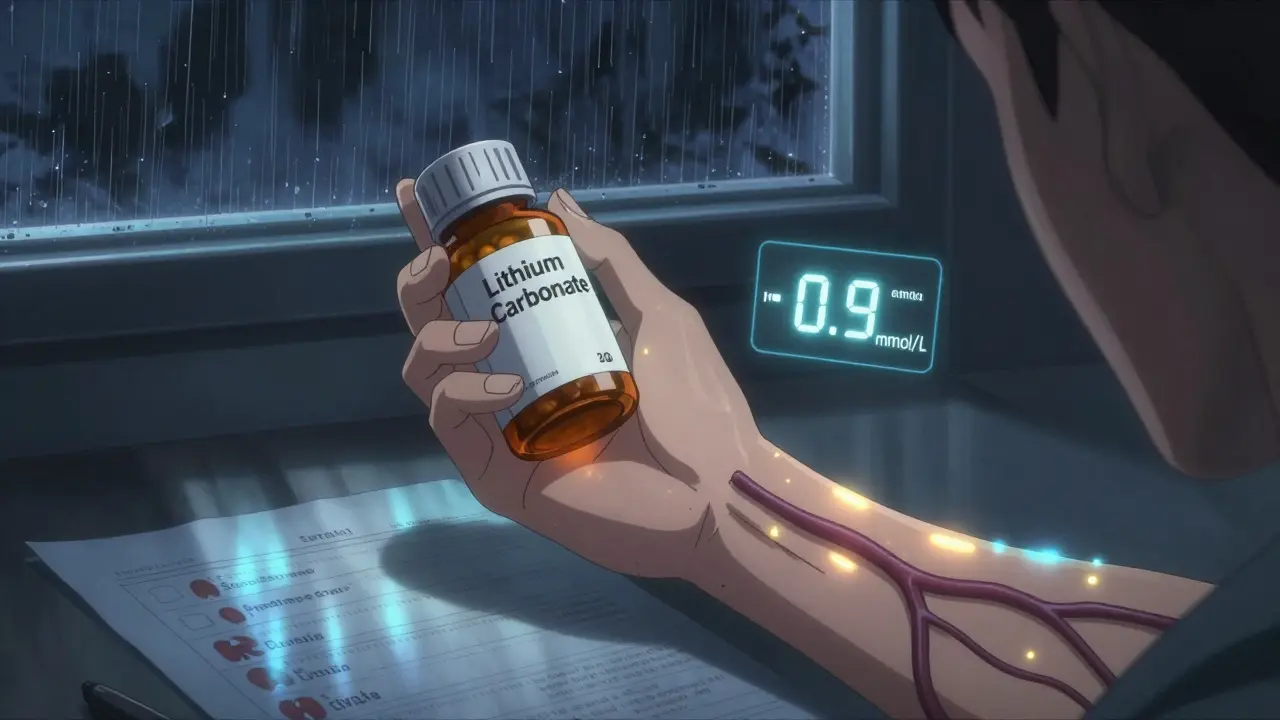
When you're managing bipolar disorder with lithium carbonate, the difference between feeling stable and crashing into depression or mania can come down to a fraction of a millimole per liter. That’s not a typo. We’re talking about levels between 0.6 and 1.2 mmol/L. Too low? The mood swings come back. Too high? You risk tremors, confusion, even seizures. And if you switch from one generic brand to another - which many patients do to save money - your blood levels can shift without you even knowing it.
Why Lithium Isn’t Like Other Medications
Most drugs have a wide safety margin. Take ibuprofen: 200 mg, 400 mg, 800 mg - you can adjust within reason without danger. Lithium doesn’t work that way. It’s a narrow therapeutic index drug, meaning the gap between a helpful dose and a toxic one is razor-thin. This isn’t theoretical. Studies show that patients with levels above 1.5 mmol/L are at risk for serious toxicity. Levels over 2.0 mmol/L can cause cardiac arrhythmias or coma.The reason? Lithium doesn’t just float around in your blood. It crosses into your brain, where it affects neurotransmitters like serotonin and dopamine. But here’s the catch: brain levels are roughly half of what shows up in your serum. So if your blood level is 1.0 mmol/L, your brain might be seeing 0.5-0.7 mmol/L. That’s why you can’t just guess your dose. You need a lab test.
Generics Aren’t Always Interchangeable
All FDA-approved generic lithium carbonate must prove they’re bioequivalent to the brand-name version - meaning their absorption and peak concentration fall within 80-125% of the original. Sounds fair, right? But here’s what that doesn’t tell you: two generics can both meet that standard and still behave differently in your body.A 2024 study in the Journal of Psychopharmacology looked at patients switched between Camcolit and Priadel, two sustained-release generics. Even when doses were identical, Camcolit users ended up with 11% higher average serum levels. Why? Because the way the drug is released from the pill matters. Camcolit releases lithium more slowly than Priadel, meaning it builds up differently over time. One pill might say “200 mg lithium carbonate,” but if it’s a different formulation, your body absorbs it at a different pace.
That’s not a flaw in the generics. It’s how extended-release drugs work. But it’s a problem if you’re switched from one to another without a blood test. One patient in the study had their lithium level jump from 0.9 mmol/L to 1.88 mmol/L after a pharmacy substitution - a near-toxic spike. No symptoms at first. No warning. Just a lab result that nearly cost them their life.
When and How to Test Your Levels
Timing matters more than you think. If you take a standard-release lithium pill three times a day, your blood should be drawn 12 hours after your last dose - usually right before your morning pill. That’s when levels are lowest and most stable. If you’re on a once-daily extended-release tablet, the test should be done 24 hours after your last dose. Miss that window, and your result could be misleading.Doctors often skip this detail. But if your test is drawn too soon after a dose, your level will look artificially high. Too late? It’ll look too low. Either way, your doctor might adjust your dose based on bad data. That’s how people end up overmedicated or undermedicated.
During the first few months of treatment, you’ll need tests every week or two. Once you’re stable, every 3-6 months is typical. But if you change brands, start a new medication, gain or lose weight, or get sick with the flu or dehydration - get tested again. Lithium is cleared by your kidneys, and anything that affects kidney function - like NSAIDs, diuretics, or even a week of low fluid intake - can send your levels soaring.

Target Levels: What’s Right for You?
There’s no one-size-fits-all number. The American Psychiatric Association says 0.8-1.0 mmol/L is ideal for acute episodes. For long-term maintenance? 0.6-0.8 mmol/L. But that’s just a guideline.For older adults - especially over 60 - many experts recommend lowering targets by 20-25%. Why? Kidney function declines with age. Lithium hangs around longer. A level of 0.8 mmol/L might be safe for a 30-year-old but dangerous for an 80-year-old. A 2024 study found patients over 80 were prescribed, on average, 437 mg less lithium per day than those under 30 - not because they needed less, but because doctors learned the hard way.
Women also tend to need lower doses than men, even when adjusted for weight. One study showed women received 96 mg less daily on average. Again, not because they’re “smaller,” but because their metabolism and body composition affect how lithium is processed.
And here’s something most patients don’t know: if you’re on a sustained-release brand like Priadel or Camcolit, your target should be at the top end of the range - 0.8-1.0 mmol/L. Why? Because these pills release lithium slowly, so your peak level is lower than with immediate-release versions. If you aim for 0.6 mmol/L with a sustained-release pill, you might not be getting enough drug in your brain.
What Else You Need to Monitor
Lithium doesn’t just affect your mood. It affects your kidneys, thyroid, and electrolytes.Every 6-12 months, you need a blood test for:
- Thyroid function (TSH, free T4) - lithium can cause hypothyroidism in up to 15% of users
- Renal function (creatinine, eGFR) - lithium can damage kidneys over time
- Sodium levels - low sodium can cause lithium to build up dangerously
Since 2022, guidelines have started recommending eGFR-cystatin C instead of creatinine alone for better accuracy in older patients. Creatinine can be misleading if you’re muscular or frail. Cystatin C gives a clearer picture of kidney filtration.
Also, avoid NSAIDs like ibuprofen or naproxen. They reduce kidney blood flow, which causes lithium to stay in your system longer. Even a few days of these meds can push your levels into the danger zone. Use acetaminophen instead if you need pain relief.

What Happens When You Switch Generics
Pharmacies often substitute generics without telling you. It’s legal. It’s cheaper. But it’s risky with lithium.One patient in Oregon switched from Priadel to a no-name generic because her insurance changed. Three weeks later, she started vomiting, shaking, and couldn’t focus. Her serum level? 1.6 mmol/L. She ended up in the ER. The pharmacy didn’t know the new generic had a different release profile. Her doctor didn’t check her levels after the switch.
That’s why you need to:
- Ask your pharmacist if your lithium brand changed
- Request a serum level test within 1-2 weeks of any switch
- Keep a log of your brand name, dose, and last test date
There are about 12 FDA-approved generic lithium carbonate products in the U.S. Each has a different dissolution profile. Some release over 4 hours. Others over 8. You can’t assume they’re the same.
What’s Changing in 2026
The FDA is tightening rules for complex generics like extended-release lithium. Starting in 2025, manufacturers must prove equivalence through real human studies - not just lab tests. That’s because, as we’ve seen, pills that look identical on paper can behave very differently in the body.Researchers are also testing genetic markers that predict how fast someone metabolizes lithium. The International Consortium on Lithium Genetics has identified 30 genes linked to dose response. In the next five years, you might get a DNA test to help your doctor pick your starting dose.
Some clinics are already using AI tools that pull data from your EHR - age, weight, kidney function, recent labs - and suggest a personalized lithium dose. It’s not perfect yet, but it’s getting closer.
Bottom Line: Don’t Assume, Test
Lithium is one of the most effective mood stabilizers we have. It cuts suicide risk by up to 80% in bipolar disorder. But it’s not a set-it-and-forget-it drug. It demands attention.If you’re on a generic lithium brand:
- Know which one you’re taking - write it down
- Never switch without checking your serum level
- Get tested after any illness, dehydration, or new medication
- Ask for thyroid and kidney checks twice a year
- Use acetaminophen, not ibuprofen, for pain
There’s no shame in needing a blood test every few months. It’s not a failure. It’s how you stay safe. Lithium isn’t a pill you take because it’s cheap. It’s a tool you use because it works - but only if you treat it with the care it demands.
8 Comments
Bryan Wolfe January 13, 2026 AT 07:16
Lithium is one of those meds that feels like walking a tightrope blindfolded - but when it works? Absolute game changer. I’ve been on it for 12 years, and yeah, I get tested every 4 months like clockwork. No excuses. My pharmacist knows me by name now, and I always ask if the brand changed. One time they switched me to a generic without telling me - I felt like a zombie for a week. Blood test showed 1.7. Scary stuff. Don’t let your insurance decide your mental health.
Jennifer Phelps January 14, 2026 AT 21:09
So if you switch generics and don't get tested you could end up with toxic levels even if you take the same mg dose and feel fine at first that's wild
beth cordell January 16, 2026 AT 10:08
THIS. 🙌 I switched brands last year and didn’t realize until I was crying in the grocery store for no reason and my hands wouldn’t stop shaking. 🤯 Lab said 1.8. ER trip. Now I have a sticky note on my pill bottle with the brand name and my last level. My therapist says I’m obsessive. I say I’m alive. 💪
Lauren Warner January 18, 2026 AT 06:31
People treat lithium like it's vitamin D. It's not. You're not a responsible adult if you don't get your levels checked after every single pharmacy change. This isn't about being paranoid - it's about not dying. And if your doctor doesn't bring it up, fire them. Seriously. This is basic safety. You wouldn't swap out insulin brands without testing. Why is lithium any different?
Craig Wright January 19, 2026 AT 13:59
It is deeply concerning that the United States permits such a critical medication to be substituted without mandatory monitoring. In the United Kingdom, all lithium prescriptions require a signed patient consent form acknowledging the risks of generic substitution. We have a duty of care. Here, it appears to be an afterthought driven by cost-cutting. This is not medical practice - it is negligence dressed as efficiency.
Ben Kono January 20, 2026 AT 23:27
I'm on Camcolit and my doc says 0.8 is perfect. I've been stable for 3 years. I take my levels seriously but I don't freak out every time I get a new bottle. Most generics are fine. Don't turn this into a panic.
Windie Wilson January 21, 2026 AT 07:08
So let me get this straight - you're telling me that a pill that costs $3 instead of $15 might turn me into a trembling, vomiting mess… and the pharmacy doesn’t even have to tell me they switched it? 🤡 I’m not mad, I’m just disappointed in America’s healthcare system. Also, why is acetaminophen suddenly the new hero? I thought it was just the stuff your grandma takes for headaches.
Jose Mecanico January 22, 2026 AT 23:28
I’ve been on lithium for 8 years. I switched from Priadel to a no-name generic once because my insurance flipped. I didn’t get tested. Two weeks later I got really dizzy and my speech got slurred. I thought it was just stress. Turns out my level was 1.6. I was lucky I didn’t have a seizure. Now I keep a little notebook: date, brand, dose, level. I show it to my doctor every visit. It’s not glamorous. But it keeps me alive.