

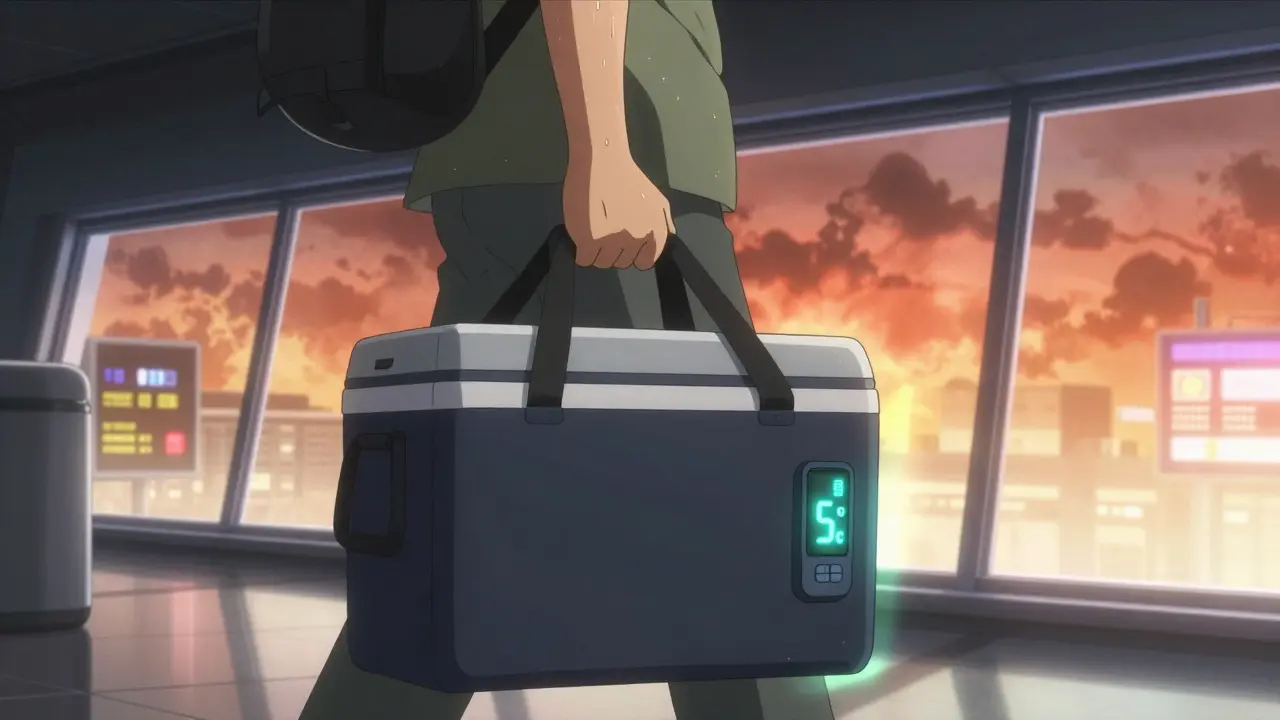
When you're traveling with medications like insulin, vaccines, or certain antibiotics, the weather outside can be just as dangerous as the road itself. A car seat in 95°F heat or a suitcase left on a frozen airport tarmac can ruin your medicine-no warning, no second chances. You might think, "It’s just a pill," but for many drugs, even a few hours outside the right temperature range can make them useless-or worse, harmful.
Know Your Medicine’s Temperature Needs
Not all medications are the same. Some can handle room temperature. Others need to stay cold. The three main categories are:- Ambient (15°C-25°C / 59°F-77°F): Most pills, capsules, and some liquid antibiotics. These are the easiest to transport. Just keep them out of direct sun and don’t leave them in a hot car.
- Refrigerated (2°C-8°C / 36°F-46°F): Insulin, many biologics, some vaccines, and certain injectables. These are the most common culprits for temperature-related failures. If your insulin looks cloudy or has particles, it’s likely degraded.
- Cryogenic (below -150°C): Only for specialized treatments like some mRNA vaccines or tissue samples. Most travelers won’t encounter this, but if you do, you’ll need professional shipping services.
Check the label. If it says "Store in refrigerator," assume it means always-even during transport. The FDA says pharmaceutical quality is determined by maximum temperature exposure, not average. One hour at 35°C can ruin a vial that’s fine at 25°C.
Hot Weather: Don’t Let Your Medicine Cook
Summer heat is the biggest threat to travelers. A car parked in the sun can hit 65°C (150°F) inside-even with the windows cracked. That’s hotter than an oven.Here’s what works:
- Keep meds in your carry-on. Never check them. Baggage holds can get hotter than your car.
- Use a small insulated cooler bag with frozen gel packs. A standard lunch-sized cooler with two ice packs can keep insulin at 2°C-8°C for up to 8 hours in 32°C weather.
- Wrap the cooler in a towel. It slows heat transfer. Don’t let the ice packs touch the medication directly-use a barrier like a cloth or paper towel to prevent freezing.
- Avoid leaving meds in the car. Even for 10 minutes. If you’re stopping for gas, take the meds with you.
- Use a temperature logger. Devices like the TempAid 2.0 record real-time temps and alert you if things get too hot. They cost $50-$100 but have saved thousands of dollars in ruined insulin.
One Reddit user reported their insulin turned cloudy after being left in a 95°F car for 45 minutes. The pharmacist confirmed it was degraded. No more effect. No refund. Just wasted money and risk.
Cold Weather: Don’t Freeze Your Medicine
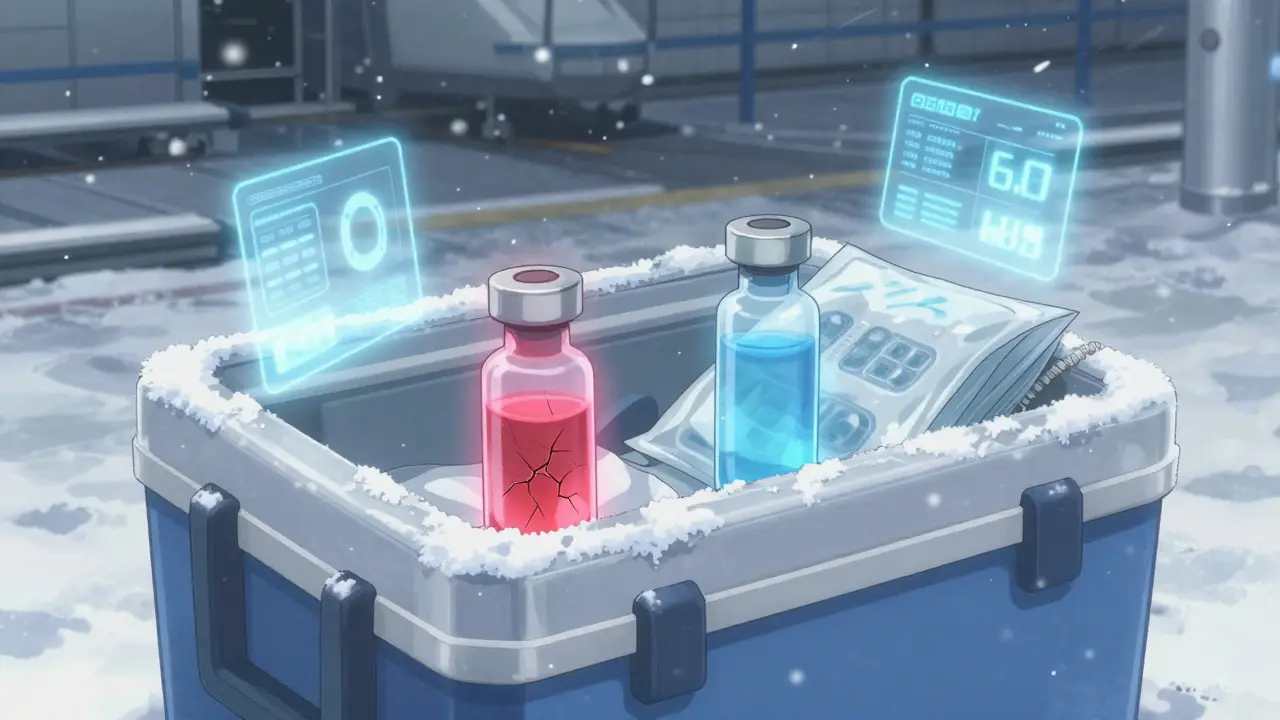
Cold is just as dangerous as heat. Insulin can freeze at -2°C. Once frozen, even if it thaws, the structure breaks down. Vaccines like MMR lose potency fast when exposed to freezing temps.Winter travel tips:
- Keep meds close to your body. A jacket pocket or waistband is better than a backpack in sub-zero weather.
- Use insulated packaging with phase-change materials. These are designed to stay between 2°C-8°C even when outside is -20°C.
- Never leave meds in an unheated car overnight. If you must, wrap them in a thermal blanket and store them inside your home before the trip.
- At airports, ask for a temperature-controlled area during security screening. Some major hubs have them. If not, carry your meds in your carry-on and request a hand inspection.
- For extended cold exposure (like a multi-day ski trip), use a hybrid cooler with battery-powered active cooling. These cost more but can maintain temperature for 72+ hours.
During the 2022-2023 winter, Pfizer reported 17% more temperature excursions below range than above-mostly because transport vehicles weren’t designed for extreme cold. If it’s below -20°C, even a 5-minute transfer from plane to van can be too long.
What Not to Use
Don’t rely on these common mistakes:- Regular water bottles: They don’t insulate. Ice melts too fast.
- Styrofoam coolers from pharmacies: These are meant for short trips, not long flights or road trips.
- Freezer packs alone: They can freeze your meds if placed directly against them.
- Room temperature storage for insulin: Even if the label says "can be kept at room temp for 28 days," that’s for storage, not transport in extreme weather.
There’s a reason the WHO says: "Procedures should be qualified to ensure appropriate conditions under probable extremes." You’re not just carrying medicine-you’re carrying your health.
Traveling by Air
Airports are a minefield for temperature-sensitive meds. Here’s how to handle it:- Carry a doctor’s note. It helps with security, even if not required.
- Use a clear, labeled cooler. TSA allows medical coolers through screening. Declare them at the checkpoint.
- Don’t let your bag sit on the jet bridge. Wait until you’re inside the terminal to open it.
- If your flight is delayed, keep your meds with you. Don’t trust gate agents to watch your bag.
- Some airlines offer refrigerated storage for medical items. Ask ahead.
According to a 2023 Varcode survey, 68% of pharmacists saw at least one temperature excursion during summer months-and most happened during the final delivery, not the flight. The same applies to travelers. The last 10 minutes matter.
What to Pack
Here’s a simple checklist for your travel kit:- Insulated cooler bag (food-grade, leak-proof)
- Two frozen gel packs (or phase-change packs)
- Thermal wrap or towel (to buffer direct contact)
- Temperature data logger (optional but highly recommended)
- Original prescription labels (in case of questions)
- Extra doses (in case of loss or damage)
- Doctor’s note (for international travel or security)
Brands like TempAid 2.0, MedAngel, and Arno have been tested in real-world conditions and hold 2°C-8°C for 48 hours. They’re heavy (around 1.5 kg), but worth it if your life depends on it.
Documentation Matters
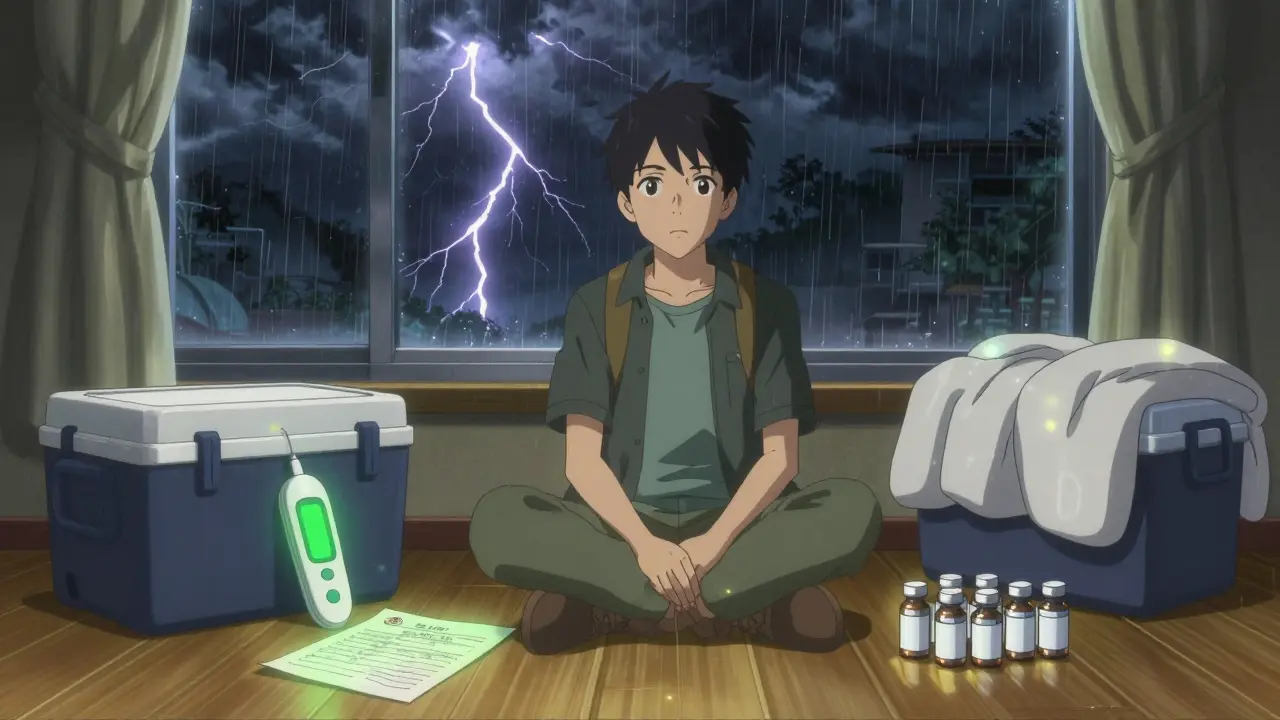
The IATA says: "A properly transported shipment without documentation is considered out of specification."That applies to you, too. Keep a log:
- Date and time you packed the meds
- Starting temperature
- Temperature readings every 4-6 hours (if using a logger)
- Where you stored the meds during stops
If you ever need to prove your meds were handled correctly-like if you’re denied refills abroad or face a medical emergency-you’ll need this. The FDA requires records kept for 3 years after expiration. You don’t need to be that formal, but a quick note in your phone can save you.
What If It’s Already Damaged?
If your insulin looks cloudy, clumpy, or has particles-stop using it. Same with vaccines that look discolored or have sediment. Even if it still looks fine, if it was left in a hot car for more than an hour, assume it’s compromised.Call your pharmacy or doctor. Don’t guess. Many insurance plans cover replacement meds in cases of accidental exposure. You’re not being paranoid-you’re being smart.
One study found that shipments with real-time monitoring had 92% fewer temperature excursions than those using old-school max-min thermometers. You don’t need a $500 device. Even a $30 Bluetooth thermometer that connects to your phone can give you peace of mind.
Final Rule: When in Doubt, Keep It Cool
Most medications are designed to stay between 2°C and 25°C. That’s the sweet spot. If you’re unsure, err on the side of caution. Keep it cool, keep it dry, keep it with you.Climate change is making extreme weather more common. The CDC says we’re seeing unprecedented temperature challenges in pharmaceutical transport. You’re not just following rules-you’re protecting your health in a world that’s getting harder to navigate.
Next time you pack your meds, think like a logistics expert. Not a tourist. Your life depends on it.
14 Comments
Cheryl Griffith January 15, 2026 AT 12:11
I used to just toss my insulin in my purse and hope for the best. Then I left it in a hot car for 20 minutes during a road trip and woke up with a panic attack thinking I'd ruined my dose. Never again. That insulated cooler trick? Game changer. I got one with a little pocket for my phone so I can check temps without opening it. Peace of mind is worth the extra weight.
Also, never trust airport staff to "watch" your bag. I saw a guy leave his cooler on the jet bridge for 15 minutes while he went to the bathroom. His insulin was useless by the time he got back. Don't be that guy.
Kasey Summerer January 16, 2026 AT 07:48
So let me get this straight… we’re now treating insulin like a fine wine that needs climate control? 🤦♂️
My grandma took her meds in a sock and lived to 92. Maybe we’re just over-engineering survival.
Also, $100 temp logger? Bro, I use my phone’s weather app and it’s 90% accurate. Chill out.
Nicholas Gabriel January 18, 2026 AT 00:56
Thank you for this. As someone who manages multiple chronic conditions, I can't tell you how many times I've seen people treat meds like snacks. "Oh, it's just a pill." No. It's not. It's my ability to breathe, to walk, to not end up in the ER.
That FDA point about maximum exposure? Critical. I had a vial go bad because someone thought "room temp for 28 days" meant "leave it in a 90°F car for 3 hours." It didn't just fail-it caused a hyperglycemic episode that landed me in the hospital.
Also, the towel trick? Genius. I wrap my gel packs in old T-shirts now. No more frozen insulin. No more panic. Just calm, smart prep.
And yes, I carry extra doses. Always. Because if you're traveling with life-sustaining meds, you're not a tourist-you're a logistics officer for your own survival. Own it.
swarnima singh January 19, 2026 AT 23:43
you know what? i think this is all just a big pharma scam to sell you more coolers and sensors. why do you need a $50 device when your body knows what it needs? i used to keep my meds in my bra and i never had a problem. also, the government is lying about temps. they want you dependent on gadgets. trust your gut, not the label.
also, i heard the CDC is funded by big pharma. they just want you scared so you buy more stuff. it's all a lie.
Isabella Reid January 21, 2026 AT 08:40
As someone who travels internationally with biologics, I’ve had to explain this to customs agents in 5 countries. The doctor’s note? Non-negotiable. The cooler? Always carry-on. The towel? Always used.
One time in Delhi, they tried to X-ray my cooler like it was a laptop. I calmly showed them the label, the note, and the fact that my insulin was still cold to the touch. They let me through. No drama.
It’s not about being paranoid. It’s about being prepared. And honestly? If you’re traveling with meds like this, you’re already a hero. Don’t let anyone make you feel otherwise.
Jody Fahrenkrug January 23, 2026 AT 03:11
Just wanted to say I started using a simple insulated lunch bag with two gel packs after reading this. No fancy tech. Just a $12 bag from Target. Been on three trips since-zero issues.
Also, I keep my meds in my coat pocket when it’s cold. Feels weird at first, but you get used to it. And honestly? It’s nice to have them close. Like a little security blanket.
kanchan tiwari January 23, 2026 AT 12:22
THEY’RE WATCHING YOU. THEY KNOW YOU’RE CARRYING MEDS. THAT’S WHY THEY MAKE YOU CHECK YOUR BAGS-SO THEY CAN TAMP WITH THE TEMPERATURES AND MAKE YOU SICK ON PURPOSE. THE AIRPORTS ARE FULL OF SENSORS THAT TRACK YOUR MEDS. I SAW A MAN IN CHICAGO WHO HAD HIS INSULIN RUINED BY A "COOLING UNIT" THAT WAS ACTUALLY A HEATER. THEY WANT YOU TO BUY MORE.
THEY’RE ALSO LYING ABOUT THE TEMPERATURES. REAL INSULIN CAN SURVIVE -40°C. THEY’RE FAKING THE DATA TO CONTROL YOU.
STOP TRUSTING LABELS. TRUST THE UNIVERSE. AND NEVER, EVER USE GEL PACKS. THEY’RE FULL OF TOXINS.
Bobbi-Marie Nova January 23, 2026 AT 13:16
Okay but can we talk about how weird it is that we treat meds like fragile art but don’t treat the people who need them with the same care?
I get the logistics. I do. But why is it on the patient to be a temperature expert? Why isn’t the system built to make this easier? I mean, we have drones that deliver pizza in 10 minutes… but my insulin? I have to carry a cooler like I’m smuggling contraband.
Also, I love that you mentioned the doctor’s note. That’s so true. I had a TSA agent tell me I "didn’t need it." I handed it over anyway. He looked at it, paused, and said, "Damn. You’re right. Sorry."
Small wins, y’all.
Allen Davidson January 25, 2026 AT 09:06
Let me tell you something real: this isn’t about gadgets. It’s about discipline. I’ve been managing diabetes for 18 years. I’ve traveled to 27 countries. I don’t use a logger. I don’t use fancy packs. I use common sense and a little planning.
Keep meds on you. Don’t let them sit. Know your limits. If it’s hot, wear a shirt with a zippered pocket. If it’s cold, tuck it under your arm. Simple.
Don’t fall for the marketing. You don’t need a $100 device. You need to be present. Your body knows what’s happening. Pay attention.
And if you’re still worried? Pack extra. Always. That’s the real safety net-not a Bluetooth thermometer.
john Mccoskey January 25, 2026 AT 21:03
Let’s be brutally honest here: 90% of people who travel with insulin are doing it wrong. They read a blog like this, nod along, then go back to their old habits because it’s "too much effort."
You think a towel is enough? A towel won’t stop a 45-minute layover on a tarmac at 110°F. You think a $30 phone thermometer is enough? It’s not calibrated. It’s not certified. It’s a toy.
And don’t even get me started on the "I kept it in my pocket" crowd. Your body heat is 98.6°F. That’s not cold. That’s borderline dangerous for insulin if you’re in a desert. You’re not a human fridge. You’re a biological organism with variable output.
The WHO and FDA guidelines exist for a reason. Ignoring them isn’t bravery-it’s negligence. And when your meds fail, don’t come crying to me because you "didn’t have time." You had time. You just chose not to use it.
Ryan Hutchison January 27, 2026 AT 15:58
Why are we even talking about this? In America, we’ve got the best meds in the world. If you can’t handle a little heat or cold, maybe you shouldn’t be traveling. My cousin went to Mexico with his insulin and just kept it in his back pocket. He’s fine. No drama.
Everyone’s so soft now. Back in my day, we carried pills in a Ziploc and prayed. We didn’t need gadgets. We had grit.
Also, why are we listening to the WHO? They’re a bunch of bureaucrats who’ve never even been to a real airport. Let Americans handle their own medicine. We don’t need global rules for this.
Samyak Shertok January 28, 2026 AT 18:57
Wait-so we’re now treating medicine like a baby who needs a temperature-controlled nursery? How about we just… let nature take its course?
Insulin’s been around since 1921. People survived wars, famines, and blackouts without insulated bags. Why are we so afraid of a little heat or cold?
Also, why does every single comment assume everyone has $100 to spend on a logger? What about the rest of us? The ones who live paycheck to paycheck? Who can’t afford a "phase-change material"? Are we just supposed to die quietly?
And who decided that "2°C to 8°C" is the magic number? Who’s funding that study? I bet it’s the same people selling the coolers.
Just saying… maybe the real problem isn’t the weather. It’s the system that made us think we need to be scientists just to stay alive.
waneta rozwan January 28, 2026 AT 23:29
Look, I get it. You’re trying to be helpful. But this post is full of fearmongering. You say "one hour at 35°C ruins insulin"-but you don’t cite a single peer-reviewed study. You quote Reddit users and a survey from a company that sells temperature loggers.
Real science? Insulin can withstand 37°C for up to 6 weeks without degradation. That’s WHO data. You’re cherry-picking worst-case scenarios to sell a product.
And the "don’t leave it in the car" rule? That’s not universal. In many countries, people don’t have cars with AC. They don’t have coolers. They have shade. And they’re fine.
Stop scaring people. Empower them. Don’t turn medicine into a horror movie.
Allen Davidson January 30, 2026 AT 23:15
Waneta, you’re not wrong about the fearmongering. But here’s the thing: the FDA doesn’t just make up those numbers. They test under worst-case conditions because they have to assume the worst. Real-world data shows that even 1–2 hours above 30°C can cause measurable degradation in some insulin batches.
And yes, people in low-resource settings manage. But that doesn’t mean we should normalize avoidable risk. We have the tools now. Why not use them?
I’m not selling anything. I’m just saying: if you have access to a $12 cooler and a towel, why wouldn’t you use them? It’s not about fear. It’s about minimizing risk. Especially when your life depends on it.