


Imagine the panic of a sudden ER visit where the doctor asks, "What exactly is your father taking?" and you're staring at a dozen different orange bottles with confusing labels. It happens more often than you'd think. In fact, medication errors cause about 7,000 deaths every year in the U.S. alone. When a senior is dealing with polypharmacy - taking five or more medications daily - the risk of an adverse drug event jumps by 88%. Keeping a precise, updated list isn't just about being organized; it's a literal lifesaver.
If you're stepping into a caregiving role, you might feel overwhelmed by the sheer volume of pills and supplements. The goal here isn't to turn you into a pharmacist, but to create a reliable reference tool that eliminates guesswork. Whether you prefer a classic notebook or a smartphone app, the key is consistency. By the end of this guide, you'll have a system that prevents duplicate therapies and ensures your loved one gets the right dose at the right time.
The Essential Ingredients of a Complete List
A simple list of names isn't enough. If a doctor is trying to stabilize a patient in a crisis, they need specifics. To avoid the 92% of errors that stem from incomplete timing or food instructions, your list needs to be granular. Every entry should include:
- The Full Name: List both the brand name and the generic name. This prevents confusion if the pharmacy switches brands.
- Exact Dosage: Don't just write "Lisinopril"; write "Lisinopril 10mg."
- Frequency and Timing: Be specific. Instead of "twice daily," use "8:00 AM and 8:00 PM."
- The "Why": Note the purpose (e.g., "for high blood pressure" or "for anxiety"). This helps you spot if two different doctors have prescribed two different drugs for the same thing.
- Special Instructions: Note if it must be taken with food or if the pill should not be crushed.
- Prescribing Info: Which doctor ordered it and which pharmacy fills it?
- The Stop Date: For antibiotics or short-term steroids, always mark when the medication should end to prevent unnecessary long-term use.
For those managing very complex regimens, adding the National Drug Code (NDC) number from the bottle can reduce dispensing errors by nearly 30%. It's the unique "social security number" for that specific drug.
Choosing Your Tool: Paper vs. Digital
There is no "perfect" system, only the system you will actually use. Many caregivers struggle with digital tools-about 71% of people abandon medication apps within three months because they are too clunky. On the other hand, paper lists can be hard to share quickly with a distant family member.
| Feature | Paper List / Binder | Digital Apps (e.g., Medisafe) |
|---|---|---|
| Ease of Setup | High (Just need a pen) | Medium (Requires account/input) |
| Emergency Access | Instant (if physically present) | Fast (if phone is available) |
| Error Reduction | Moderate | High (42% lower error rate for 4+ drugs) |
| Update Speed | Slow (Manual rewrite) | Fast (Quick edit) |
| Accessibility | Local only | Shareable via cloud/email |
The professional recommendation? Use a hybrid approach. Keep a master paper list (or a laminated chart with pill photos) in the kitchen or wallet for emergencies, and use a digital backup for daily reminders and sharing with the rest of the family.
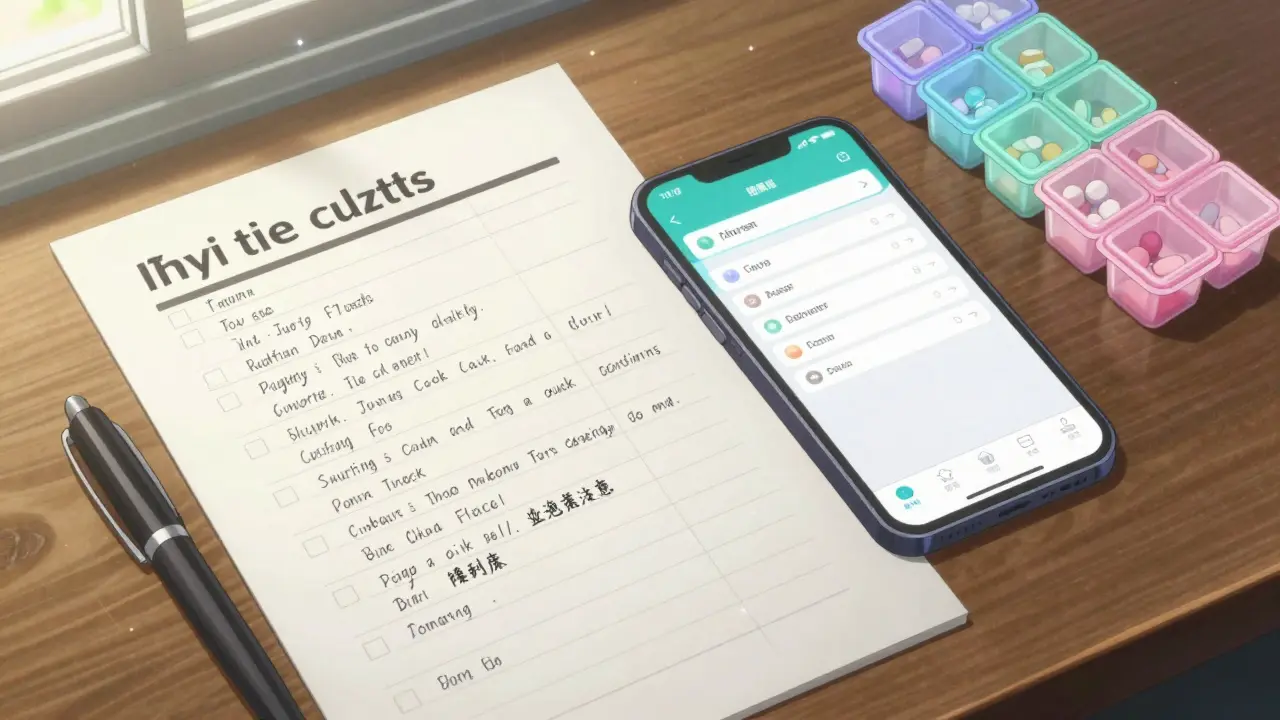
Step-by-Step Setup Guide
Setting up your system takes a bit of heavy lifting upfront, but once it's running, it only takes about 15 minutes a week to maintain. Here is how to do it right:
- The Great Inventory (2-3 Hours): Gather every single bottle, blister pack, and vitamin from every drawer and cabinet. Don't forget the "as needed" (PRN) meds tucked away in a bedside table.
- The Documentation Phase: Use a standardized checklist to record the details mentioned above. Give yourself about 10 minutes per medication to ensure you aren't rushing.
- Chronological Mapping: Instead of listing meds by importance, list them by the time they are taken. This creates a natural workflow for your daily routine.
- Create Backups: Print a copy for the fridge, one for the caregiver's wallet, and one to keep in the patient's bag. Save a PDF version on a shared cloud drive for family members.
- Set an Update Ritual: Schedule a recurring event-Sunday evenings work best for most-to review the list. If a doctor changes a dose on Tuesday, update the list within 24 hours. Outdated records are linked to 78% of senior hospital readmissions.
- The Provider Sync: Share the finalized list with every doctor the patient sees. This prevents the dangerous scenario where a cardiologist prescribes something that interferes with a neurologist's medication.

Handling the Tricky Parts
Not all medications are straightforward. You'll likely run into a few common hurdles that can throw your organization off.
"As Needed" (PRN) Medications: Things like pain relievers or anti-anxiety meds don't fit into a strict schedule. Don't mix these into your daily timeline. Instead, create a separate "PRN Log" where you record the date, time, and reason the medication was given. This prevents accidental overdosing.
The Supplement Blur: Many people treat vitamins and herbal supplements as "not real medicine," but they can cause serious interactions. Treat supplements exactly like prescriptions on your list. Note the dosage and the brand, as quality varies wildly.
Hospital Transitions: This is the danger zone. Discharge instructions often clash with what's already on your list. When leaving a hospital, use the "brown bag method": put every current medication in a physical bag and hand it to the discharging nurse. Ask them to cross-reference the bag with the new discharge orders right there in the room.
Pro Tips for Long-Term Success
If you've been doing this for a while, you know that fatigue is the biggest enemy. Here are a few ways to keep the system from collapsing:
- Color Coding: Use highlighters to categorize meds (e.g., yellow for morning, blue for evening, red for urgent/PRN). This reduces visual clutter and mistakes.
- Medication Synchronization: Ask your pharmacy about "med sync" services. They can align all refill dates to one day a month, which automatically keeps your digital lists and refill schedules in sync.
- The Quarterly Pharmacist Review: If your loved one takes five or more drugs, schedule a formal review with a pharmacist every three months. They are trained to spot "prescribing cascades," where one drug is given to treat the side effect of another.
- The Caregiver's Notebook: Use a three-ring binder with tabs for "Current Medications," "Doctor Contact Info," and "Questions for Next Visit." Having a dedicated spot for everything prevents the "where did I put that paper?" panic.
What should I do if the doctor's office gives me a list that differs from mine?
Do not guess. Immediately flag the discrepancy to the provider. Ask them specifically, "My records show X dose, but your list says Y; which is the current correct version?" Document the date and time they confirmed the change and update all copies of your list immediately.
How do I handle medications from three different specialists?
Designate one primary care provider (PCP) as the "medication coordinator." Every time a specialist changes a dose, send a copy of the updated list to the PCP. This ensures one doctor has the "master view" and can check for dangerous drug-drug interactions.
Are there free tools I can use instead of expensive software?
Yes. The FDA's "My Medicines" template is a free, evidence-based resource. Additionally, many pharmacies offer free digital tracking through their own apps. If you prefer tech-free, a simple shared Google Sheet (accessible via a tablet or phone) works effectively for most families.
How often do I really need to update the list?
Any change-even a small dose adjustment-requires an update within 24 hours. However, a full audit of the list (checking for expired meds or pills that are no longer needed) should happen at least once a quarter or after any hospital stay.
What is the 'brown bag method' and why is it helpful?
The brown bag method involves placing every single medication, supplement, and cream the patient is taking into one physical bag and bringing it to every appointment. This allows the doctor to see the actual bottle and dose, eliminating errors caused by the patient or caregiver misremembering a name or dosage on a written list.