

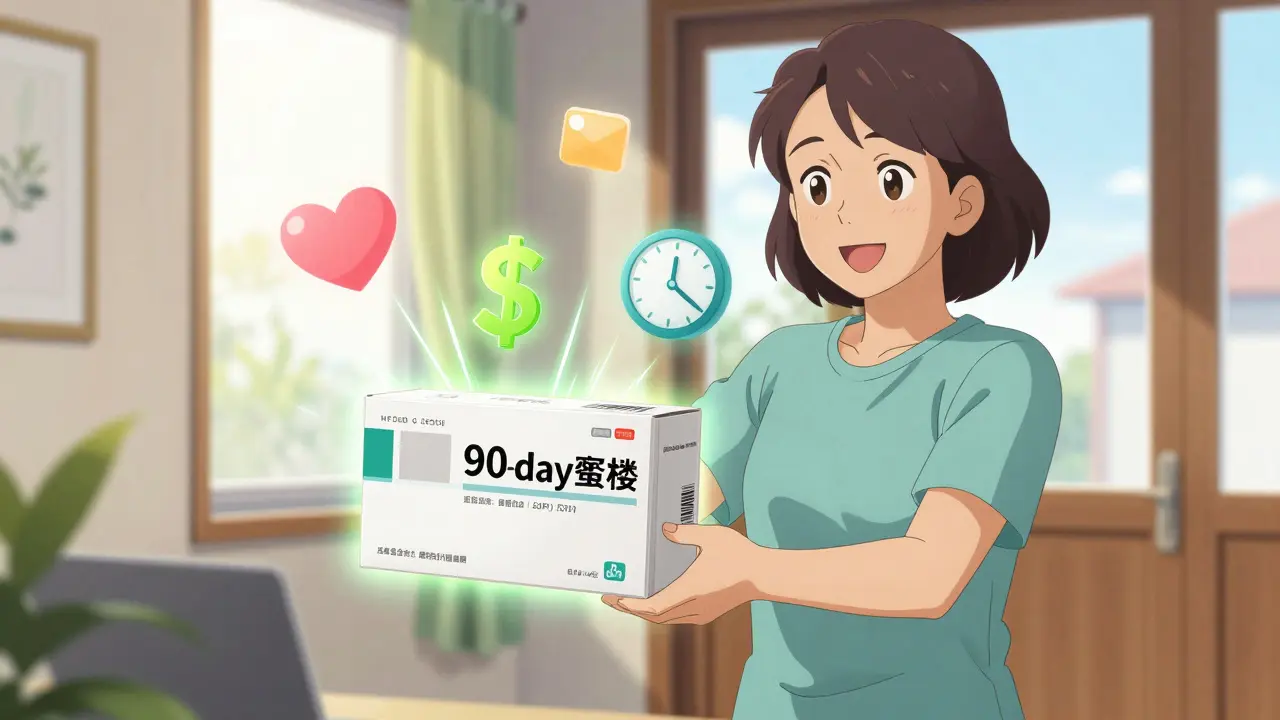
Getting your prescriptions filled for 90 days instead of 30 can save you serious money-sometimes over $30 a year per medication. And it’s not just about saving cash. It means fewer trips to the pharmacy, less chance of running out, and better control over your health. If you take medication for a long-term condition like high blood pressure, diabetes, or high cholesterol, you’re already paying for it every month. Why not get three months’ worth at the same price as one?
How 90-Day Fills Save You Money
Most insurance plans charge the same copay whether you get 30 days or 90 days of medication. That means if your copay is $4.90 for a 30-day supply, you pay that same $4.90 for 90 days. You’re getting three times the pills for the same price. Over a year, that’s up to $39.20 saved on just one medication. Multiply that by three or four meds you take regularly, and you’re talking about over $150 in savings annually-without changing anything else.
Mail-order pharmacies often make this even easier. Services like CVS Caremark Mail Service or HPSM’s Postal Prescription Services (PPSRX) deliver your 90-day supply right to your door, usually at no extra shipping cost. Retail pharmacies like CVS and Walgreens now offer 90-day fills right in-store too. So whether you prefer picking it up or having it delivered, the option is there.
Who Qualifies for a 90-Day Prescription
You don’t need special permission or a complex application. Most people on long-term medication qualify. The rules are simple:
- You’re taking the medication for a chronic condition-like high blood pressure, diabetes, thyroid issues, or cholesterol.
- You’ve already been taking it for a while and it’s working well.
- Your doctor has written at least one refill on the prescription.
Insurance companies and pharmacy benefit managers (PBMs) require this because they want to make sure you’re stable on the drug before giving you a longer supply. If you just started a new medication, you might need to wait 30 to 60 days before switching to a 90-day fill. But once you’re settled, you’re golden.
How to Get a 90-Day Prescription
There are two ways to get a 90-day supply. Neither is complicated.
- Ask your pharmacy-If your prescription still has refills left, you can walk into any in-network pharmacy and ask for a 90-day fill. They’ll check your insurance plan, confirm eligibility, and dispense the full three-month supply. No new prescription needed.
- Ask your doctor-If your prescription has no refills left, or if your insurance requires it, ask your doctor to write a new prescription for a 90-day supply. Most doctors are happy to do this. Just say: “Can you write this for a 90-day supply? I want to save money and cut down on pharmacy trips.”
Pro tip: Call your insurance provider first. Some plans only allow 90-day fills through mail-order, while others let you choose. Knowing your plan’s rules ahead of time saves time and frustration.
Where to Get Your 90-Day Supply
You have two main options: retail pharmacies and mail-order services.
| Option | Cost | Convenience | Best For |
|---|---|---|---|
| Retail Pharmacy | Same copay as 30-day supply | Pick up in person, same day | People who like control, need meds fast, or want to chat with pharmacist |
| Mail-Order Pharmacy | Often lower copay, free shipping | Delivered to your door every 90 days | People who want zero trips, automatic refills, and maximum savings |
Mail-order services like HPSM’s PPSRX or CVS Caremark Mail Service are especially good if you’re on Medicare Part D or a Medicaid plan. They’re designed for long-term meds and often have lower out-of-pocket costs. Retail pharmacies have caught up too-many now offer 90-day fills right at the counter. So if you’re already going to the pharmacy for something else, ask if they can fill your maintenance meds for 90 days too.
Why This Matters Beyond Saving Money
It’s not just about the cash. Studies show people who get 90-day supplies are more likely to take their meds as prescribed. That means fewer hospital visits, fewer complications, and better long-term health. For example, someone with high blood pressure who skips doses because they forgot to refill is at higher risk for stroke or heart attack. Getting 90 days at a time removes that barrier.
And let’s not forget time. Eight fewer trips to the pharmacy each year. That’s two hours of your life saved-time you could spend with family, at work, or just relaxing. For people with mobility issues, chronic pain, or busy schedules, that’s huge.
What Could Go Wrong-and How to Fix It
It’s not always smooth sailing. Here are the most common issues and how to handle them.
- “My pharmacy won’t give me a 90-day fill.”-Some pharmacies don’t know the rules or are hesitant because they earn less per fill. Ask to speak to the pharmacist directly. If they still say no, call your insurance company. They can tell the pharmacy to comply.
- “My insurance doesn’t cover it for this drug.”-Some medications, especially newer ones, aren’t eligible. Check with your insurer or use GoodRx to compare prices. Sometimes paying cash is cheaper than using insurance.
- “I need to refill sooner.”-If you run out early, most plans allow early refills if you’ve used the medication as directed. Just call your pharmacy and explain.
The biggest mistake people make? Not asking. If you don’t bring it up, no one will. Pharmacists and doctors are busy. They assume you know your options. You have to speak up.
Real-World Example
Take Maria, 62, from Portland. She takes three maintenance meds: lisinopril for blood pressure, metformin for diabetes, and atorvastatin for cholesterol. Her copay for each 30-day supply was $12. That’s $36 a month, or $432 a year. She asked her doctor for 90-day prescriptions. Now, her copay is still $12-but for 90 days. So she pays $12 every three months. That’s $48 a year total. She saved $384 in one year. Plus, she only visits the pharmacy four times a year instead of twelve. She says it’s the easiest change she’s ever made.
What’s Next?
More insurers are pushing 90-day fills. UnitedHealth Group estimates that if just 70% of people on maintenance meds switched to 90-day supplies, Americans could save $23 billion over ten years. Right now, only about 12% of these prescriptions are filled through mail-order. That means 88% of people are leaving money on the table.
The trend is clear: longer supplies, lower costs, better adherence. It’s not a gimmick. It’s a smart, proven way to take control of your health and your wallet.
Can I get a 90-day prescription for any medication?
No-only maintenance medications for chronic conditions like high blood pressure, diabetes, cholesterol, asthma, or thyroid disorders. Medications you take occasionally, like antibiotics or pain relievers, won’t qualify. Your insurance plan will have a list of eligible drugs, so always check.
Do I need a new prescription from my doctor?
Not always. If your prescription still has refills left, your pharmacy can give you a 90-day supply without a new script. But if your prescription is out of refills, you’ll need to ask your doctor for a new one written for 90 days. Most doctors will do this without hesitation if you ask.
Is mail-order better than getting it at the pharmacy?
It depends. Mail-order often has lower copays and free delivery, which is great for savings and convenience. But if you need your meds right away or prefer talking to a pharmacist in person, retail pharmacies work just as well. Many now offer 90-day fills in-store. Try both and see which one saves you more.
Can I switch back to 30-day refills if I change my mind?
Yes, absolutely. There’s no penalty. If you find 90-day fills aren’t right for you-maybe you travel a lot or have trouble storing large quantities-you can always go back to 30-day refills. Just call your pharmacy or doctor and ask.
What if my insurance doesn’t cover 90-day fills?
Check GoodRx or SingleCare. Sometimes the cash price at a pharmacy is lower than your insurance copay-even for a 30-day supply. If you’re paying full price, it’s worth comparing. Also, ask your doctor about generic alternatives. Many generics are much cheaper and still eligible for 90-day fills.
10 Comments
Jacob Hessler March 25, 2026 AT 10:51
this is bs why are we letting big pharma and insurance companies tell us how to live? i dont need 90 days of pills i need to know what im really taking. they're just trying to lock us in so we cant switch plans. dumb.
James Moreau March 26, 2026 AT 20:25
i've been doing 90-day fills for my blood pressure med for 3 years now. saved me like $400 last year. no more rushing to the pharmacy at 7pm because i ran out. also, my pharmacist remembers my name now. small win.
J. Murphy March 28, 2026 AT 08:45
sounds nice but what if u forget ur meds at home? then u got a whole 3 months of pills missing. also why should i trust mail order? what if they lose it?
Jesse Hall March 29, 2026 AT 17:23
this is literally the easiest money-saving hack ever 😊 i switched to 90-day for my diabetes med and now i have more time to hang with my kids. also no more pharmacy line stress. 10/10 recommend
Brandon Shatley March 30, 2026 AT 21:41
i tried this last year after my mom had a stroke from missing doses. now i get my 90-day refills through mail order. saved me 2 trips a month. honestly? it changed my life. dont overthink it just ask.
Jefferson Moratin March 31, 2026 AT 05:40
The structural incentive here is not merely economic but epistemological: by reducing the frequency of pharmaceutical interaction, the system inadvertently reinforces a condition of medical autonomy. One is no longer a patient in a transactional relationship with a dispenser, but a steward of chronic care. This is not convenience. This is redefinition.
Caroline Dennis April 1, 2026 AT 13:17
Adherence metrics improve by 27% with 90-day fills per JAMA studies. The PBM-driven model reduces fragmentation in chronic care management. Don’t confuse cost savings with clinical efficacy-they’re synergistic.
Zola Parker April 2, 2026 AT 08:32
lol so now we're supposed to be grateful that corporations give us 3x the pills for the same price? next they'll say 'thanks for not suing us' 😏
Marissa Staples April 2, 2026 AT 11:28
i get what they're saying but what if you're on a plan that only lets you do mail order? what if you hate waiting? i just like seeing the pharmacist. it's nice. you know?
Rachele Tycksen April 4, 2026 AT 10:58
i did this for my cholesterol med and my pharmacy said no so i called my insurance and they made them do it. so easy. i just didnt know to ask before. dumb i know but now i save like 200 a year. lol