

Every year, millions of unused or expired pills sit in bathroom cabinets, kitchen drawers, and medicine chests across the U.S. Many people don’t know what to do with them-so they keep them. Or worse, they flush them down the toilet or toss them straight into the trash. Both of those choices are risky. Flushing can pollute drinking water. Leaving them lying around invites accidental poisoning or misuse. The correct way to dispose of expired medications isn’t complicated, but it does require a few simple steps. And it matters-not just for your safety, but for your community and environment.
Why Proper Disposal Matters
It’s easy to think, "It’s just one pill," but the numbers tell a different story. In the U.S., about 15-20% of all prescribed medications go unused. That’s billions of pills each year. The FDA and EPA estimate that improper disposal contributes to pharmaceuticals showing up in 80% of U.S. streams and rivers. Even tiny traces of antibiotics, hormones, or painkillers can affect fish, frogs, and eventually, our water supply.
There’s also a human cost. The CDC reports over 60,000 emergency room visits every year because children accidentally swallowed medications left in reach. And according to SAMHSA, nearly 10 million Americans misused prescription drugs in 2021-many of them pulled from family medicine cabinets. Expired meds don’t lose their potency overnight. A bottle of oxycodone from 2021 can still knock someone out today. That’s why getting rid of them properly isn’t optional-it’s essential.
Best Option: Use a Drug Take-Back Program
If you want the safest, most effective method, go straight to a drug take-back program. These are organized by the DEA and run year-round at pharmacies, hospitals, and law enforcement sites. In 2023, over 14,000 permanent collection sites operated across the country. Walgreens and CVS alone have more than 5,000 kiosks between them. You can drop off pills, patches, ointments, and even some liquids-no questions asked.
These programs destroy medications using high-temperature incineration, which neutralizes 99.8% of active ingredients. That’s far more effective than anything you can do at home. The DEA’s National Prescription Drug Take Back Day happens twice a year-in April and October-but you don’t need to wait. Most locations accept drops any time.
Find your nearest site using the DEA’s online locator. Just type in your zip code. It’s free. No ID needed. And if you’re in a rural area with no nearby drop-off, don’t worry-we’ll cover alternatives next.
Home Disposal: The FDA-Approved 5-Step Method
Not everyone lives near a pharmacy with a drop box. Maybe you’re stuck at home, or your local site closed last year. That’s okay. The FDA and EPA have a clear, safe method for home disposal that works with things you already have.
Here’s how to do it right:
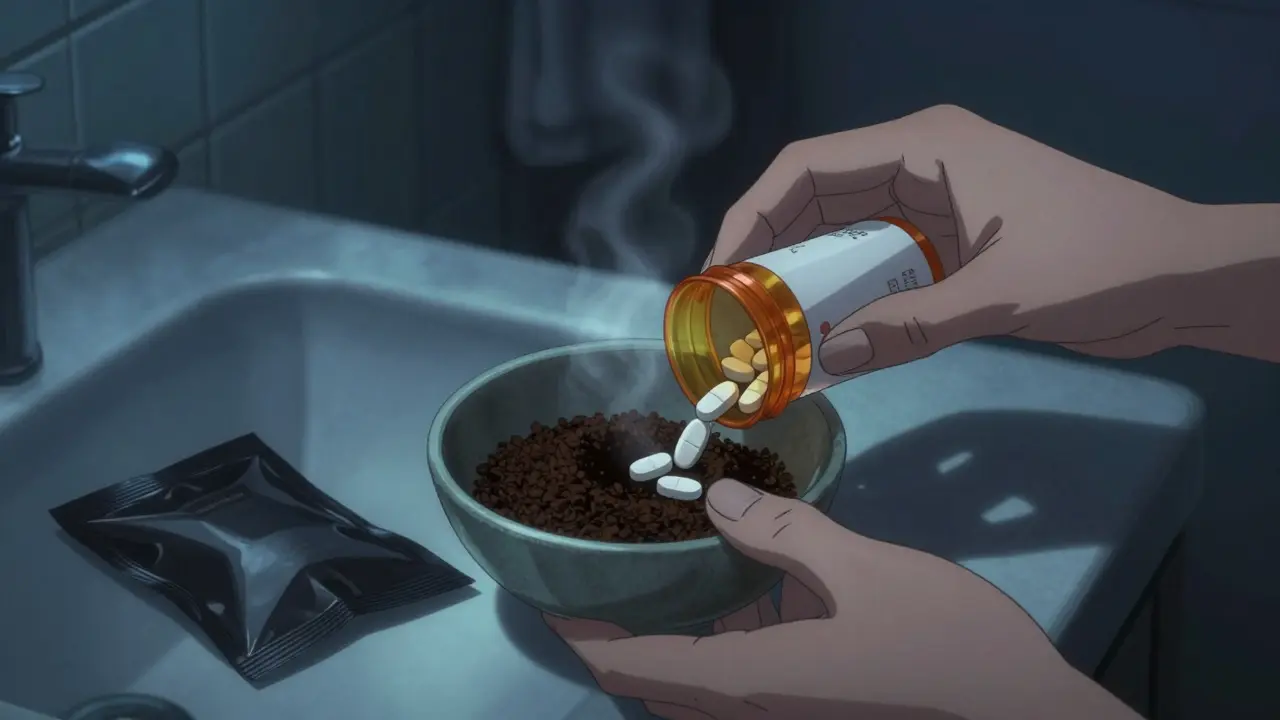
- Remove pills from their original bottles. Don’t just dump them out. Take them out one by one. This prevents someone from finding the bottle and seeing your name, prescription number, or dosage.
- Mix them with something unappealing. Use 1 cup (240ml) of used coffee grounds, cat litter, or dirt per standard prescription bottle. The goal is to make the mixture look and smell disgusting. Don’t use water, sugar, or anything that might dissolve the pills. You want it to be unattractive to kids, pets, or people who might go through your trash.
- Put the mix in a sealed container. Use a resealable plastic bag (at least 2-mil thick) or an empty jar with a tight lid-like an old peanut butter tub. Make sure it won’t leak. Liquids, like cough syrup or insulin, should be poured into absorbent material like paper towels first, then sealed.
- Hide your personal info. Before throwing away the empty bottle, take a permanent marker and black out every bit of writing on the label: your name, the pharmacy, the prescription number. Scrub it until it’s unreadable. This is a step most people skip-and it’s the most important for privacy.
- Put it in the trash. Not the recycling. Not the compost. Just the regular garbage, on your normal pickup day. If you’re worried about someone digging through your trash, wait until the morning of collection to put it out.
This method isn’t perfect, but it’s the best option when you can’t get to a take-back site. Studies show it reduces misuse risk by over 80%. It’s not 100% foolproof-some compounds can still leach into landfills-but it’s a huge improvement over flushing or tossing pills loose.
Special Cases: Liquids, Inhalers, Needles, and More
Not all medications are the same. Some need extra care.
- Liquids (like cough syrup or insulin): Pour them into absorbent material like cat litter or paper towels. Seal it in a bag before tossing. Don’t pour liquids down the sink.
- Inhalers (like albuterol): These are pressurized. If crushed in a trash compactor, they can explode. Don’t throw them in the trash. Take them to a medical waste facility or a pharmacy that accepts them. Many Walgreens and CVS locations have special bins for inhalers.
- Needles and sharps: Never put them loose in the trash. Use an FDA-cleared sharps container. If you don’t have one, use a rigid plastic bottle-like an empty detergent bottle with a tight cap. Tape the lid shut and label it "SHARPS." Drop it off at a pharmacy or hospital. Most pharmacies give these containers for free.
- Patches (like fentanyl): These are dangerous even after they’re used. Fold them in half with the sticky side together, and flush them immediately. The FDA allows flushing for only 15 specific high-risk medications, including fentanyl patches. If you’re unsure, check the FDA’s Flush List (updated January 2023).
What NOT to Do
There are common myths about disposal. Let’s clear them up:
- Don’t flush unless it’s on the FDA’s list. Only 15 medications are approved for flushing. Everything else? Don’t do it. Flushing contributes to 12% of pharmaceutical pollution in water.
- Don’t crush pills. Crushing releases airborne particles and can expose you to dangerous chemicals. The only exception is using a special product like DisposeRx, which is designed for that purpose.
- Don’t recycle pill bottles. Most recycling programs don’t accept them because of contamination risk. Toss them in the trash after removing labels.
- Don’t keep "just in case." Medications expire for a reason. They lose effectiveness. Some become toxic. Storing them increases the chance of accidental overdose or misuse.
Tools and Tips to Make It Easier
You don’t need to buy special kits-but they help. A 2021 study from the National Association of Boards of Pharmacy found that people who kept a pre-made disposal kit at home made 64% fewer mistakes.
Here’s what to keep on hand:
- A small container of used coffee grounds (store it in a jar in the pantry)
- A pack of heavy-duty resealable bags (2-mil or thicker)
- A permanent marker
- A small pair of scissors (for cutting patches)
Some pharmacies offer prepaid mail-back envelopes (like DisposeRx) for $2.50-$5. These are great if you have a lot of meds to dispose of. They’re 98.5% effective at neutralizing drugs and come with instructions. You can order them online or pick them up at 76% of U.S. pharmacies.
Pro tip: Mark the date on your pill bottles when you open them. That way, you’ll know when they’re getting close to expiration. A little prep saves you a lot of hassle later.
What’s Changing in 2026?
The system is getting better. In 2024, the FDA will launch a mobile app to help you find disposal sites in real time. It’s already in beta with over 12,000 users. By 2025, new federal rules will require all prescription bottles to include disposal instructions right on the label. And in 2023, Congress approved $1.2 billion from opioid settlement funds to expand take-back programs-especially in rural areas.
More pharmacies are adding drop boxes. More states are funding disposal programs. The goal is to have 92% of U.S. households with year-round access by 2030. But right now, the system still has gaps. If you’re in a rural town with no drop-off, your home disposal method is your lifeline. Use it correctly.
What If You Accidentally Expose Someone?
Accidents happen. If a child swallows a pill, or someone inhales powder from a crushed tablet, call Poison Control immediately: 1-800-222-1222. It’s free, confidential, and available 24/7. Don’t wait for symptoms. Don’t try to induce vomiting. Just call.
If you’re worried about someone misusing your meds, talk to your pharmacist. They can help you lock them up, reduce your prescription size, or guide you to disposal options.
Can I just throw expired pills in the recycling bin?
No. Recycling centers don’t accept pill bottles or medication residue. The chemicals can contaminate other recyclables. Always put empty bottles in the trash after removing or blacking out the labels. The plastic itself may be recyclable, but not when it’s been in contact with drugs.
Is it safe to mix medications with cat litter?
Yes, and it’s actually recommended. Used cat litter is absorbent, smells unpleasant, and makes pills unrecognizable. Coffee grounds work just as well. Avoid using food items like sugar or cereal-they can attract animals or look like something edible.
What if I can’t find a take-back location near me?
Use the FDA’s home disposal method: mix pills with coffee grounds or cat litter, seal them in a bag, black out the label, and throw them in the trash. It’s not perfect, but it’s the safest option available when no other method works. Rural residents are 3.2 times less likely to have access to drop-off sites, so this method was designed for exactly this situation.
Do I need to remove the pills from blister packs?
Yes. The plastic blister packs can trap pills inside, making it hard to mix them properly with absorbent material. Carefully pop each pill out and place it in the container with coffee grounds or litter. You can throw the empty blister pack in the trash after removing the pills.
Are there any medications that must be flushed?
Yes. The FDA maintains a short list of medications that pose an immediate danger if misused. These include fentanyl patches, oxycodone, and certain painkillers. If your medication is on this list, flush it immediately. You can find the full list on the FDA’s website. For everything else, use the mixing method.
Getting rid of expired medication isn’t about perfection. It’s about progress. One less pill in the cabinet. One less chance for a child to get sick. One less drug floating in our water. You don’t need a special kit. You don’t need to drive miles. Just take five minutes, grab some coffee grounds, and do it right.
13 Comments
George Vou March 10, 2026 AT 08:48
lol i just throw mine in the trash. who cares? the planet's gonna die anyway. 🤷♂️
Scott Easterling March 10, 2026 AT 16:41
Seriously? You're telling me to mix pills with cat litter?? That's the FDA-approved method?? I've seen what happens when cats dig through trash... this is just asking for a biohazard. And don't get me started on the 'coffee grounds' nonsense. Who even has that lying around? I'm not a hipster, I'm just trying to not die from my own prescriptions.
Mantooth Lehto March 10, 2026 AT 22:29
I just cried reading this. 😭 My grandma took my dad's painkillers last year and ended up in the ER. I never knew how dangerous this was. Thank you for writing this. I'm going to clean out my cabinet tonight. 💪❤️
Jazminn Jones March 11, 2026 AT 23:14
While your methodology is technically aligned with FDA guidelines, one must question the epistemological validity of relying on municipal waste systems for pharmaceutical containment. The very premise of landfill disposal-however ‘sealed’-presupposes a flawed ontological framework wherein chemical integrity is assumed to be subordinate to anthropocentric convenience. One might argue, then, that the true ethical imperative lies not in procedural compliance, but in systemic reform: universal take-back infrastructure, mandatory pharmaceutical stewardship programs, and the abolition of single-use prescription containers. This guide, while well-intentioned, is a Band-Aid on a hemorrhaging artery.
Melba Miller March 13, 2026 AT 06:51
I'm sorry, but if you're in a rural area and you can't get to a drop-off, you're just out of luck. This country is falling apart. We used to have real solutions. Now we're telling people to mix pills with coffee grounds? That's not a solution, that's surrender. And don't even get me started on how they let foreign pharmacies ship these things over here. This is a national disgrace.
Katy Shamitz March 13, 2026 AT 13:52
This was so helpful!! I had no idea about the patches needing to be flushed. I’ve been saving my fentanyl patches for ‘just in case’… yikes. I’m doing this right now. I feel so much better. Thank you for caring enough to write this. You’re a gem. 💕
Nicholas Gama March 14, 2026 AT 02:25
The FDA’s ‘mix with cat litter’ advice is a joke. If you think that stops leaching, you’re delusional. Real solution: ban all non-essential prescriptions. End the pharmaceutical industry’s monopoly. Then we won’t have this problem.
Mary Beth Brook March 14, 2026 AT 18:33
The 2-mil bag requirement is non-compliant with EPA 40 CFR Part 266. The EPA mandates a minimum 10-mil HDPE for pharmaceutical containment in municipal solid waste. This guide is legally misleading. Recommend immediate revision.
Neeti Rustagi March 15, 2026 AT 05:32
In India, we have community pharmacy take-back drives every month. It is a simple, dignified, and effective system. Why does the United States, with its vast resources, rely on coffee grounds and plastic bags? There is a moral responsibility here that goes beyond mere procedure. The dignity of public health must be upheld with systemic grace, not makeshift solutions.
Dan Mayer March 16, 2026 AT 04:35
wait so i dont have to take the pills out of the blister pack? i thought i did? oops lol
Janelle Pearl March 16, 2026 AT 23:18
I just cleared out my medicine cabinet. Took me 12 minutes. Used coffee grounds, a ziplock, and a sharpie. Felt weirdly peaceful. Like I just did something quiet but powerful. I didn’t know I was holding onto so much danger. Thank you for the reminder. Small acts matter.
Philip Mattawashish March 18, 2026 AT 01:47
You know what’s really dangerous? The fact that the government lets Big Pharma dictate how we treat our own bodies. You think this guide is about safety? It’s about control. They want you to believe you’re doing the right thing by following their ‘5-step method.’ But the real solution? Stop prescribing so damn much in the first place. We’re all just lab rats in a pill factory.
Tom Sanders March 19, 2026 AT 09:37
I just threw mine in the recycling. It's plastic. What's the big deal?