

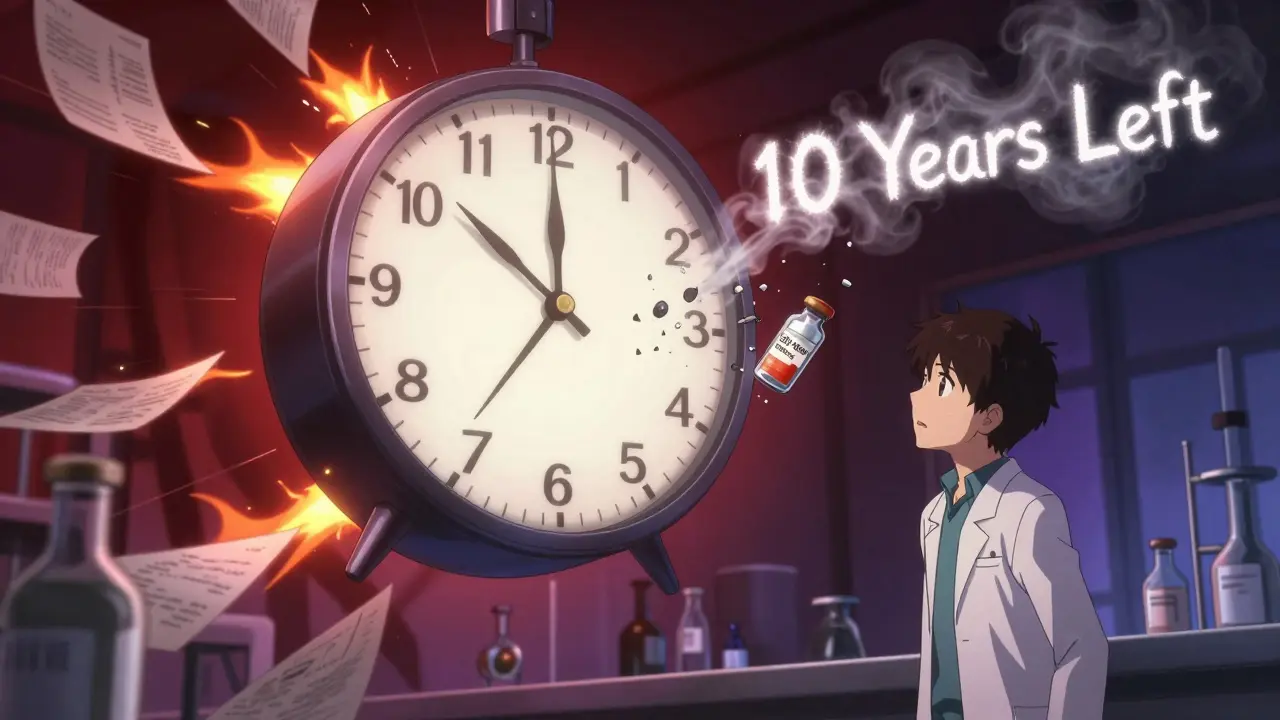
Most people assume that when a pharmaceutical company gets a patent on a new drug, they have 20 years to sell it without competition. That sounds fair - until you realize the clock starts ticking before the drug even hits the pharmacy shelf. In reality, the actual time a drug has market exclusivity is often less than half of that - usually between 10 and 15 years. And for many drugs, it’s even shorter.
Why the 20-Year Patent Doesn’t Mean 20 Years of Profits
The U.S. patent system gives inventors 20 years of protection from the date they file the patent application. Sounds straightforward, right? But here’s the catch: drug companies file patents early - often during preclinical testing, sometimes even before human trials begin. That’s because they want to lock in legal protection as soon as possible. The problem? It takes an average of 8 to 12 years just to get FDA approval.
That means by the time a drug finally reaches patients, 5 to 10 years of its patent life are already gone. If a company files a patent in year one of research and gets approval in year ten, they’re left with only 10 years of exclusivity. For some drugs, especially complex biologics, the development process can stretch past 12 years, leaving just 8 years on the clock. That’s not enough to recoup the average $2.6 billion spent on R&D, according to studies published in the American Journal of Managed Care and PubMed.
The Hatch-Waxman Act: A Compromise That’s Been Strained
In 1984, Congress passed the Hatch-Waxman Act to balance two goals: encouraging innovation and making generics affordable. The law created a system where innovator companies could get a limited extension on their patent to make up for time lost during FDA review. This is called Patent Term Extension (PTE), and it can add up to five extra years.
But there’s a hard cap: no matter how long the delay, the total market exclusivity period can’t exceed 14 years from the date the FDA approves the drug. So even if a drug took 12 years to get approved, the patent can’t be extended past 14 years of post-approval exclusivity. That’s why most drugs end up with 10 to 13 years of real market protection - not 20.
And here’s the twist: the 14-year cap was designed in the 1980s, when patents lasted 17 years. When U.S. law changed to 20 years in 1995 to match international standards under TRIPS, the cap stayed the same. That means today’s drugs start with a longer patent, but still get the same maximum extension - making the gap between nominal and effective life even wider.
Regulatory Exclusivities: The Hidden Layers of Protection
Patents aren’t the only shield drugmakers have. The FDA also grants separate types of exclusivity that don’t depend on patents at all. These are called regulatory exclusivities, and they kick in automatically when a drug is approved.
- New Chemical Entity (NCE) Exclusivity: 5 years of protection from generic competition, even if no patent exists.
- New Clinical Investigation Exclusivity: 3 years for new uses or formulations of existing drugs.
- Orphan Drug Exclusivity: 7 years for drugs treating rare diseases affecting fewer than 200,000 Americans.
- Pediatric Exclusivity: 6 months added to any existing patent or exclusivity period if the company studies the drug in children.
These aren’t just side notes - they’re critical tools. A drug might lose its patent at year 12, but still be protected by NCE exclusivity until year 14. Then, if the company gets pediatric exclusivity, that protection stretches to 14.5 years. This is why some drugs stay off-limits to generics for longer than their patents suggest.
Secondary Patents and the ‘Evergreening’ Strategy
Here’s where things get complicated - and controversial. Many companies don’t rely on just one patent. They file dozens. These are called secondary patents, and they cover things like:
- New formulations (extended-release pills)
- Different dosages
- Drug combinations (e.g., two medications in one pill)
- Metabolites or isomers of the original molecule
- New methods of delivery (patches, injections, inhalers)
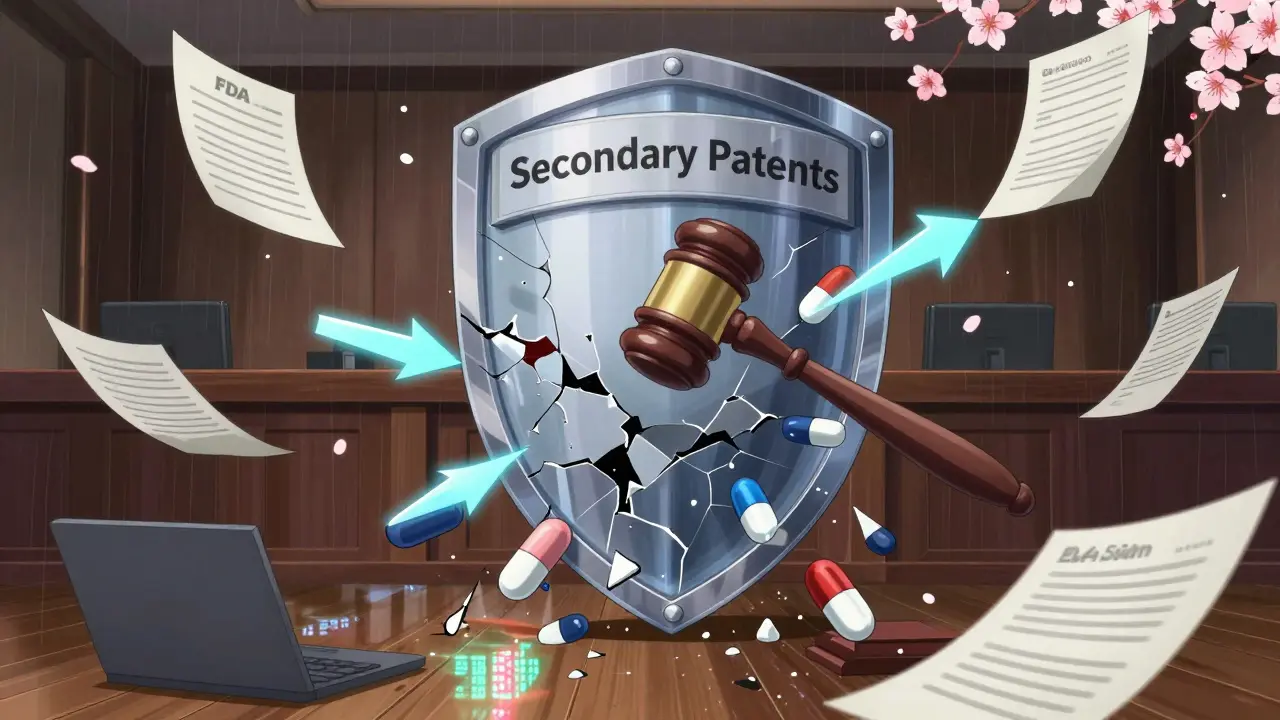
A 2023 study by the R Street Institute found that blockbuster drugs - those making over $1 billion a year - often have 20 to 30 patents attached to them. These aren’t always about improving the drug. Sometimes, they’re about delaying generics. This practice is called “evergreening,” and it’s a major reason why some drugs stay expensive long after their original patent expires.
For example, a drug might have its main patent expire in 2028, but a secondary patent on a new pill coating lasts until 2031. Generic makers can’t launch until that patent expires - even if the active ingredient is identical. And if the brand company sues the generic manufacturer within 45 days of receiving a notice of intent to sell a copycat version, the FDA must wait 30 months before approving it - regardless of whether the patent is valid. This “30-month stay” gives brand companies time to fight in court, often dragging out the process.
How Other Countries Handle It
The U.S. isn’t alone in struggling with this issue. Canada offers a Certificate of Supplementary Protection (CSP), which gives up to 2 years of extra protection after patent expiry. Japan allows up to 5 years of Patent Term Extension, similar to the U.S. But in Europe, the system is more complex - with individual countries handling extensions differently.
What’s consistent across all major markets? The same problem: the time between patent filing and market approval eats up most of the protection period. And in every country, companies are turning to secondary patents and exclusivities to keep generics out as long as possible.
What This Means for Patients and Payers
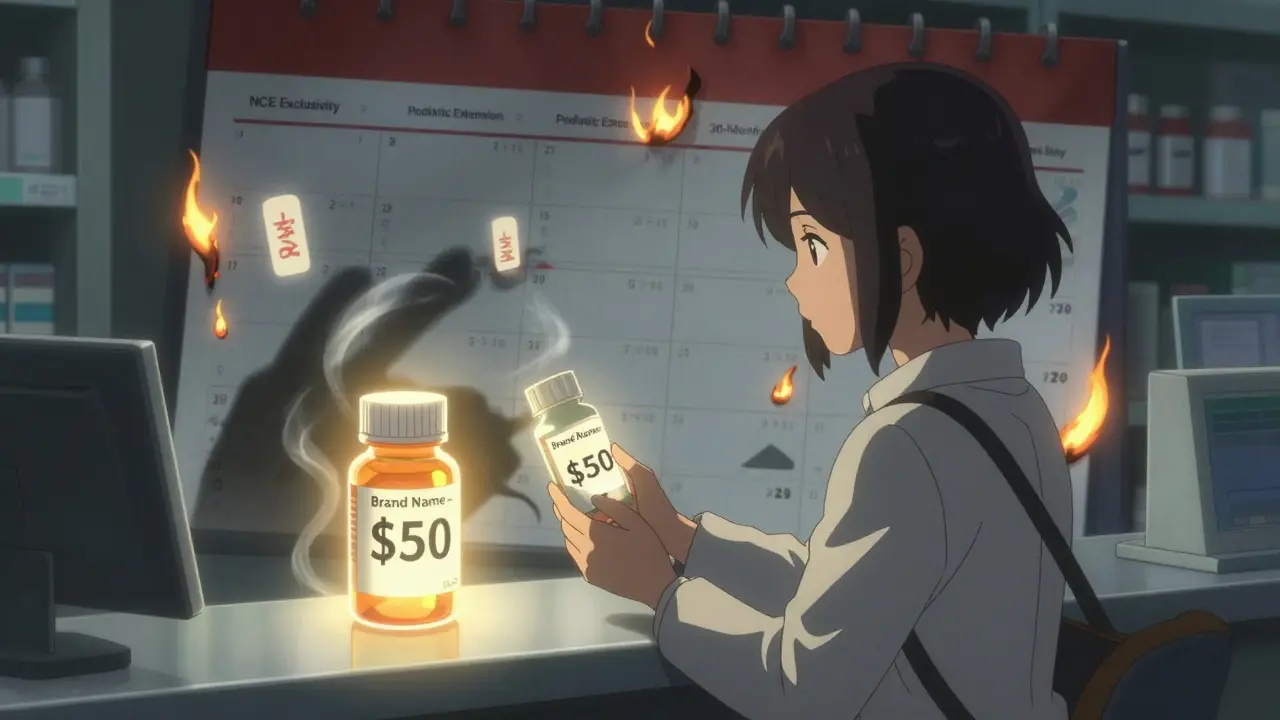
When a drug’s exclusivity ends, prices drop - fast. Generic versions can cost 80 to 90% less than the brand name. That’s why insurers, pharmacies, and government programs like Medicare watch patent expiration dates like a clock ticking toward savings.
But when companies use evergreening tactics, those savings are delayed. Patients may pay hundreds or thousands more per year than they should. Managed care organizations report that predicting when a drug will go generic is nearly impossible because of the patchwork of patents and exclusivities. One drug might have 15 patents listed in the FDA’s Orange Book - and only one of them might be truly valid. But until a court rules otherwise, generics stay off the market.
The Bottom Line: Effective Patent Life Is a Mirage
The 20-year patent sounds like a long time. But in the real world of drug development, it’s more like a countdown that starts before the race even begins. Most drugs get 10 to 13 years of real market exclusivity - and that’s only if they’re lucky. For many, it’s closer to 8 years. And even then, companies stretch that time with secondary patents, exclusivities, and legal delays.
Is this system broken? Not entirely. It was designed to reward innovation, and it has worked: the U.S. leads the world in new drug approvals. But the gap between what Congress intended and what’s happening today is growing. Companies aren’t just protecting their inventions - they’re engineering monopolies. And patients and payers are paying the price.
For now, the best way to understand a drug’s true exclusivity window is to look beyond the patent number. Check the FDA’s Orange Book. Look for NCE or orphan exclusivity. Watch for patent lawsuits. Because when it comes to drug pricing, the real clock isn’t on the patent - it’s in the courtroom, the regulatory agency, and the pharmacy counter.
What is effective patent life?
Effective patent life is the actual amount of time a pharmaceutical company can sell a drug without generic competition, after accounting for the years spent in research, clinical trials, and FDA approval. It’s usually 10 to 15 years, even though the patent itself lasts 20 years from the filing date.
Why is the patent term 20 years if drugs only get 10-15 years of exclusivity?
The 20-year patent term starts when the patent is filed - often during early research, before human testing begins. It takes 8 to 12 years on average to get FDA approval, so most of the patent clock runs before the drug even reaches patients. That’s why the real market exclusivity is much shorter.
What is the Hatch-Waxman Act and how does it affect patent life?
The Hatch-Waxman Act of 1984 created a balance between brand-name drug companies and generic manufacturers. It allows innovators to extend their patent by up to 5 years to make up for FDA review time, but caps total exclusivity at 14 years from FDA approval. It also streamlined generic approval, but created loopholes companies now use to delay competition.
What are secondary patents and why do they matter?
Secondary patents cover minor changes to a drug - like a new pill coating, extended-release formula, or combination with another drug. They’re often filed after approval and can delay generic entry by years. High-revenue drugs can have 20-30 secondary patents, creating what experts call a “patent thicket” to block competition.
Do regulatory exclusivities extend drug prices longer than patents?
Yes. Even if a patent expires, regulatory exclusivities like New Chemical Entity (5 years) or Orphan Drug (7 years) protection can prevent generics from launching. These are separate from patents and are granted automatically by the FDA upon approval.
How do generic companies know when they can enter the market?
Generic manufacturers check the FDA’s Orange Book, which lists all patents and exclusivities for brand drugs. They must wait until all patents and exclusivities expire - unless they challenge a patent in court. If they file a certification that a patent is invalid or won’t be infringed, the brand company can sue, triggering a 30-month delay in generic approval.
Is evergreening legal?
Yes - for now. Filing secondary patents on minor changes is legal under current U.S. law. But regulators and courts are increasingly scrutinizing these patents, especially when they lack real therapeutic benefit. Some lawsuits have successfully invalidated weak secondary patents, but many still hold up due to the cost and complexity of litigation.
What’s Next for Drug Patents?
The pressure is building. With over $250 billion in drug sales expected to face patent expiration by 2025, companies are racing to extend their monopolies. At the same time, lawmakers, insurers, and patient advocates are pushing for reforms - like stricter rules on secondary patents and faster generic approvals.
Until then, the system remains a maze of patents, exclusivities, and legal delays. For patients, it means higher prices. For payers, it means unpredictable costs. And for the companies that make these drugs, it means a constant battle to protect what’s left of their effective patent life - before the clock runs out.
8 Comments
Lance Nickie January 14, 2026 AT 16:18
patent my ass. drug cos just wanna charge 5k for aspirin.
Gregory Parschauer January 15, 2026 AT 14:44
Let’s be crystal clear: this isn’t a broken system-it’s a *designed* exploitation machine. The 20-year patent is a theatrical prop. The real game is regulatory arbitrage: stacking NCE, orphan, pediatric, and secondary patents like Jenga blocks until the whole tower collapses on the taxpayer’s wallet. And don’t get me started on the 30-month stay-that’s not legal protection, it’s corporate extortion with a law degree. The Hatch-Waxman Act was supposed to be a compromise. Now it’s a backdoor monopoly factory. Meanwhile, patients are forced to choose between insulin and rent. This isn’t capitalism. It’s feudalism with FDA logos.
Milla Masliy January 15, 2026 AT 18:48
I’ve worked in pharma compliance for 12 years, and honestly, this post nails it. The Orange Book is a nightmare-sometimes 15 patents listed, and 12 of them are on the color of the pill or the shape of the capsule. I’ve seen generics get held up for years over patents that would never hold up in court… but the legal fees kill the small players first. It’s not just about profit-it’s about who gets to survive the fight. And honestly? The system rewards patience, not innovation. The real innovators are the ones trying to break through the patent thicket, not the ones building it.
Damario Brown January 16, 2026 AT 18:39
so like… the patent starts when u file it right? but u file it like 10 years before u even test on humans? so u got 10 years gone before u even sell the drug? then u get 5 more years from hax-waxman? but capped at 14? so u only get 4 years to make back 2.6 bil? lol. and then u file 27 more patents on the same damn pill? bro. just admit u’re a cartel. the fda is just your bouncer. and the 30-month stay? that’s not law, that’s a corporate delay tactic with a law degree. why dont we just make all patents expire at approval? problem solved. no more evergreening. no more lawsuits. just drugs. cheap. for people.
John Pope January 17, 2026 AT 06:51
Think about it: the patent system was designed for inventors, not corporations. Back then, a man in a garage could patent a lightbulb and have 17 years to profit. Now? A multinational hires 300 lawyers to file patents on the *texture* of a pill coating. This isn’t innovation-it’s intellectual landmining. The 20-year clock isn’t a reward for discovery; it’s a countdown to corporate control. And the FDA? They’re not regulators-they’re gatekeepers for a $250 billion oligopoly. We don’t need more extensions. We need a reset. Patents should start at FDA approval. End of story. Anything else is just legal theater for the wealthy.
Clay .Haeber January 17, 2026 AT 08:21
Oh wow, a 10-year monopoly? How *daring*. Next you’ll tell me that pharmaceutical CEOs don’t vacation in the Caymans on the backs of diabetic grandmas. Let’s be real: if you spent $2.6 billion to make a drug, you’re not a visionary-you’re a gambler who lost at poker and now wants the whole table to pay for your losses. And let’s not pretend those secondary patents are about ‘innovation.’ That’s like calling a new color of iPhone ‘groundbreaking.’ You’re not curing disease-you’re gaming a broken system. And the fact that we call this ‘free enterprise’ is the real tragedy.
Priyanka Kumari January 17, 2026 AT 12:36
As someone from India where generics save lives daily, this post hits hard. I’ve seen people in my village pay 10x more for insulin because the patent hadn’t expired yet-even though the molecule is 20 years old. The U.S. system isn’t just unfair-it’s deadly. Regulatory exclusivities and secondary patents aren’t protecting innovation; they’re protecting profits. And the cost? Lives delayed, families bankrupted, children without medicine. We need global reform. Patents should be tied to actual therapeutic advance, not cosmetic changes. Let generics in faster. Let people live. That’s not radical-it’s basic human decency.
Avneet Singh January 18, 2026 AT 16:09
Honestly, this is just a textbook case of rent-seeking masquerading as innovation. The entire pharma model is predicated on extracting monopoly rents through legal obfuscation-patent thickets, evergreening, 30-month stays. The real innovation is in the litigation departments, not the labs. And the fact that we still treat this as a legitimate business model speaks volumes about our societal priorities. We don’t reward curing disease-we reward legal engineering. The system isn’t broken. It’s working exactly as intended-for shareholders, not patients.