

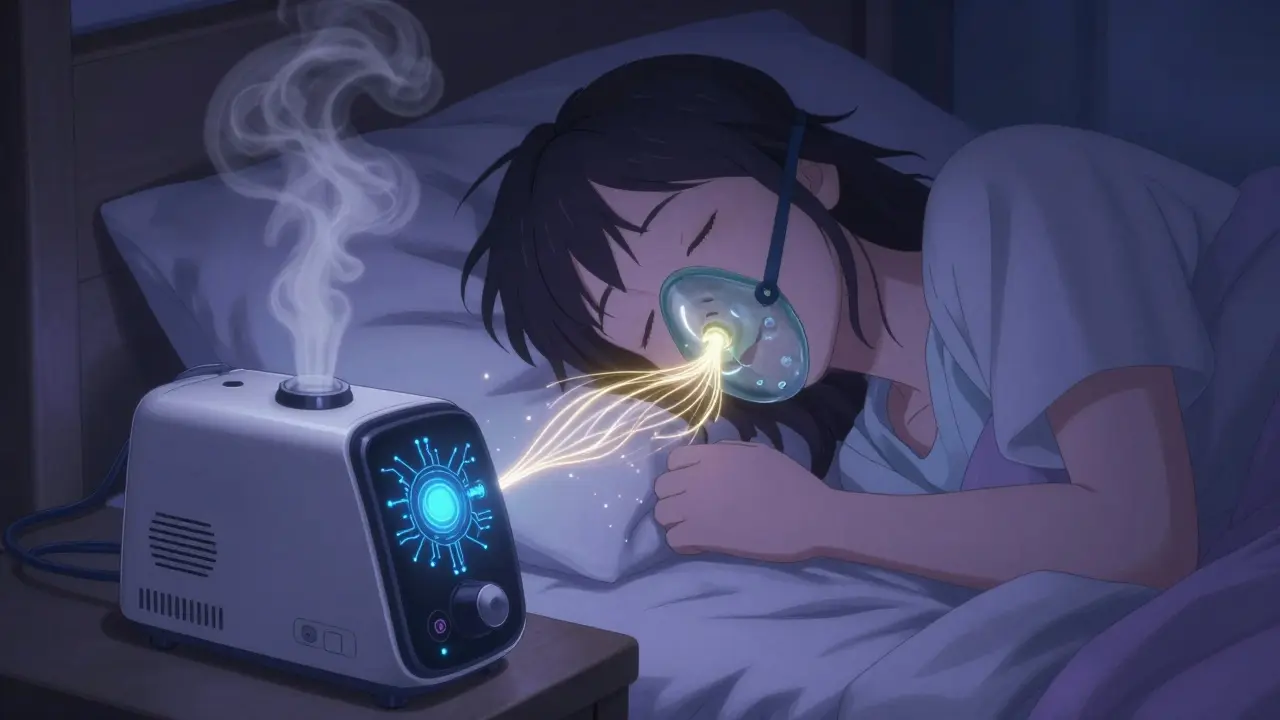
What CPAP Machines Do and Why They Matter
If you’ve been told you have sleep apnea, you’ve probably heard about CPAP machines. These devices aren’t optional luxuries-they’re medical tools that can literally save your life. Obstructive sleep apnea causes your airway to collapse while you sleep, stopping your breathing dozens or even hundreds of times a night. Without treatment, that leads to high blood pressure, heart disease, stroke, and daytime exhaustion so bad it affects your job, relationships, and safety behind the wheel.
CPAP (Continuous Positive Airway Pressure) machines work by blowing a steady stream of air through a mask, keeping your airway open like a tiny balloon. It’s not magic, but it’s the most effective non-surgical treatment available. Studies show people who use CPAP consistently cut their risk of heart problems by 20-30%. The first working CPAP was tested in 1981, and today, over 22 million Americans have sleep apnea-but 80% of them still don’t know it.
The Four Main Types of CPAP Machines
Not all CPAP machines are the same. There are four main types, each designed for different needs and budgets.
Standard CPAP delivers one fixed pressure all night. It’s the most common and cheapest option, usually costing between $500 and $1,000. Models like the ResMed AirSense 10 or Philips DreamStation are reliable and widely covered by insurance. But if your breathing changes during the night-say, when you roll onto your back or get a cold-you might still wake up gasping because the pressure doesn’t adjust.
APAP (Auto-Adjusting PAP) is smarter. It monitors your breathing and changes pressure automatically, usually between 4 and 20 cm H₂O. If you snore, it increases pressure. If you’re breathing smoothly, it drops down. This reduces discomfort and improves sleep quality. A 2021 review found APAP users stick with therapy 15% more often than those on standard CPAP. The catch? They cost $1,700 to $3,000. ResMed’s AirSense 11 AutoSet is a top pick, with 4.7 out of 5 stars from over 1,200 reviews.
BiPAP (Bilevel PAP) gives you two pressures: higher when you inhale, lower when you exhale. This makes breathing feel more natural, especially if you need high pressure (above 15 cm H₂O) or have other lung conditions like COPD. It’s not for everyone-only 10-15% of sleep apnea patients need it-but for those who do, it’s life-changing. BiPAP machines cost $600 to $1,600, but require a separate titration study, adding $300-$500 to the total.
EPAP devices are tiny, disposable valves you stick in your nostrils. They cost $50-$150 a month and only work for mild sleep apnea (AHI under 15). They’re not a replacement for CPAP in moderate or severe cases, where effectiveness drops to 45% compared to 85% for CPAP.
And then there’s the travel CPAP. The ResMed AirMini, for example, weighs less than a pound and fits in your palm. It’s perfect for road trips or hotel stays. But it doesn’t have a built-in humidifier-you need to buy one separately for $80. It’s also louder than standard machines, at 52 dBA versus 30 dBA.
Choosing the Right Mask: It’s Not One Size Fits All
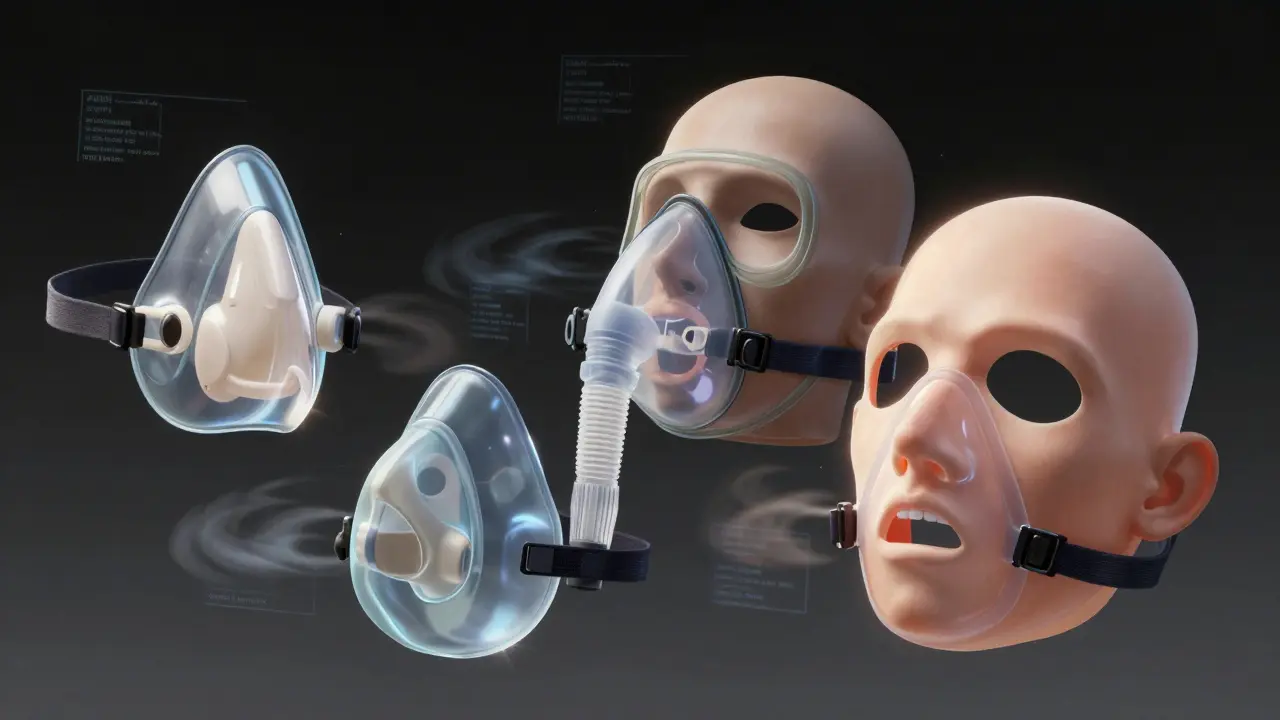
Most people quit CPAP not because the machine is uncomfortable-but because the mask is. A bad fit means leaks, dry mouth, red marks, and frustration. There are four main mask types, and your best choice depends on how you sleep and breathe.
- Nasal pillows: Tiny silicone tips that sit just inside your nostrils. Best for side sleepers and people who hate feeling claustrophobic. Users report 35% less facial irritation than with full-face masks. The AirFit P10 is the most popular, with users cutting leak rates from 15 to 3 L/min.
- Nasal masks: Cover your nose only. Good for people who breathe through their nose and don’t mind a bit of coverage. 45% of users choose this type. They’re stable and quiet.
- Full-face masks: Cover nose and mouth. Only needed if you breathe through your mouth while sleeping. But they’re bulkier, cause more skin irritation, and leak more often. About 18% of users use them.
- Hybrid or oral masks: Designed for people with severe nasal blockages. Rare-only 5% of users-but critical for those who need them.
Proper fitting isn’t just about size-it’s about your face shape. Measure your nasal bridge width, cheekbone structure, and how your skin moves when you breathe. A poor fit causes 60% of leaks. Acceptable leak rates are under 24 L/min. If your mask leaks more than that, it’s not working right.
Why People Stop Using CPAP (And How to Stay on Track)
Here’s the hard truth: 45-83% of people stop using CPAP within the first year. That’s not because the machine doesn’t work-it’s because they don’t stick with it. The biggest reason? Poor mask fit. A 2023 study found 20-30% of patients quit because their mask hurt their face, not because the pressure was too high.
Here’s what actually helps people stick with it:
- Start slow. Don’t try to wear it all night on day one. Use it for 2 hours during the day while watching TV. Get used to the feeling. Then add 30 minutes each night until you’re sleeping with it.
- Use the ramp feature. Every modern CPAP has a ramp setting that slowly increases pressure over 5-45 minutes. This helps you fall asleep without fighting the air. 75% of users who use ramp stay on therapy longer.
- Get humidification. Dry nose, sore throat, and congestion are the #1 complaints. Heated humidifiers (set between 86°F and 95°F) cut these complaints by 50%. If your machine doesn’t have one, get one.
- Use heated tubing. Cold air in the tube causes condensation and discomfort. Heated tubing keeps the air warm and moist. Users with it have 78% adherence versus 52% without.
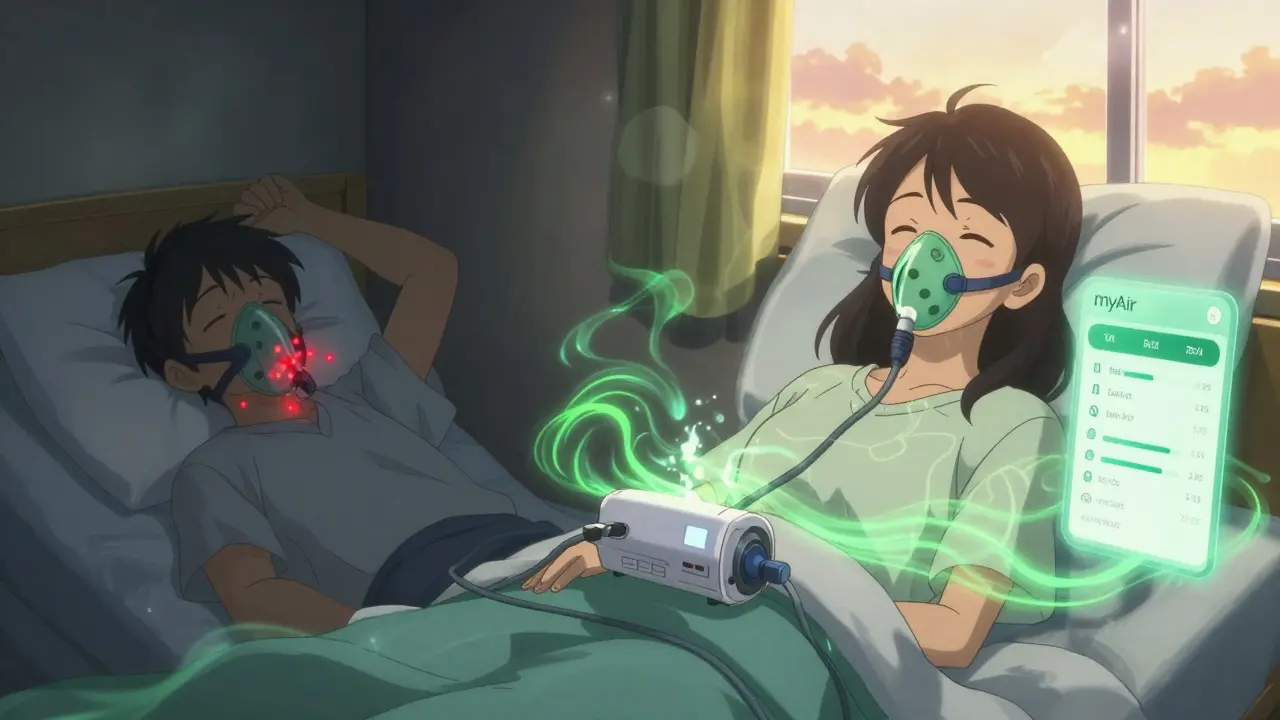
- Track your data. Most machines now record usage, leak rates, and AHI. Reviewing this with your sleep doctor helps you fix problems before they make you quit. ResMed’s myAir app gives personalized coaching and boosts adherence by 27%.
One Reddit user, u/SleepyEngineer, switched from CPAP to APAP and dropped his AHI from 8.2 to 2.1. Another, u/NasalPillowFan, went from 15 L/min leaks to 3 L/min after switching to nasal pillows. These aren’t outliers-they’re people who made small changes and stuck with it.
What to Do If CPAP Isn’t Working
If you’ve tried everything and still can’t tolerate CPAP, you’re not alone. But quitting isn’t your only option.
First, go back to your sleep clinic. You might need a different mask, a different pressure range, or a different machine type. Many people need 2-4 mask fittings before they find one that works. Cleveland Clinic says 30% of users need multiple tries.
If you have mouth breathing, try a chin strap with a nasal mask. If you’re claustrophobic, try nasal pillows. If the air feels too strong, ask about BiPAP. If you travel a lot, get a travel CPAP. And if you’re on a tight budget, some companies offer 60-night trial periods-like CPAP.com’s guarantee-so you can return it if it doesn’t fit.
For people with severe apnea who still can’t tolerate CPAP, newer options like ASV (adaptive servo-ventilation) or transnasal devices like Transcend’s Micro 3 are emerging. These are pricier-up to $2,800-but they’re changing the game for those who’ve given up.
Insurance, Costs, and What’s Changing in 2026
Most insurance plans cover 80% of CPAP costs after your deductible, but you’ll need a prescription and prior authorization. Medicare and Medicaid require you to use your machine at least 4 hours a night, 70% of nights, to keep coverage. Starting in 2024, all new CPAP machines must include usage tracking for this reason.
Prices vary wildly. A basic CPAP runs $500-$1,000. APAPs cost $1,700-$3,000. BiPAPs are $600-$1,600. Travel CPAPs like the AirMini are $650. EPAPs are $50-$150/month. Don’t buy online without a prescription-some sites sell fake or used machines.
The market is shifting. ResMed and Philips dominate 75% of sales. But after Philips recalled 3.5 million devices in 2021 due to foam toxicity risks, ResMed’s market share jumped. Today, new machines are quieter, smarter, and more connected. Philips’ DreamStation 3 runs at 25 dBA-almost silent. ResMed’s AirSense 11 uses AI to predict breathing problems before they happen.
Employers are getting involved too. Trucking companies like Schneider Logistics now require drivers with AHI over 20 to use CPAP. Their accident rates dropped 32%.
Final Thoughts: This Isn’t a Quick Fix-It’s a Lifeline
CPAP isn’t glamorous. It’s a mask, a hose, a machine that hums while you sleep. But if you use it, you’ll sleep better. You’ll feel more awake. You’ll lower your risk of a heart attack or stroke. You’ll drive safer. You’ll live longer.
The hardest part isn’t the machine. It’s getting used to it. But every person who sticks with it says the same thing: ‘I wish I’d started sooner.’
Don’t wait for ‘tomorrow.’ Start today-with a 10-minute trial, a better mask, or a call to your sleep specialist. Your future self will thank you.
14 Comments
Daz Leonheart February 2, 2026 AT 13:13
I started with a full-face mask and hated it. Switched to nasal pillows after three months of barely using it. Now I sleep like a baby. No more morning headaches. Took me a while to get used to it, but it was worth every second.
Mandy Vodak-Marotta February 3, 2026 AT 10:37
I used to think CPAP was for old people until I got diagnosed at 28. My wife said I sounded like a chainsaw. I tried to ignore it for a year. Then I had a near-miss driving home from work. That’s when I got serious. The ramp feature saved me. I didn’t even know that was a thing until someone mentioned it. Now I forget I’m wearing it.
Nathan King February 3, 2026 AT 19:48
The notion that CPAP adherence is purely a matter of personal discipline is fundamentally flawed. The device’s ergonomics, pressure dynamics, and psychological burden are systemic design failures masked as individual noncompliance. One cannot reasonably expect physiological adaptation to a mechanical intrusion without addressing the sociotechnical context of sleep hygiene, which remains woefully under-researched in clinical practice.
Harriot Rockey February 5, 2026 AT 04:58
If you're struggling, don't give up. I was on the verge of quitting until I tried a heated hose. My throat stopped feeling like sandpaper. Then I started using myAir app - it gave me little wins every week. I didn’t realize how much better I felt until I missed a night and crashed. Now I’m 18 months in and I don’t even remember what it felt like to wake up exhausted.
rahulkumar maurya February 7, 2026 AT 00:25
I find it amusing that Americans treat CPAP like a luxury product. In India, we don’t have access to half of this tech. My cousin uses a manual air pump made from a bicycle pump and a plastic tube. He sleeps with it every night. No app. No humidifier. Just willpower and a prayer. Maybe we’re the ones who’ve been doing it right all along.
Alec Stewart Stewart February 7, 2026 AT 21:16
I was skeptical too. But I tried the 60-night trial from CPAP.com and kept it. The mask was the problem at first - not the machine. Once I got the right fit, I slept like I was 25 again. My boss noticed I wasn’t nodding off in meetings. My wife said I stopped snoring. I didn’t even know I was doing that. Best $200 I ever spent.
Roshan Gudhe February 7, 2026 AT 22:57
There’s a quiet revolution happening here. We’re not just treating sleep apnea - we’re reclaiming the night. For centuries, sleep was seen as passive. But now, with data tracking, AI adjustments, and connected devices, it’s become a science of restoration. The machine isn’t the enemy. The silence we used to mistake for rest was the real problem.
Jhoantan Moreira February 9, 2026 AT 18:29
I’ve seen people give up on CPAP because they think it’s too complicated. But the real issue is they don’t feel heard. A good sleep tech doesn’t just hand you a machine - they sit with you, adjust the strap, laugh at your first awkward try, and remind you it’s okay to hate it at first. It’s not about the tech. It’s about the human touch.
Joseph Cooksey February 11, 2026 AT 03:47
Let’s be real - the entire CPAP industry is a glorified racket. You pay thousands for a machine that makes you feel like a cyborg, then they charge you $80 for a hose that should cost $12. The foam recall? That was a cover-up. They knew the foam was degrading and still sold millions. Now they’re pushing ‘smart’ machines with AI that ‘predicts’ your breathing - as if your body needs a Silicon Valley algorithm to tell it how to inhale. Wake up. This isn’t medicine. It’s a subscription model disguised as healthcare.
Meenal Khurana February 11, 2026 AT 19:26
Nasal pillows changed everything.
Jesse Naidoo February 12, 2026 AT 09:13
I tried everything. Mask, ramp, humidifier, heated tube, even the fancy AI machine. Still couldn’t sleep. Then I realized - I was using it while awake. I was so scared of the noise, the mask, the feeling of being trapped, I’d put it on at 11pm and take it off at midnight. I didn’t even try to sleep with it. I was using it as a security blanket. I finally just slept without it for a week. And guess what? I didn’t die. Maybe I don’t need it. Maybe the diagnosis was wrong.
Sherman Lee February 13, 2026 AT 09:58
Did you know the government is using CPAP data to track your sleep habits? Your insurance company gets your AHI numbers, your leak rates, your usage logs. They’re building a sleep profile on you. Next thing you know, your premiums go up because you ‘didn’t sleep enough’. And don’t get me started on the 2026 mandate - they’re gonna link it to your driver’s license. You think this is about health? It’s about control. The machines have microphones. They’re listening. I’m not kidding.
Lorena Druetta February 15, 2026 AT 03:03
I am writing to express my heartfelt appreciation for the comprehensive and meticulously researched content presented in this post. The clarity with which the various modalities of positive airway pressure therapy are delineated is nothing short of exemplary. Your emphasis on adherence strategies, particularly the utilization of ramp features and heated tubing, demonstrates a profound understanding of patient-centered care. I commend your dedication to disseminating evidence-based information with such precision and compassion. This is precisely the kind of resource that empowers individuals to reclaim their health with dignity and confidence.
Zachary French February 15, 2026 AT 18:21
Okay so I went full drama mode on this. I bought a $2,800 ASV machine because I thought I was too 'special' for CPAP. I cried the first night because the mask felt like a space helmet. I told my therapist I felt 'violated by air'. I tried nasal pillows, then full face, then a chin strap, then a humidifier, then a different hose, then a different machine, then a different doctor. I even tried sleeping with it on the couch for two weeks because I was 'traumatized'. Then I found out I was using the wrong size mask. I was wearing a medium. My face is small. I switched to small. Leak rate went from 38 to 2. I cried again. This time from relief. I’m 6 months in. I’m alive. And I’m not even mad anymore.