

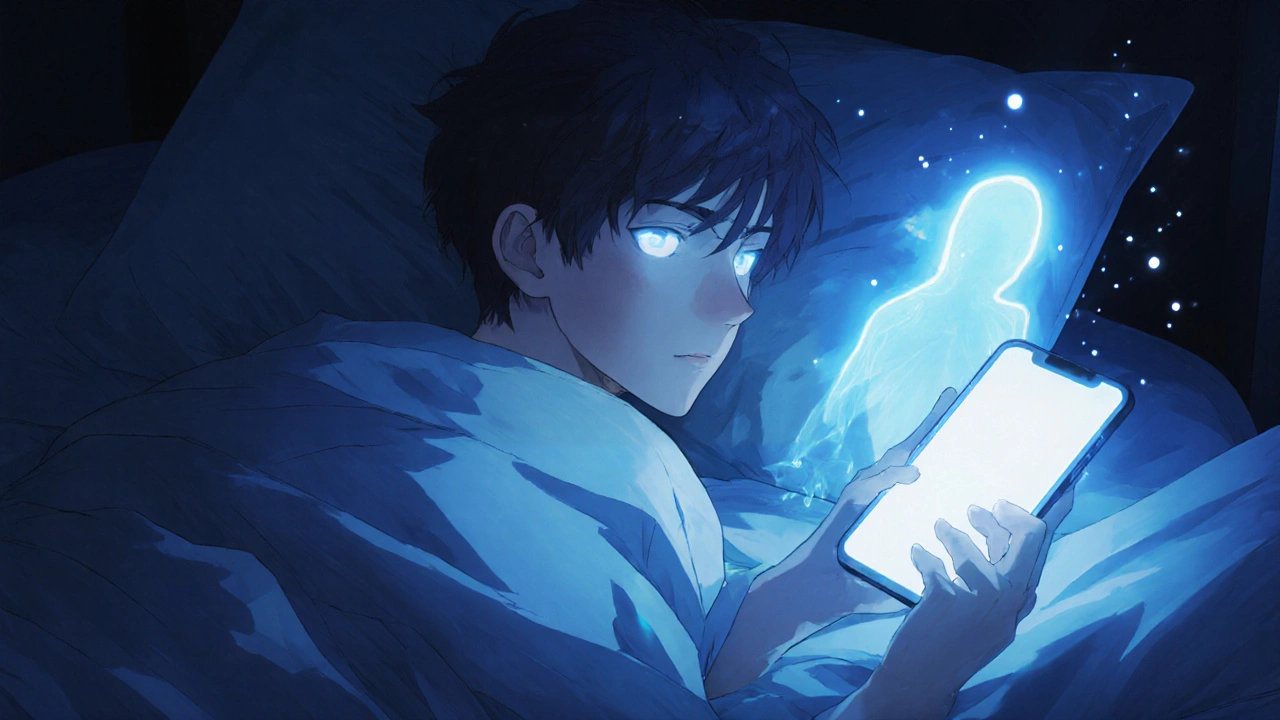
Why your phone is keeping you awake
You turn off the lights, crawl into bed, and reach for your phone. Just five minutes, you tell yourself. But five minutes turns into 30. Then an hour. You finally put it down-only to lie there wide awake, heart racing, mind spinning. This isn’t laziness. It’s biology.
Blue light from screens-phones, tablets, laptops-tricks your brain into thinking it’s still daytime. Your body produces melatonin, the sleep hormone, when it gets dark. But blue light, especially between 460 and 480 nanometers, shuts that down. Harvard researchers found that just 6.5 hours of blue light exposure suppresses melatonin for 3 hours. That’s longer than green light, and it shifts your internal clock by 3 full hours.
Most people don’t realize their phone is a light bomb. LED screens emit 30-40% blue light. Incandescent bulbs? Only 15%. At 30 centimeters away, two hours of scrolling before bed gives you 30-50 lux of blue light-enough to cut melatonin in half. That’s not a myth. It’s physics.
What the science really says
Not all studies agree. Some researchers argue that blue light isn’t the villain-it’s the brightness. A 2022 University of Toronto study showed that when they controlled for total light intensity, blue vs. yellow light made no difference to melatonin. The real trigger? Light hitting your retinal ganglion cells. So maybe it’s not the color-it’s the exposure.
But here’s the catch: even if blue light isn’t the only factor, it’s the most common one. We’re not sitting under dim yellow lamps before bed. We’re staring at bright, cool-white screens. And that’s enough to disrupt sleep for most people. The American Academy of Sleep Medicine says 83% of Americans use screens within an hour of bedtime. That’s not coincidence. That’s a public health pattern.
And the consequences are real. Poor sleep from screen use links to higher risks of diabetes, heart disease, and obesity. It messes with memory, focus, and mood. A 2023 study showed people who used blue light filters less often, spent less time outdoors, and scrolled in bed had worse sleep, concentration, and mental clarity.
How much screen time is too much?
The answer isn’t perfect-but it’s clear enough to act on.
The American Academy of Sleep Medicine recommends no screens for at least one hour before bed. Harvard researchers go further: avoid bright screens after 9 p.m. if you sleep at 11 p.m. But here’s what actually works for most people: 90 minutes.
A Sleep Foundation survey found that 83% of people who stopped screens 90 minutes before bed cut their sleep onset time from over 45 minutes down to under 20. That’s a game-changer. You don’t need to be perfect. Just give yourself space.
Why 90 minutes? It’s not magic. It’s the time it takes for melatonin to rise naturally after light exposure drops. Your body needs that window to shift from alert mode to sleep mode. If you’re scrolling until 10:45, you’re fighting your own biology.
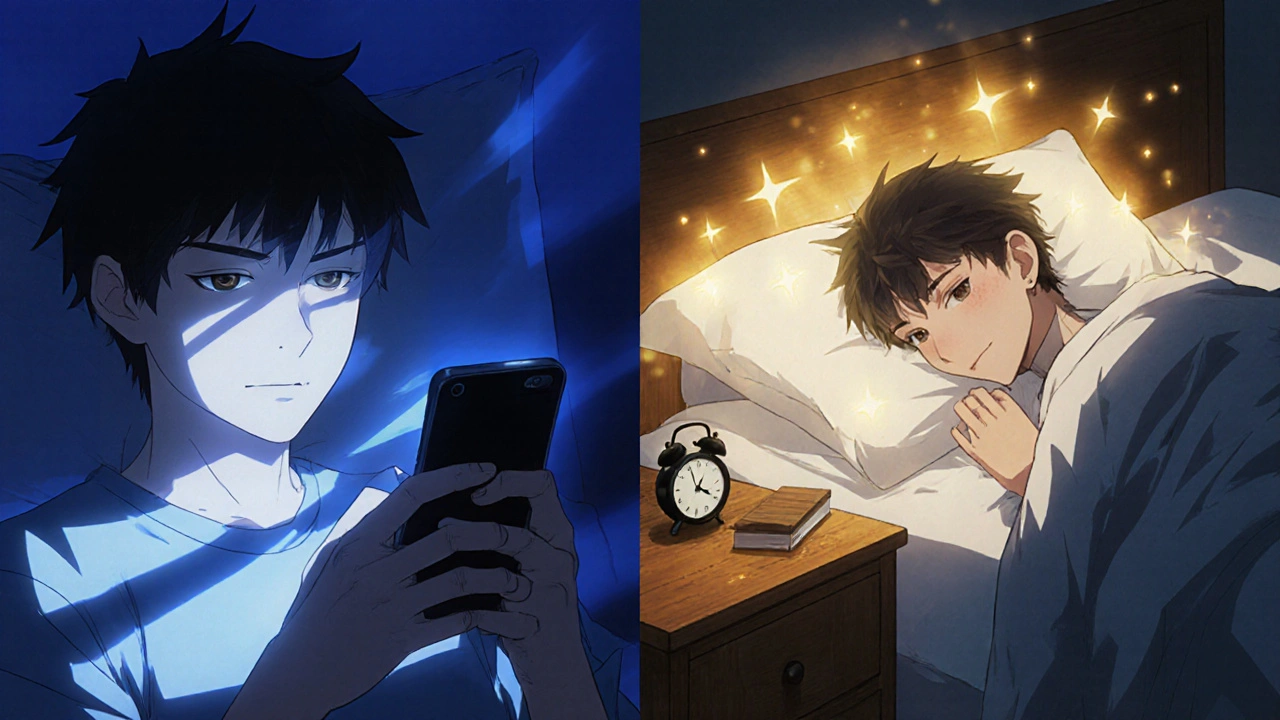
What actually works to reduce blue light
Not all solutions are equal. Here’s what helps-and what doesn’t.
- Night Shift (iOS) or f.lux (Android/PC): These reduce blue light by about 60%. They help-but they’re not a fix-all. If your screen is still bright, you’re still suppressing melatonin.
- Blue-light-blocking glasses: 68% of users on Amazon report better sleep. But 22% say the yellow tint makes screen work annoying. They’re useful if you work late-but not if you’re just watching Netflix.
- Dim your screen: Keep brightness below 50 nits. That’s about 30% of max brightness. You don’t need it to be blinding. Your eyes adjust faster than you think.
- Distance matters: Hold your phone at least 40 cm away. The closer you are, the more light hits your eyes. Move it to your nightstand. Use speakerphone.
One of the most effective habits? Replace screen time with something calm. Read a physical book. Listen to a podcast. Stretch. Journal. The goal isn’t just to block light-it’s to stop stimulation. Your brain needs to wind down, not switch gears.
Why blue light filters alone aren’t enough
Many people buy blue-light glasses or turn on Night Shift-and expect instant sleep. But 32% of users in Sleepopolis forums say they saw little improvement. Why? Because blue light isn’t the only problem.
Screen time before bed also means:
- Stimulating content (social media, news, videos)
- Emotional arousal (arguments, FOMO, anxiety triggers)
- Delayed bedtime (you lose track of time)
- Disrupted routines (no wind-down ritual)
Dr. Matthew Walker, a sleep scientist at UC Berkeley, puts it bluntly: even if blue light effects are overstated, replacing bedtime routines with screens is still a major sleep killer. You’re not just avoiding light-you’re reclaiming your evening.
The best fix? A routine. Same time. Same ritual. No screens. Just calm. Your body learns patterns. If you always read at 10 p.m., your brain starts preparing for sleep at 9:45.
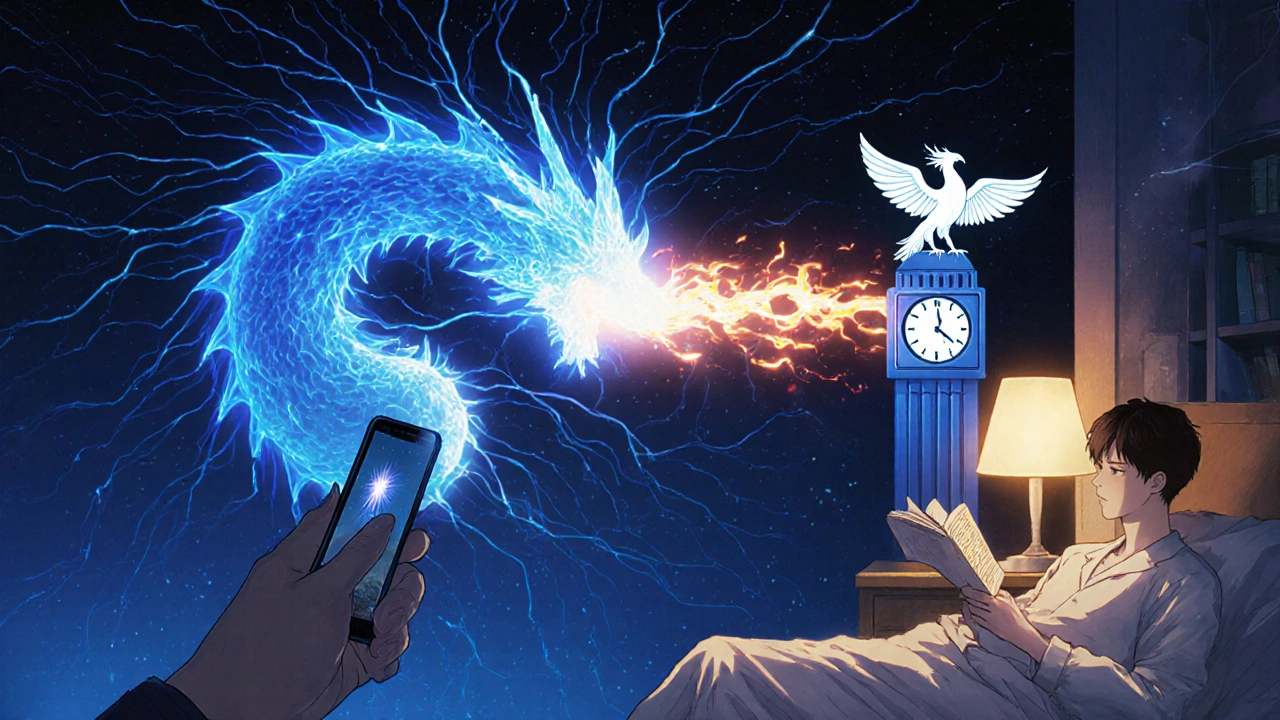
What’s new in 2025
Technology is catching up. Apple’s iOS 17 introduced Sleep Focus, which automatically dims your screen and silences notifications one hour before your scheduled bedtime. It’s built into the system now-no extra app needed.
Meanwhile, researchers are moving toward personalized sleep advice. Chronomics launched the first commercial epigenetic test in early 2024 that measures your individual sensitivity to light. Are you a night owl? A morning person? Your genes might tell you how much light you can handle before bed.
The NIH just funded a $2.4 million study on teens and blue light, with results expected in early 2025. Early data suggests adolescents are far more sensitive to evening light than adults.
But here’s the bottom line: you don’t need a test or a new app. You need to stop scrolling.
How to start tonight
You don’t have to overhaul your life. Just try this:
- Set a bedtime alarm for 90 minutes before you want to sleep.
- When it goes off, put your phone in another room.
- Use a cheap alarm clock instead of your phone.
- Read a book, listen to calm music, or just sit quietly.
- Do this for 7 days. No exceptions.
University of Glasgow found it takes most people 5.7 days to form this habit. That’s less than a week. The Sleep Health Foundation’s ‘Darkness Before Dawn’ program has an 82% success rate with this exact plan.
If you work late, use blue-light filters-but keep brightness low and distance high. If you’re on your phone for work, try a red filter app. Red light has the least impact on melatonin.
And if you still can’t sleep? It’s not just the light. Talk to a doctor. Chronic sleep issues need more than filters. But for most people? Cutting screen time before bed is the single most effective step they can take.
Final thought: Your brain doesn’t know it’s nighttime
For millions of years, your ancestors slept when the sun went down. Now, your phone is a mini-sun in your hands. Your body hasn’t caught up. And it’s paying the price.
You don’t need to live like a monk. You don’t need to buy expensive gadgets. You just need to stop using screens 90 minutes before bed. That’s it. No magic. No hype. Just biology.
Try it for a week. Then ask yourself: do you feel more rested? Do you fall asleep faster? Do you wake up less often? If the answer is yes, you’ve already won.
Does blue light from screens really affect sleep?
Yes. Blue light, especially between 460-480 nanometers, suppresses melatonin-the hormone that tells your body it’s time to sleep. Studies from Harvard and others show it can delay sleep onset by hours. Even if brightness plays a role, screens are the most common source of evening blue light exposure.
How long before bed should I stop using screens?
Aim for at least 90 minutes. The American Academy of Sleep Medicine recommends one hour, but research shows people who stop screens 90 minutes before bed cut their time to fall asleep in half. This gives your body enough time to naturally raise melatonin levels after light exposure drops.
Are blue-light-blocking glasses worth it?
For many, yes-68% of users report better sleep. But they’re not a cure-all. If your screen is still bright or you’re scrolling through stressful content, the glasses won’t fix it. They work best when combined with dimming your screen, keeping distance, and avoiding stimulating apps before bed.
Can I use my phone in bed if I turn on Night Shift?
It’s better than nothing, but still not ideal. Night Shift reduces blue light by about 60%, but your screen is still bright and your brain is still engaged. The bigger issue isn’t just light-it’s mental stimulation. Reading emails, scrolling TikTok, or replying to messages keeps your mind active. Try moving your phone out of the bedroom instead.
Is there a link between blue light and long-term health problems?
Yes. Chronic sleep disruption from evening light exposure is linked to higher risks of obesity, diabetes, heart disease, and even some cancers. This isn’t just about feeling tired. It’s about your body’s ability to repair itself at night. Melatonin isn’t just a sleep hormone-it’s an antioxidant that helps regulate cell function.
8 Comments
Bharat Alasandi November 20, 2025 AT 05:28
Bro, this is the real deal. I used to scroll till 2 a.m. and wonder why I felt like a zombie. Started the 90-min rule last week-no phone past 10:30. Sleep onset dropped from 40 mins to 12. My brain finally stopped screaming. Night Shift ain't enough. You gotta remove the stimulus. Game changer.
Kristi Bennardo November 22, 2025 AT 01:31
This is irresponsible pseudoscience dressed up as health advice. You're fear-mongering about blue light while ignoring the fact that circadian disruption is caused by irregular sleep schedules, stress, and caffeine. The Harvard study you cite? It was conducted on controlled lab conditions with artificial light-real humans don't live in a physics lab. Stop pushing fear-based habits. People need to take responsibility for their own routines, not blame their phones.
Shiv Karan Singh November 22, 2025 AT 19:40
Lmao 90 mins? Bro you think your body is a clock? 😂 I work night shifts, scroll till 4am, wake up at 10, and I'm fitter than 90% of the 'sleep gurus' on Reddit. Blue light? More like blue brainwash. You're all just scared of your own shadows. #NoSleepNoProblem
Ravi boy November 23, 2025 AT 21:09
i tried the 90 min thing last month. put my phone in kitchen. got a real alarm clock. started reading that old book i bought in 2020 and forgot about. slept like a baby. no magic. just quiet. my mom said i stopped talking in my sleep. weird but good. also my dog stopped barking at 2am. maybe he was tired too lol
Matthew Karrs November 25, 2025 AT 18:52
Let’s be real-this is all corporate sleep-industry propaganda. Apple and Samsung profit off your guilt. They sell you ‘Sleep Focus’ while they monetize your attention 24/7. The real issue? Algorithmic content designed to hijack dopamine. Blue light? A distraction. The real villain is your feed. You think turning off Night Shift fixes it? Nah. You’re still scrolling. You’re still hooked.
Matthew Peters November 26, 2025 AT 18:03
I used to think this was all hype… until I started tracking my sleep with my Apple Watch. The difference between 30 mins before bed vs 90? My deep sleep jumped 47%. My REM improved. I actually woke up *before* my alarm. And I didn’t even change my coffee schedule. The science isn’t just solid-it’s *personal*. You don’t need to be perfect. Just consistent. One week. Try it. Your future self will thank you.
Liam Strachan November 26, 2025 AT 21:56
I really like how this post balances the science without being alarmist. I’ve been using blue light glasses for a while, but honestly, the biggest change came when I started reading physical books before bed. No screen glow, no notifications, just quiet. It’s not about the tech-it’s about creating space. Small shifts, big results. Thanks for the practical tips!
Gerald Cheruiyot November 28, 2025 AT 02:32
We’ve been told for decades that light affects sleep. But now we’ve turned it into a moral crusade. What’s really being asked is not to avoid blue light-but to avoid being awake. To surrender to rhythm. To stop treating night as an extension of day. The body doesn’t need filters. It needs silence. Not just visual. Mental. Emotional. The phone is just the symptom. The cure? Stillness. And that’s harder than turning on Night Shift.