

Kidney Disease Antacid Safety Checker
Antacid Safety Assessment Tool
This tool helps you determine if your antacid is safe based on your kidney function and current health status. If you have kidney disease, it's critical to understand the risks of over-the-counter antacids.
Safety Assessment Results
Please select your kidney function and antacid type to see your safety assessment.
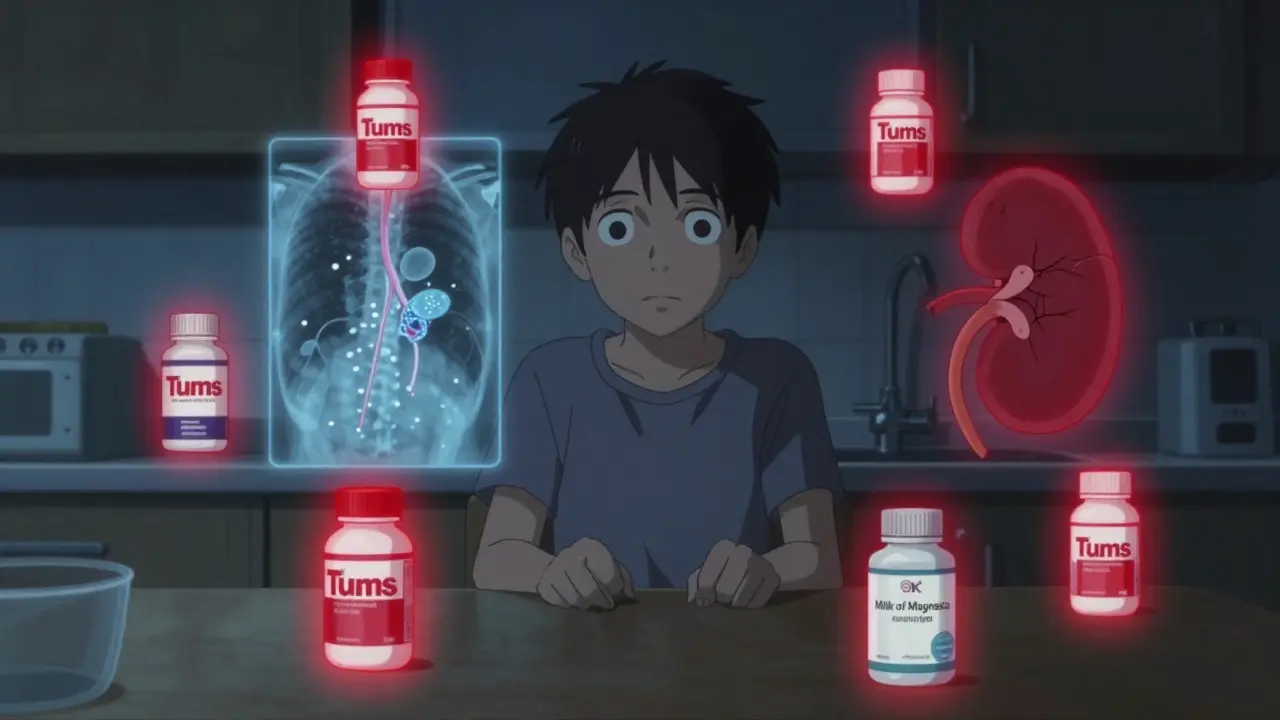
Many people reach for antacids like Tums or Milk of Magnesia when they feel heartburn. But if you have kidney disease, what seems like a simple fix could be dangerous - even life-threatening. The problem isn’t just that antacids work differently in people with kidney disease. It’s that many patients don’t realize they’re not just treating heartburn - they’re accidentally taking powerful phosphate binders with serious side effects.
How Antacids Work in Kidney Disease
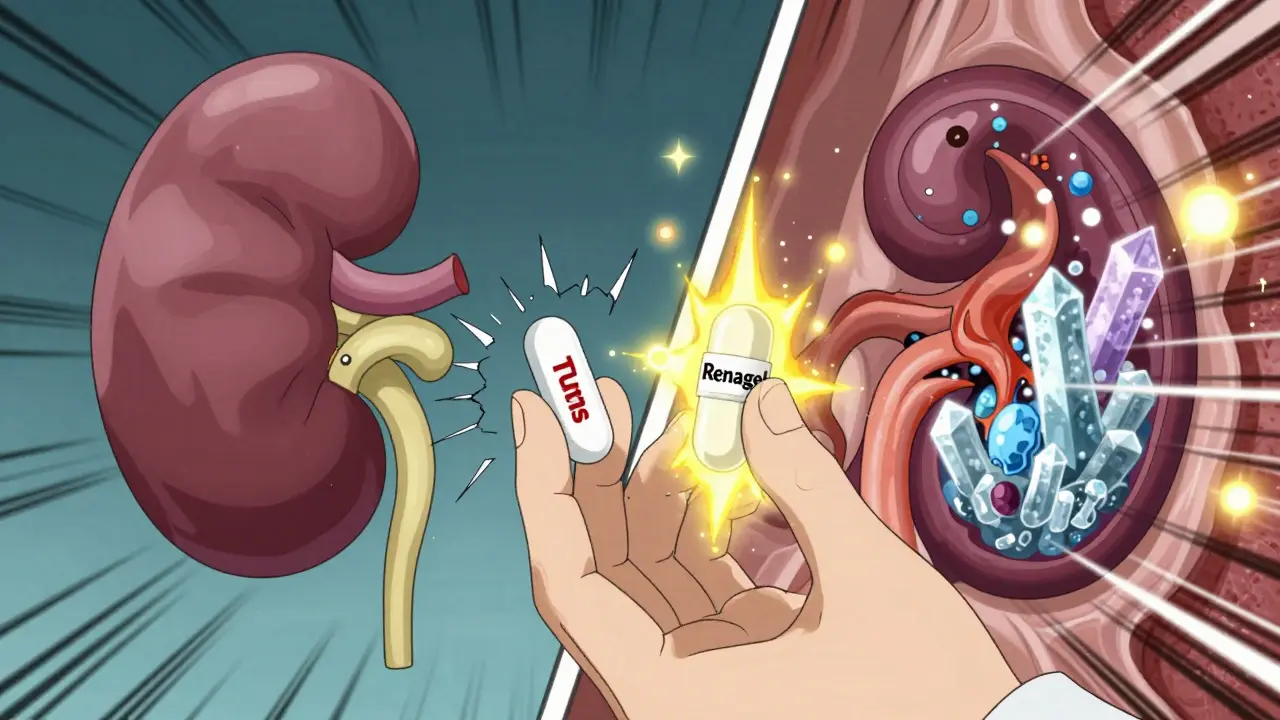
Antacids like calcium carbonate, aluminum hydroxide, and magnesium hydroxide were originally designed to neutralize stomach acid. But in people with chronic kidney disease (CKD), they take on a second, critical role: phosphate binders.
When your kidneys fail, they can’t remove excess phosphate from your blood. That phosphate builds up, leading to weak bones, heart damage, and even death. Phosphate binders work by sticking to phosphate in your food before it gets absorbed. Calcium carbonate and aluminum hydroxide do this by forming insoluble complexes in your gut - the same way they neutralize acid.
For many patients, especially those in early stages of CKD, antacids are used as phosphate binders because they’re cheap and easy to get. A month’s supply of generic calcium carbonate costs about $10. Prescription binders like sevelamer or lanthanum carbonate can cost over $2,000. That’s why so many people with kidney disease rely on over-the-counter antacids - even when their doctors never told them to.
The Hidden Dangers: Aluminum, Calcium, and Magnesium
Not all antacids are safe for kidney patients. Each type carries unique risks:
- Aluminum-based antacids (like Gaviscon or some generic forms) can cause aluminum toxicity. This isn’t just a theoretical risk - it’s documented in medical literature. Aluminum builds up in the blood when kidneys can’t filter it out. Levels above 60 mcg/L can cause dialysis dementia, bone pain, and anemia. The FDA has required warning labels since 1990, but most patients still don’t know.
- Calcium-based antacids (like Tums) help bind phosphate, but they also increase calcium in your blood. In CKD patients, high calcium (above 10.2 mg/dL) raises the risk of vascular calcification - calcium deposits in your arteries. One study found this increased heart attack and stroke risk by 30-50%. Many patients don’t realize their heartburn pills are silently hardening their blood vessels.
- Magnesium-based antacids (like Milk of Magnesia) are especially dangerous for people with advanced kidney disease. The kidneys normally clear magnesium. When they can’t, magnesium builds up. Levels above 4 mg/dL cause muscle weakness. At 10 mg/dL, it can paralyze your breathing. There are documented cases of CKD patients ending up in the ER with temporary paralysis from taking magnesium for constipation.
According to the National Kidney Foundation, magnesium-containing antacids should be avoided entirely in patients with GFR below 30 mL/min - which is CKD stage 4 or 5. Yet, a 2022 survey found that 42% of kidney patients used these products without consulting their nephrologist.
Prescription vs. Over-the-Counter: What’s the Difference?
Prescription phosphate binders like sevelamer (Renagel), lanthanum carbonate (Fosrenol), and sucroferric oxyhydroxide (Velphoro) are designed specifically for kidney patients. They’re more effective, safer, and don’t carry the same risks as antacids.
For example:
| Product | Phosphate Reduction | Monthly Cost | Key Risks |
|---|---|---|---|
| Calcium Carbonate (Tums) | 15-25% | $10 | Hypercalcemia, vascular calcification |
| Sevelamer (Renagel) | 25-35% | $2,000-$2,500 | Gastrointestinal upset |
| Lanthanum Carbonate (Fosrenol) | 25-35% | $2,500-$3,500 | Choking risk (tablet form) |
| Sucroferric Oxyhydroxide (Velphoro) | 30-40% | $4,000 | Black stools, iron overload |
| Aluminum Hydroxide | 20-30% | $15 | Aluminum toxicity, bone disease, dementia |
Prescription binders don’t add calcium or aluminum to your body. They’re designed to bind phosphate without interfering with your mineral balance. But cost and access are huge barriers. Many patients can’t afford them. Others don’t have insurance that covers them. So they turn to antacids - and don’t realize they’re playing Russian roulette with their health.
Who Should Use Antacids - and Who Should Avoid Them
There’s no one-size-fits-all answer. It depends on your kidney function:
- CKD Stage 3 (GFR 30-59): Calcium carbonate can be used as a phosphate binder, but only if your serum calcium is below 10.2 mg/dL and you have no signs of vascular calcification. Dose: 600-1200 mg elemental calcium per meal. Avoid aluminum and magnesium products completely.
- CKD Stage 4-5 (GFR below 30): Do not use antacids as phosphate binders. Only use prescription binders under your nephrologist’s care. If you need heartburn relief, calcium carbonate is the only option - and even then, take it at least two hours before or after your phosphate binder. Never take it daily without monitoring.
- Dialysis patients: Avoid all aluminum and magnesium antacids. Even occasional use can cause fatal hypermagnesemia. Calcium carbonate is still risky - many dialysis patients develop hypercalcemia from long-term use.
Also, antacids interfere with other medications. They can reduce absorption of antibiotics, thyroid medicine, and seizure drugs like phenytoin by up to 40%. The Cleveland Clinic recommends taking other meds at least one hour before or four hours after an antacid.
What Patients Are Really Experiencing
Real stories show how dangerous this gap in knowledge is.
One patient on the American Kidney Fund forum took Tums daily for heartburn for six months. Her nephrologist discovered her calcium level was 11.2 - dangerously high. A CT scan showed new calcium deposits in her arteries. She didn’t know Tums was a phosphate binder.
Another Reddit user took Milk of Magnesia for constipation. Her magnesium level hit 8.7. She ended up in the ER with leg paralysis. She had no idea it was unsafe with her stage 4 CKD.
A 2022 survey of 1,200 kidney patients found 68% couldn’t tell the difference between prescription binders and over-the-counter antacids. Nearly half had used them without asking their doctor. The most common reason? "I didn’t think it was a big deal."
What You Should Do
If you have kidney disease and take antacids:
- Know your GFR. If it’s below 30, stop using aluminum and magnesium antacids immediately.
- Check what’s in your antacid. Look at the active ingredients. Calcium carbonate? Maybe okay - but only with monitoring. Aluminum hydroxide? Stop. Magnesium hydroxide? Stop.
- Ask your nephrologist. Don’t assume your doctor knows you’re taking antacids. Many patients don’t mention them because they think they’re "just" for heartburn.
- Get blood tests. If you’re using calcium carbonate, check your serum calcium and phosphate monthly. If you’ve used aluminum products, ask for an aluminum level test.
- Watch for symptoms. Nausea, confusion, frequent urination? Could be high calcium. Muscle weakness, low blood pressure? Could be high magnesium. Bone pain or memory problems? Could be aluminum toxicity.
And if you’re a caregiver or family member - don’t assume the patient knows. Many kidney patients are older, have other conditions, and take dozens of pills. They don’t realize antacids are dangerous. Talk to them. Help them check labels.
The Bigger Picture
This isn’t just about individual choices. It’s a systemic failure. The FDA issued new warnings in March 2023. The Centers for Medicare & Medicaid Services now track antacid-related hospitalizations in CKD patients as a quality metric. The NIH is funding a $12.5 million study to figure out how to make this safer.
But until patients are properly educated, the risks will keep rising. In 2022, antacid complications cost the U.S. healthcare system $427 million. 57% of ER visits for antacid-related problems in kidney patients were due to patients not knowing the difference between OTC and prescription products.
There’s hope. New drugs like tenapanor (Xphozah) work differently - they block phosphate absorption without binding it. They’re easier to take and don’t carry the same mineral risks. But they’re still new, expensive, and not available to everyone.
For now, the safest path is simple: If you have kidney disease, don’t use antacids as phosphate binders unless your nephrologist says so. And even then, monitor closely.
Can I still take Tums if I have kidney disease?
You may be able to take calcium carbonate (Tums) if you have early-stage kidney disease (CKD stage 3) and your calcium levels are normal. But you must take it only with meals to bind phosphate, and never exceed 1200 mg elemental calcium per meal. You should avoid it entirely if your GFR is below 30 mL/min or if you have high calcium, vascular calcification, or are on dialysis. Always check with your nephrologist first.
Is Milk of Magnesia safe for kidney patients?
No. Magnesium hydroxide (Milk of Magnesia) is not safe for anyone with CKD stage 4 or 5 (GFR below 30 mL/min). Even in stage 3, it’s risky. Your kidneys can’t clear magnesium, so it builds up. Levels above 4 mg/dL cause muscle weakness. Above 10 mg/dL, it can stop your breathing. Many patients end up in the ER after using it for constipation. Use a safe laxative like polyethylene glycol instead.
What are the signs of aluminum toxicity from antacids?
Aluminum toxicity from antacids can cause bone pain, muscle weakness, confusion, memory loss, and seizures. In advanced cases, it leads to dialysis dementia - a condition that causes progressive cognitive decline. These symptoms often develop slowly over months or years. If you’ve used aluminum-containing antacids regularly and have kidney disease, ask your doctor for a serum aluminum test.
Why do doctors still recommend calcium carbonate for some kidney patients?
Calcium carbonate is still recommended in early CKD (stage 3) because it’s effective, affordable, and widely available. It binds phosphate well and can help control levels without expensive prescription drugs. But it’s only safe if your calcium levels are monitored monthly and you don’t have signs of heart or bone damage. Once your kidney function drops below 30 mL/min, you should switch to a prescription binder.
How can I tell if my antacid is a phosphate binder?
Check the active ingredients. If it contains calcium carbonate, aluminum hydroxide, or magnesium hydroxide, it acts as a phosphate binder in kidney disease - even if it’s sold as a heartburn remedy. Prescription binders often have different names (like Renagel or Fosrenol), but OTC antacids with these ingredients do the same job. Don’t assume "it’s just for heartburn" - in kidney disease, it’s a powerful drug.
Next Steps
If you’re managing kidney disease and use antacids:
- Make a list of every medication and supplement you take - including OTC antacids.
- Bring it to your next nephrologist appointment.
- Ask: "Which of these are safe for my kidney stage?" and "Should I be on a prescription phosphate binder?"
- Get your serum calcium, phosphate, magnesium, and aluminum levels checked within the next month if you’ve used antacids regularly.
There’s no shame in using antacids. But there’s danger in ignorance. The right choice isn’t always the cheapest one - it’s the one that keeps you alive.
13 Comments
Alex MC March 16, 2026 AT 11:53
Interesting post. I’ve been on dialysis for 3 years and never realized Tums could be doing this to me. My calcium levels have been creeping up, and my doctor never mentioned it. I’ll get them checked this week.
Ali Hughey March 16, 2026 AT 15:18
OF COURSE the system is rigged 😤💊
Phosphate binders cost $2000?! Meanwhile, Tums is $5 at Walmart? 🤡
They don’t want you to know this because Big Pharma is FEDERALLY PROTECTED from accountability. I’ve got 3 friends who ended up in ERs after using antacids - all ignored by their nephrologists. #CoverUp #PharmaLies 🚨💣
Jimmy V March 17, 2026 AT 15:22
Stop using magnesium antacids if GFR <30. Full stop. That’s not a suggestion - it’s a death sentence waiting to happen. Milk of Magnesia is not a laxative for kidney patients. It’s a time bomb. Use PEG instead. Period.
Kelsey Vonk March 19, 2026 AT 14:21
It’s wild how something so common - like popping a Tums after dinner - can quietly wreck your body when you have CKD. I didn’t know I was taking a phosphate binder. I thought I was just soothing my stomach. I feel so naive now. 🙈
Emma Nicolls March 21, 2026 AT 03:50
i had no idea milk of magnesia was dangerous for my kidneys i just thought it helped with constipation lol thanks for the post
Richard Harris March 21, 2026 AT 07:10
this is really important info. i’ve been taking calcium carbonate for years and never thought to ask if it was safe. i’ll book an appt with my nephrologist tomorrow.
Kandace Bennett March 22, 2026 AT 14:58
Of course Americans are still using OTC antacids like candy. We don’t even know how to read labels anymore. In Europe, we have strict guidelines - you can’t even buy aluminum-based antacids without a prescription. Maybe if we had universal healthcare, people wouldn’t be this dangerously clueless. 🇺🇸🤦♀️
rakesh sabharwal March 23, 2026 AT 16:43
The fundamental failure here is not pharmacological - it’s epistemological. The patient-physician dyad has been commodified into a transactional model wherein pharmaceutical inertia supersedes clinical vigilance. Calcium carbonate, while cost-effective, introduces a confounding variable into mineral homeostasis that is neither monitored nor contextualized within the broader metabolic cascade. One must ask: is this stewardship or negligence? The data suggests the latter.
Devin Ersoy March 24, 2026 AT 01:40
Wait, so you’re saying Tums is basically a stealth drug? That’s hilarious. I’ve been giving my grandma Tums for heartburn for years. She’s got stage 4 CKD. So… I’ve been poisoning her? 😅
Also, why is this not on the FDA’s homepage? Someone’s making bank off this loophole. #PharmaGreed
Scott Smith March 25, 2026 AT 04:43
My mom was on dialysis. She took Tums every day. We didn’t know it was a phosphate binder until her calcium hit 11.5. We switched to sevelamer - her bones are better now. If you have kidney disease, check your meds. Seriously. It’s not about being paranoid - it’s about being alive.
Katherine Rodriguez March 25, 2026 AT 23:57
why do people even use antacids anymore? just eat less spicy food. problem solved. also why are you all so scared of pills? just take the prescription ones. its not that hard.
Shruti Chaturvedi March 27, 2026 AT 05:54
Thank you for sharing this. I work with elderly patients and many don’t understand the difference between heartburn medicine and kidney meds. I’ll start handing out simple one-page guides with active ingredients highlighted. Small steps, right?
Sally Lloyd March 27, 2026 AT 12:47
I’ve been reading about this for months. I think the real issue is the FDA’s silence. They know aluminum toxicity is preventable. They know calcium carbonate causes vascular calcification. But they haven’t mandated warning labels on OTC antacids. Why? Because they’re afraid of lawsuits from manufacturers. I’m not paranoid - I’m informed. 🕵️♀️